Home
Class 12
PHYSICS
A chain is placed on a rough table, part...

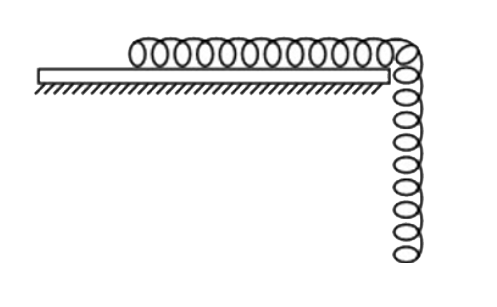
A chain is placed on a rough table, partially hanging, as shown in the figure. The coefficient of static friction between the chain and the table is `mu` = 0.4. If the maximum possible length of the hanging part is x and the length of the chain is L, then what is the value of `(L)/(x)`?

Text Solution

Verified by Experts

The correct Answer is:

3.8
Promotional Banner

Similar Questions

Explore conceptually related problems

A homogoneous chain of length L lies on a table. The coefficient of friction between the chain and the table is mu . The maximum length which can hang over the table in equilibrium is

A heavy uniform chain lies on horizontal table top. If the coefficient of friction between the chain and the table surface is 0.25, then the maximum fraction of the length of the chain that can hang over one edge of the table is

A heavy uniform chain lies on horizontal table top. If the co-efficient of friction between the chain and the table surface is 0.5, the maximum percentage of the length of the chain that can hang over one edge of the table is

A heavy uniform metal chain is kept on the surface of a horizontal table. The coefficient of friction between the chain and the table surface is 0.02 . Find the maximum fraction of length of the chain that could hung over on one edge of the table ?

A uniform chain of mass m and length I is kept on the table with a part of it overhanging (see figure). If the coefficient of friction between the table and the chain is 1//3 then find the maximum length of the chain that can overhang such that the chain remain in equilibrium.

A uniform chain is placed at rest on a rough surface of base length l and height h on an irregular surface as shown in figure Then the minimum coefficient of friction between the chain and the surface must be equal to

In the figure shown, the coefficient of static friction between the block A of mass 20 kg and horizontal table is 0.2. What should be the minimum mass of hanging block just beyond which blocks start moving?

The coefficient of static friction between the two blocks shown in figure is mu and the table is smooth. What maximum horizontal forced F can be applied to he block of mass M so that the block move together?

The coefficient of static friction between the two blocks shown in figure is mu and the table is smooth. What maximum horizontal forced F can be applied to he block of mass M so that the block move together?

A wooden block of mass m resting on a rough horizontal table is pulled by a force F as shown in the figure. If mu is the coefficient of friction between block and table, its acceleration will be
