Home
Class 12
PHYSICS
The graph of elongation of rod of a subs...


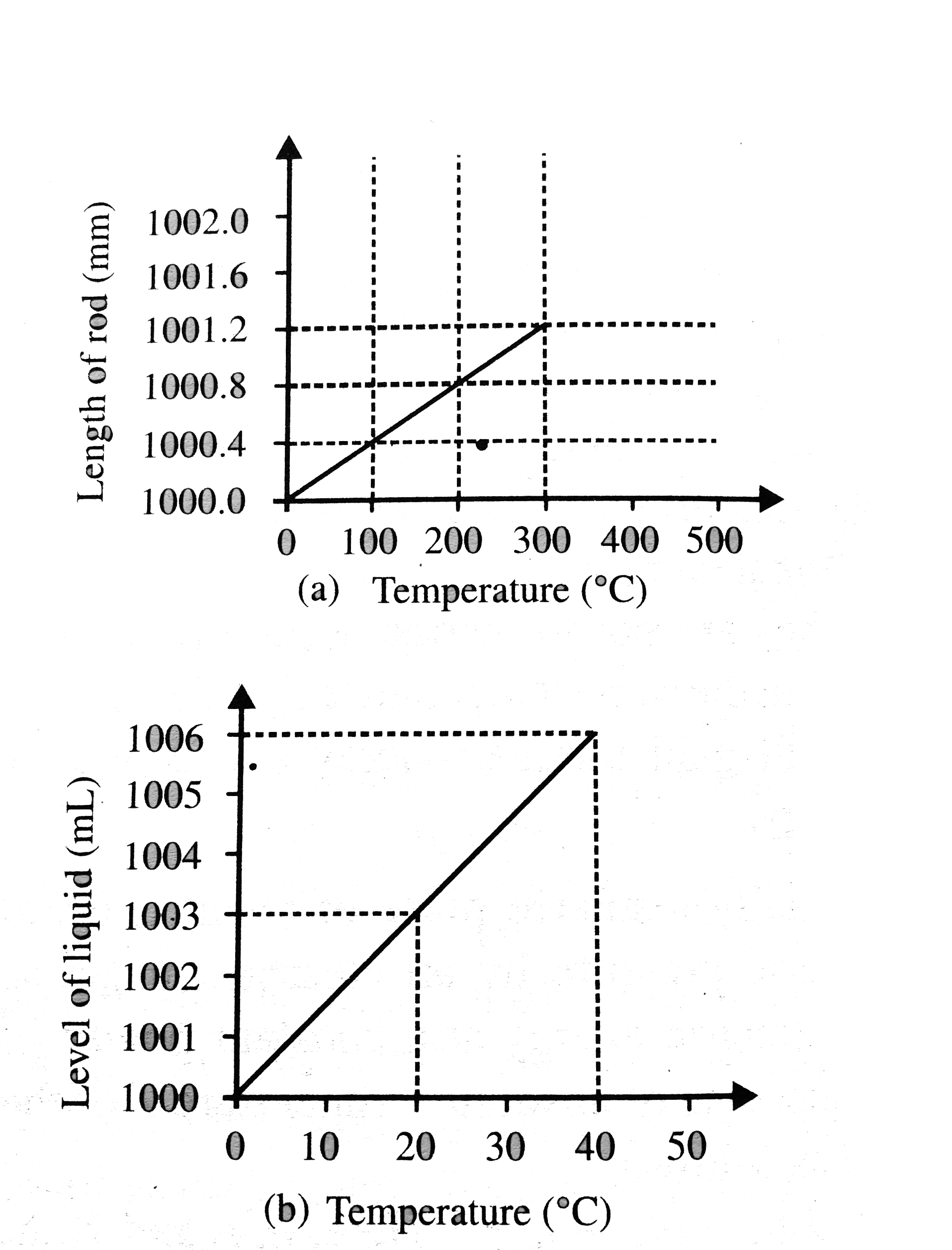
The graph of elongation of rod of a substance A with temperature rise is shown if Fig. A liquid B contained in a cylindrical cessel made up of substance A, graduated in millilitres at `0^@C` is heated gradually. The readings of the liquid level in the vessel corresponding to different temperatures are shown in the figure. the real volume expansivity of liquid is

A

`2.7xx10^(-5).^(@)C^(-1)`

B

`15.4xx10^(-5).^(@)C^(-1)`

C

`16.2xx10^(-5).^(@)C^(-1)`

D

`151.2xx10^(-5).^(@)C^(-1)`

Text Solution

Verified by Experts

The correct Answer is:

C
Promotional Banner

Similar Questions

Explore conceptually related problems

The variation of vapour pressure of different liquids with temperature is shown in figure Calculate graphically boiling points of liquids A and B.

The variation of vapour pressure of different liquids with temperature is shown in figure If we take liquid C in a closed vessel and heat it continuously. At what temperature will it boil?

The temperatures versus time graph is shown in figure. Which of the substance A,B and C has the lowest heat capacity if heat is supplied to all of them at equal rates.

Figure. Shows the graphs of elongation versus temperature for two different metals. If these metals are employed to form a straight bimetallic strip of thickness 6 cm and heated, it bends in the form of an arc, the radius of cuvature chaging with temperature approximately as shown in the figure. The linear expansivities of the two metals are

A fluid having a thermal coefficient of volume expansion gamma is filled in a cylindrical vessel up to a height h_0 . The coefficient of linear thermal expansion of the material of the vessel is alpha . If the fluid is heated with the vessel , then find the level of liquid when temperature increases by Deltatheta .

A substance is in the solid form at 0^@ C. The amount of heat added to this substance and its temperature are plotted in the following graph. If the relative specific heat capacity of the solid substance is 0.5, find from the graph (i) the mass of the substance, (ii) the specific latent heat of the melting process and (ii) the specific heat of the substance in the liquid state. Specific heat capacity of water =1000 cal//kg//K

Figure shown two adiabatic vessels, each containing a mass m of water at different temperature. The ends of a metal rod of length L, area of cross section A and thermal conductivity K, are inserted in the water as shown in the figure. Find the time taken for the difference between the temperature in the vessels to become half of the original value. The specific heat capacity of water is s. Neglect the heat capacity of the rod and the container and any loss of heat to the atmosphere.

A cylindrical vessel containing a liquid is closed by a smooth piston of mass m as shown in the figure. The area of cross section of the piston is A. If the atmospheric pressure is P_0 , find the pressure of the liquid just below the piston. ,

A substance initially in solid state at 0^@ C is heated. The graph showing the variation in temperature with the amount of heat supplied is shown in Fig. 11.7. If the specific heat capacity of the solid substance is 500 J kg^(-1)^@C^(-1) , use graph to find : (i) the mass of the substance, and (ii) the specific latent heat of fusion of the substance in the liquid state.

A 0.60 kg sample of water and a sample of ice are placed in two compartmetnts A and B separated by a conducting wall, in a thermally insulated container. The rate of heat transfer from the water to the ice through the conducting wall is constant P, until thermal equilibrium is reached. The temperature T of the liquid water and the ice are given in graph as functions of time t. Temperature of the compartments remain homogeneous during whole heat transfer process. Given specific heat of ice =2100 J//kg-K , specific heat of water =4200 J//kg-K , and latent heat of fusion of ice =3.3xx10^5 J//kg . Initial mass of the ice in the container equal to
