Home
Class 12
PHYSICS
AB is a light rigid rod. Which is rotati...

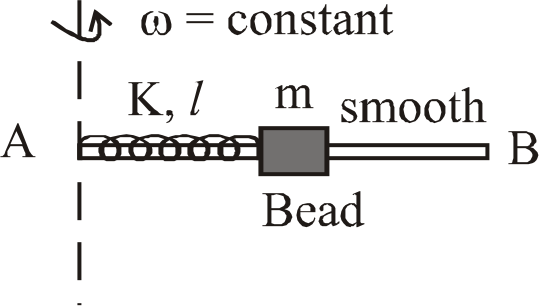
`AB` is a light rigid rod. Which is rotating about a vertical axis passing through `A,A` spring of force constant `K` and natural length `l` is attached at `A` and its other end is attached to a small bead of mass `m`. The bead can slide without friction on the rod. At the initial moment the bead is at rest (w.rt. the rod) and the spring is unstreached Select correct option

A

`V_(max)=sqrt((momega^(2)l^(2))/(k-momega^(2)))`

B

`V_(max)=sqrt((momega^(4)l^(2))/(k-momega^(2)))`

C

`V_(max)=sqrt((momega^(4)l^(2))/(momega^(2)-k))`

D

`V_(max)=sqrt((momega^(2)l^(2))/(momega^(2)-k))`

Text Solution

Verified by Experts

The correct Answer is:

B
Promotional Banner

Similar Questions

Explore conceptually related problems

A bead of mass m can slide without friction along a vertical ring of radius R. One end of a spring of force constant k=(3mg)/(R ) is connected to the bead and the other end is fixed at the centre of the ring. Initially, the bead is at the point A and due to a small push it starts sliding down the ring. If the bead momentarily loses contact with the ring at the instant when the spring makes an angle 60^(@) with the vertical, then the natural length of the spring is

One end of a light spring of natural length d and spring constant k is fixed on a rigid wall and the other is attached to a smooth ring of mass m which can slide without friction on a vertical rod fixed at a distance d from the wall. Initially the spring makes an angle of 37^(@) with the horizontal as shown in fig. When the system is released from rest, find the speed of the ring when the spring becomes horizontal. [ sin 37^(@) = 3/5]

On end of a light spring of natural length d and spring constant k is fixed on a rigid wall and the other is attached to a smooth ring of mass m which can slide without friction on a vertical rod fixed at a distance d from the wall. Initially the spring makes an angle of 37^@ with the horizontal. as shown in figure. When the system is released from rest, find the speed of the ring when the spring becomes horizontal. (sin 37^@=3/5) .

One end a light spring of natural length d and spring constant k ( = mg //d) is fixed on a rigid support and the other end is fixed to a smoth ring of mass m which can slide without friction on a vertical rod fixed at a distance d from the support. Initially , the spring makes an angle of 37^(@) with the horizontal as shown in the figure. The system is released from rest. The speed of the ring at the same angle subtended downward will be

Moment of inertia of a thin rod of mass m and length l about an axis passing through a point l/4 from one end and perpendicular to the rod is

Find the moment of inertia of the rod AB about an axis yy as shown in figure. Mass of the rod is m and length is l.

Two identical small balls are suspended by ends of a rod. Whole assembly is rotating about vertical axis passing through center of rod. At a certain value of omega both strings make 37° with vertical. Find omega

Two identical small balls are suspended by ends of a rod. Whole assembly is rotating about vertical axis passing through center of rod. At a certain value of omega both strings make 37° with vertical. Find omega

A rod of length l=2m is maintained to rotate with a constant angular velocity omega=1 rad//s about vertical axis passing through one end (fig). There is a spring of spring constant k=1 N//m which just encloses rod inside it in natural length. One end of the spring is attached to axis of rotation. S is sleeve of mass m=1kg which can just fix on rod. All surfaces are smooth. With what minimum kinetic energy (in J ) sleeve should be projected so that it enters on the rod without impulse and completely compresses the spring.

A uniform rod of mass m and length l_(0) is rotating with a constant angular speed omega about a vertical axis passing through its point of suspension. Find the moment of inertia of the rod about the axis of rotation if it make an angle theta to the vertical (axis of rotation).
