Home
Class 12
CHEMISTRY
Two closed bulbs of equal volume (V) con...

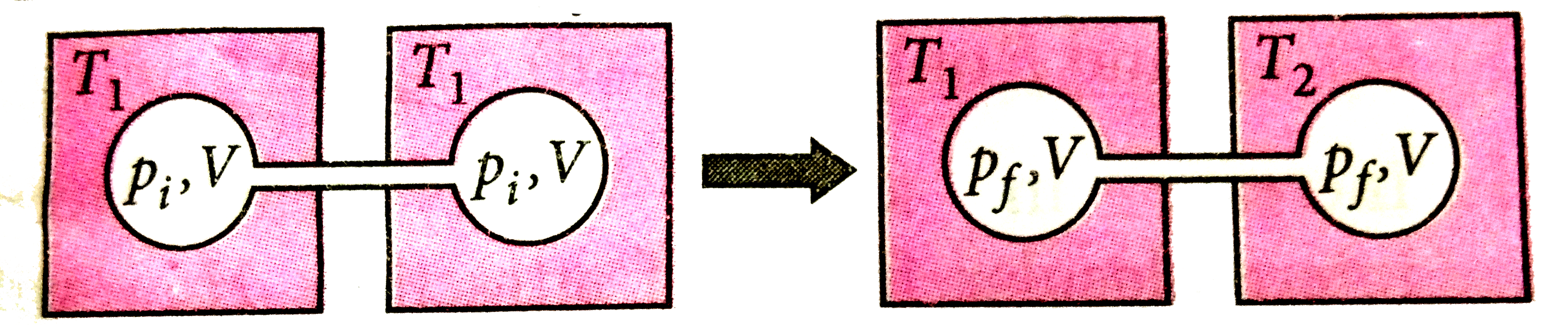
Two closed bulbs of equal volume (V) containing an ideal gas initially at pressure `P_(i)` and temperature `T_(1)` are connected through a narrow tube of negligible volume as shown in the figure below . The temperature of one of the bulbs is then raised to `T_(2)` . the final pressure Pf is

A

`2p_(i)((T_(1)T_(2))/(T_(1)+T_(2)))`

B

`p_(i)((T_(1)T_(2))/(T_(1)+T_(2)))`

C

`p_(i)((T_(1))/(T_(1)+T_(2)))`

D

`p_(i)((T_(2))/(T_(1)+T_(2)))`

Text Solution

Verified by Experts

The correct Answer is:

D
Promotional Banner

Similar Questions

Explore conceptually related problems

Two closed vessels of equal volume containing air at pressure P_(1) and temperature T_(1) are connected to each other through a narrow tube. If the temperature in one of the vessels is now maintained at T_(1) and that in the other at T_(2) , what will be the pressure in the vessels?

Two closed vessels of equal volume containing air at pressure P_(1) and temperature T_(1) are connected to each other through a narrow tube. If the temperature in one of the vessels is now maintained at T_(1) and that in the other at T_(2) , what will be the pressure in the vessels?

Two closed vessel A and B of equal volume containing air at pressure P_(1) and temperature T_(1) are connected to each other through a naroow open tube. If th temperature of one is now maintained at T_(1) and other at T_(2) (wehre T_(1) gt T_(2) ) then that what will be the final pressure ?

An ideal gas has pressure P, volume V and temperature T. Select the correct option.

Four moles of an ideal gas at a pressure of 4 atm and at a temperature of 70^(@)C expands is othermally to four times its initial volume : What is (i) the final temperature and (ii) the final volume ?

Two containers of equal volume contain the same gas at pressure P_(1) and P_(2) and absolute temperature T_(1) and T_(2) , respectively. On joining the vessels, the gas reaches a common pressure P and common temperature T . The ratio P//T is equal to

Two containers of equal volume contain the same gas at pressure P_(1) and P_(2) and absolute temperature T_(1) and T_(2) , respectively. On joining the vessels, the gas reaches a common pressure P and common temperature T . The ratio P//T is equal to

A closed vessel A having volume V contains N_(2) at pressure P and temperature T. another closed vessel B having the same volume V contains. He at the same pressure P. but temperature 2T. The ratio of masses of N_(2) and He in the vesses A and B is

A uniform tube of volume V contains an ideal monatomic gas at a uniform pressure P the temperature of the gas varies linearly along te length of the tube ad T and 2 T are the temperature at the ends.

An insulated container of gas has two chambers separated by an insulating partition. One of the chambers has volume V_1 and contains ideal gas at pressure P_1 and temperature T_1 .The other chamber has volume V_2 and contains ideal gas at pressure P_2 and temperature T_2 . If the partition is removed without doing any work on the gas, the final equilibrium temperature of the gas in the container will be
