Home
Class 12
PHYSICS
The spectral emissive power E(lambda) fo...

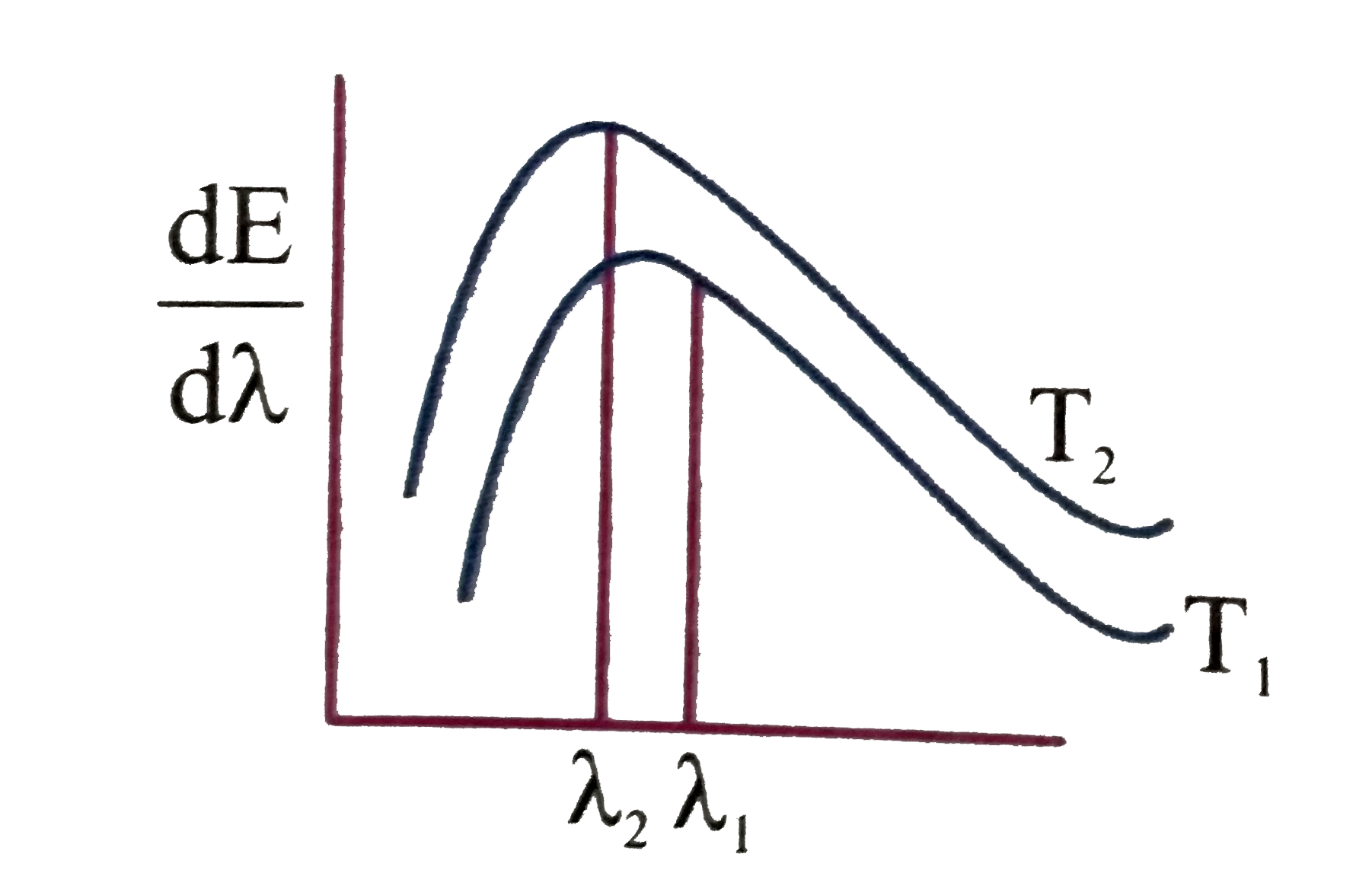
The spectral emissive power `E_(lambda)` for a body at temperature `T_(1)` is poltted againist the wavelenght and area under the curve is found to be `9A.At` a different temperature `T_(2)` the area is found to be A then `lambda_(1)//lambda_(2)=`
.

A

3

B

`(1)/(3)`

C

`(1)/(sqrt3)`

D

`sqrt3`

Text Solution

Verified by Experts

The correct Answer is:

D
Promotional Banner

Similar Questions

Explore conceptually related problems

A black body emits maximum radiation of wavelength lambda_(1) at a certain temperature T_(1) . On increasing the temperature, the total energy of radiation emitted is increased 16 times at temperature T_(2) . If lambda_(2) is the wavelength corresponding to which maximum radiation is emitted at temperature T_(2) . Calculate the value of ((lambda_(1))/(lambda_(2))) .

Let the wavelength at which the the spectral emissive power of a black body (at a temperature T) is maximum, be denoted by lamda_(max) as the temperature of the body is increased by 1K, lamda_(max) decreases by 1 percent. The temperature T of the black body is

A solid at temperature T_(1) is kept in an evacuated chamber at temperature T_(2)gtT_(1) . The rate of increase of temperature of the body is propertional to

If lambda_(m) denotes the wavelength at which the radiative emission from a black body at a temperature T K is maximum, then

The stress-strain graph for a metallic wire is shown at two different temperature, T_(1) and T_(2) which temperature is high T_(1) or T_(2) ?

Assertion : Blue star is at high temperature than red star. Reason : Wein's displacement law states that T prop (1//lambda_(m)) .

A heat engine absorbs heat q_(1) from a source at temperature T_(1) and heat q_(2) from a source at temperature T_(2) . Work done is found to be J (q_(1) + q_(2)) . This is in accordance with

Two bodies of different temperatures T_1 and T_2 if brought in thermal contact, do not necessarily settle to the mean temperature (T_1 + T_2)//2. Why?

Ultraviolet light of wavelengths lambda_(1) and lambda_(2) when allowed to fall on hydrogen atoms in their ground state is found to liberate electrons with kinetic energy 1.8 eV and 4.0 eV respectively. Find the value of (lambda_(1))/(lambda_(2)) .

Activation energy (E_(a)) and rate constants ( k_(1) and k_(2) ) of a chemical reaction at two different temperatures ( T_(1) and T_(2) ) are related by
