Home
Class 12
PHYSICS
A block of mass m is connected to a spri...

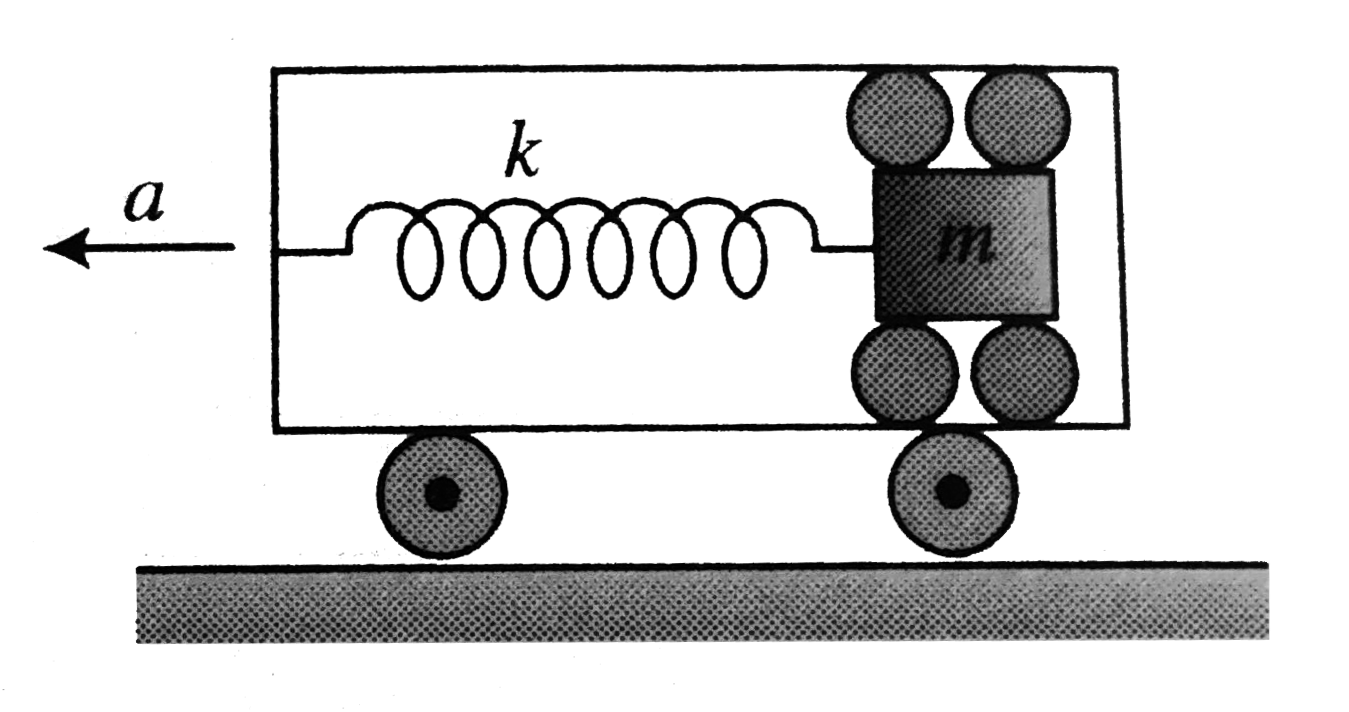
A block of mass `m` is connected to a spring of spring constant k as shown in figure. The frame in which the block is placed is given an acceleration a towards left. Neglect friction between the block and the frame walls. The maximum velocity of the block relative to the frame is

A

`(F)/(sqrt(mL))`

B

`(F)/(2sqrt(mK))`

C

`(F)/(sqrt(2mK))`

D

`(2F)/(sqrt(mK))`

Text Solution

Verified by Experts

The correct Answer is:

A
Promotional Banner

Similar Questions

Explore conceptually related problems

A block of mass m is suspended by different springs of force constant shown in figure.

A block of mass m is attached to one end of a mass less spring of spring constant k. the other end of spring is fixed to a wall the block can move on a horizontal rough surface. The coefficient of friction between the block and the surface is mu then the compession of the spring for which maximum extension of the spring becomes half of maximum compression is .

Two blocks of masses m_1 and m_2 are connected by a spring of spring constant k figure. The block of mass m_2 is given a shape impulse so that it acquires a velocity v_0 towards right. Find a. the velocity of the centre of mass b. the maximum elongation that the spring will suffer.

A block of mass m is attached to two unstretched springs of spring constants k_1 and k_2 as shown in figure. The block is displaced towards right through a distance x and is released. Find the speed of the block as it passes through the mean position shown.

A block of mass m is connected to a spring of force constant k. Initially the block is at rest and the spring has natural length. A constant force F is applied hrizontally towards right. The maximum speed of the block will be (there is no friction between block and the surface)

A block of mass m compresses a spring iof stifffness k through a distacne l//2 as shown in the figure .If the block is not fixed to the spring the period of motion of the block is

A block of mass m is attached to two unstretched springs of springs constant k_(1) and k_(2) as shown in figure. The block is displaced towards right through a distance x and is released. Find the speed of the block as it passes through the mean position shown.

A block of mass m is attached to a frame by a light spring of force constant k. The frame and block are initially at rest with x = x_(0) , the natural length of the spring. If the frame is given a constant horizontal accelration a_(0) towards left, determine the maximum velocity of the block relative to the frame (block is free to move inside frame). Ignore any friction.

Two block of same mass'm' are joined with an dideal spring of spring constant k and sept on a rough surface as shown in figure. The spring is initially unstretched and coefficient of friction between the blocks and horizontal surface is mu and 2 mu respectively. What should be the maximum speed of block 'A' such that the block 'B' does not move ?

Two block of masses m1 and m2 are connected with a massless unstretched spring and placed over a plank moving with an acceleration 'a' as shown in figure. The coefficient of friction between the blocks and platform is mu
