Home
Class 12
PHYSICS
A ball of mass m collides with a station...

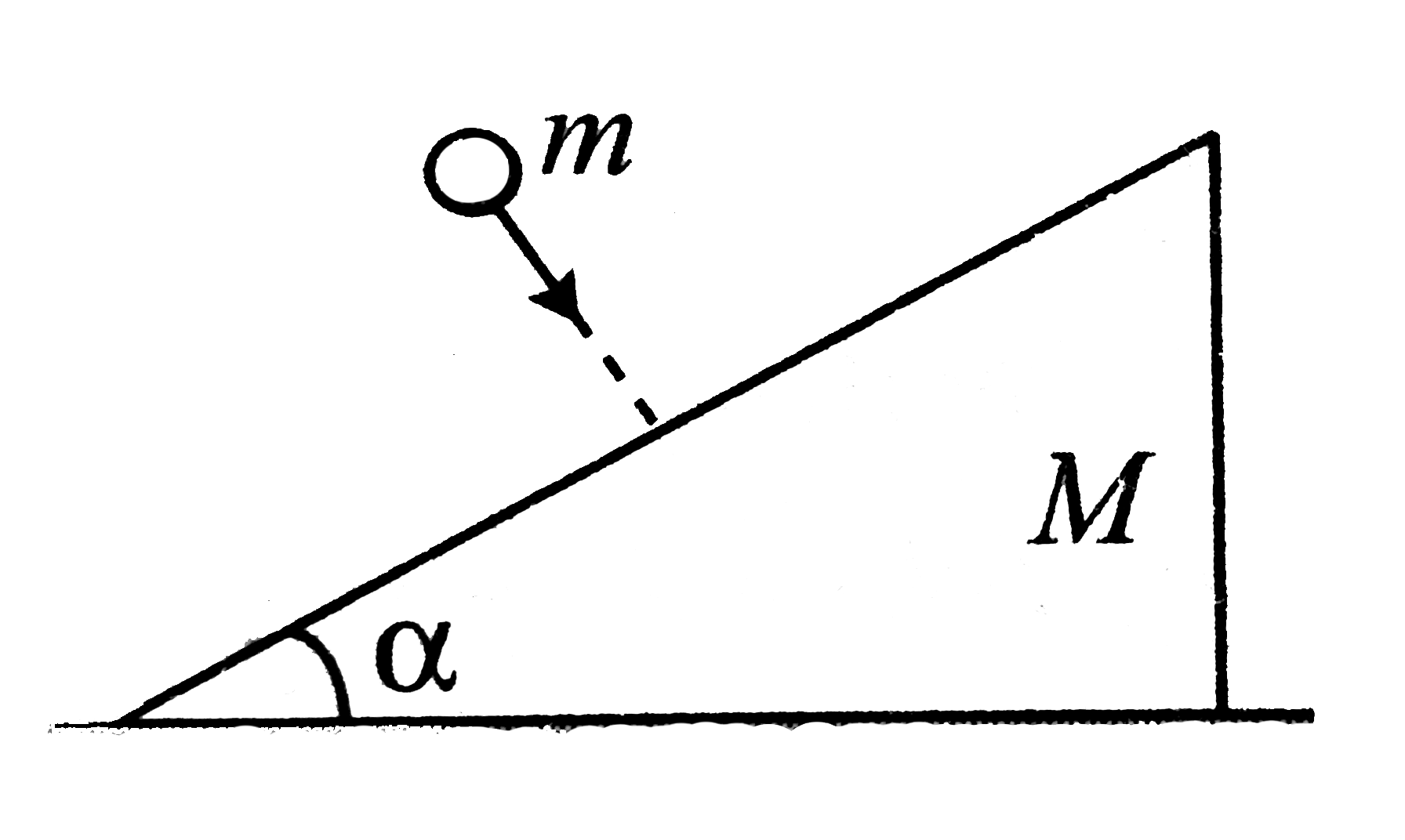
A ball of mass `m` collides with a stationary wedge of mass `M`, perpendicular to its inclined face, inclined at an angle as shown in the figure. If the coefficient of restitution between the wedge and ball is `e`, calculate the ratio of modulus of velocity of the ball immediately after and before collision. Also calculate the velocity of wedge just after collision.

A

`(d)/(1-e^(2))`

B

`(d)/(1+e^(2))`

C

`(de^(2))/(1+e^(2))`

D

`(de^(2))/(1-e^(2))`

Text Solution

Verified by Experts

The correct Answer is:

A
Promotional Banner

Similar Questions

Explore conceptually related problems

A particle of mass m, collides with another stationary particle of mass M. If the particle m stops just after collision, then the coefficient of restitution for collision is equal to

A ball of mass m moving with constant horizontal velocity u strikes a stationary wedge of mass M on its inclined surface as shown in the figure. After collision, the ball starts moving up the inclined plane. The wedge is placed on frictionless horizontal surface. a. Calculate the velocity of wedge immediately after collision. b. Calculate the maximum height the ball can ascend on the wedge.

A ball is dropped on a smooth inclined plane and is observed to move horizontally after the impact. The coefficient of restitution between the plane and ball is e. The inclination of the plane is

A smooth block of mass m is held stationary on a smooth wedge of mass M and inclination theta as shown in figure .If the system is released from rest , then the normal reaction between the block and the wedge is

A ball collides with a frictionless wall with velocity u as shown in the figure. Coefficient of restitution for the impact is e. (a) Find expression for the velocity of the ball immediately after the impact. (b) If impact is perfectly elastic what do you observe?

A ball of mass m collides with the ground at an angle. With the vertical. If the collision lasts for time t , the average force exerted by the ground on the ball is : (e = coefficient of restitution between the ball and the ground) .

A ball rolls without sliding over a rough horizontal floor with velocity v_(0)=7m//s towards a smooth vertical wall. If coefficient of restitution between the wall and the ball is e=0.7 . Calculate velocity v of the ball after the collision.

The first ball of mass m moving with the velocity upsilon collides head on with the second ball of mass m at rest. If the coefficient of restitution is e , then the ratio of the velocities of the first and the second ball after the collision is

A ball of mass m moving with a speed 2v_0 collides head-on with an identical ball at rest. If e is the coefficient of restitution, then what will be the ratio of velocity of two balls after collision?

A ball of mass m moving with a speed 2v_0 collides head-on with an identical ball at rest. If e is the coefficient of restitution, then what will be the ratio of velocity of two balls after collision?
