Home
Class 12
PHYSICS
Two uniform rods of equal length but dif...

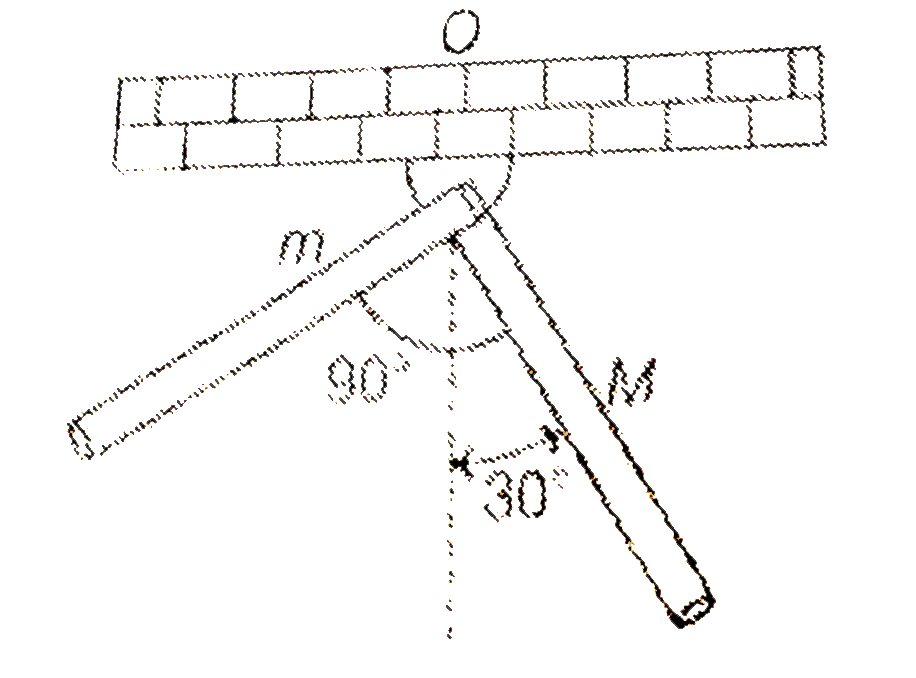
Two uniform rods of equal length but different masses are rigidly joined to form an L-shaped body, which is then pivoted as shwon. If in equilibrium, the body is in the shown configuration, ratio `M//m will be

A

2

B

3

C

`sqrt(2)`

D

`sqrt(3)`

Text Solution

Verified by Experts

The correct Answer is:

D
Promotional Banner

Similar Questions

Explore conceptually related problems

Two masses m and M are attched with strings as shwon . If the system is in equilibrium then , tan theta

Two uniform identicla rods each of mass M and length l are joined to form a cross as shown in figure. Find the momet of inertia of the cross about a bisector as shown doted in the figure

Three identical rods each of length L and mass m are joined to form a U -shape as shown in figure. The distance of centre of mass of combined system from the corner .O. is

Two uniform thin rods each of length L and mass m are joined as shown in the figure. Find the distance of centre of mass the system from point O

A uniform rod of length L and mass m is free to rotate about a frictionless pivot at one end as shown in figure. The rod is held at rest in the horizontal position and a coin of mass m is placed at the free end. Now the rod is released The reaction on the coin immediately after the rod starts falling is

A uniform rod of mass M and length L lies flat on a frictionless horizantal surface. Two forces F and 2F are applied along the length of the rod as shown. The tension in the rod at point P is

A uniform rod of length l and mass m is hung from, strings of equal length from a ceiling as shown in figure. Determine the tensions in the strings?

Three identical rods each of mass M, length l are joined to form an equilateral DeltaABC . Find the Moment of Inertia about BC as shown.

Three uniform rods, each of length 21 ( = 1m) and mass M = 8 kg are rigidly joined at their ends to form a triangular framework. Find the moment of inertia of the framework about an axis passing through the midpoints of two of its sides?

Two bodies of different masses are moving with same kinetic energy. Then, the ratio of their moment is equal to the ratio of their
