Home
Class 12
PHYSICS
A totally reflecting small plane mirror ...

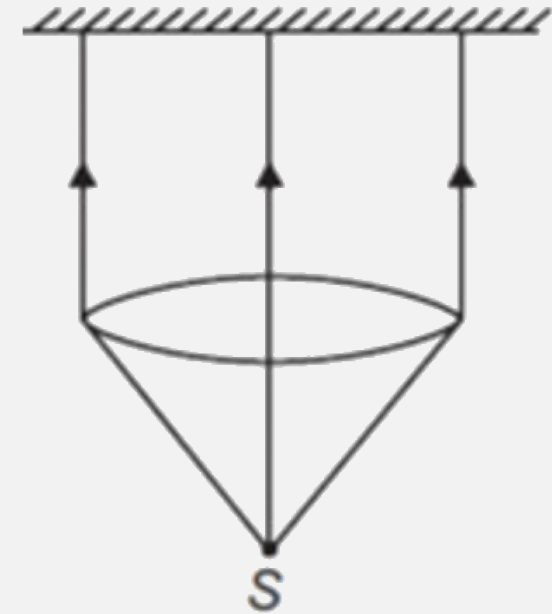
A totally reflecting small plane mirror placed horizontally faces a parallel beam of light as shown in the figure. The mass of the mirror is 200 g. Assume that there is no absorption in the lens and that `20%` of the light emitted by the source goes through the lens. The power of the source needs to support the weight of the mirror is `P xx 10^(8)` watt, where P is [take `g = 10 ms^(-2)`]

Text Solution

Verified by Experts

The correct Answer is:

15
Promotional Banner

Similar Questions

Explore conceptually related problems

A totally reflecting, small plane mirror placed horizontally faces a parallel beam of lighy as shown in figure. The mass of the mirror is 20g. Assume that there is no absorption in the lens and that 30% of the light emitted by the source goes through the lens. Find the power of the source needed to support the weight of the mirror. Take g= 10 m s^-2.

A parallel beam of light, parallel to the principal axis of a concave mirror, on reflection meets at the :

An object, a convex lens of focal length 20 cm and a plane mirror are arranged as shown in the figure. How far behind the mirror is the second image formed?

Two plane mirrors are inclined to each other at an angle theta . A ray of light is reflected at one mirror and then at the other. Find the total deviation of the ray.

A plane mirror reflects a beam of light to form a real image, The incident beam should be

A plane mirror is falling vertically as ssshown in the figure. If S is a point source of light, the rate of increase of the length AB is

A point source of light is placed in front of a plane mirror.

A source of light lies on the angle bisector of two plane mirrors inclined at angle theta . The value of theta , so that the light reflected from one mirror does not reach the other mirror will be.

Two plane mirrors makes an angle of 120^(@) with each other. The distance between the two images of a point source formed in them is 20 cm . Determine the distance from the light source of the point where the mirrors touch, the light source lies on the bisector of the angle formed by the mirrors.

Two mirrors are inclined at angle theta as shown in figure. Light rays are incident parallel to one of mirrors. Light will start retracing its path after the reflection if
