Home
Class 12
PHYSICS
A non-conducting ring of mass m and radi...

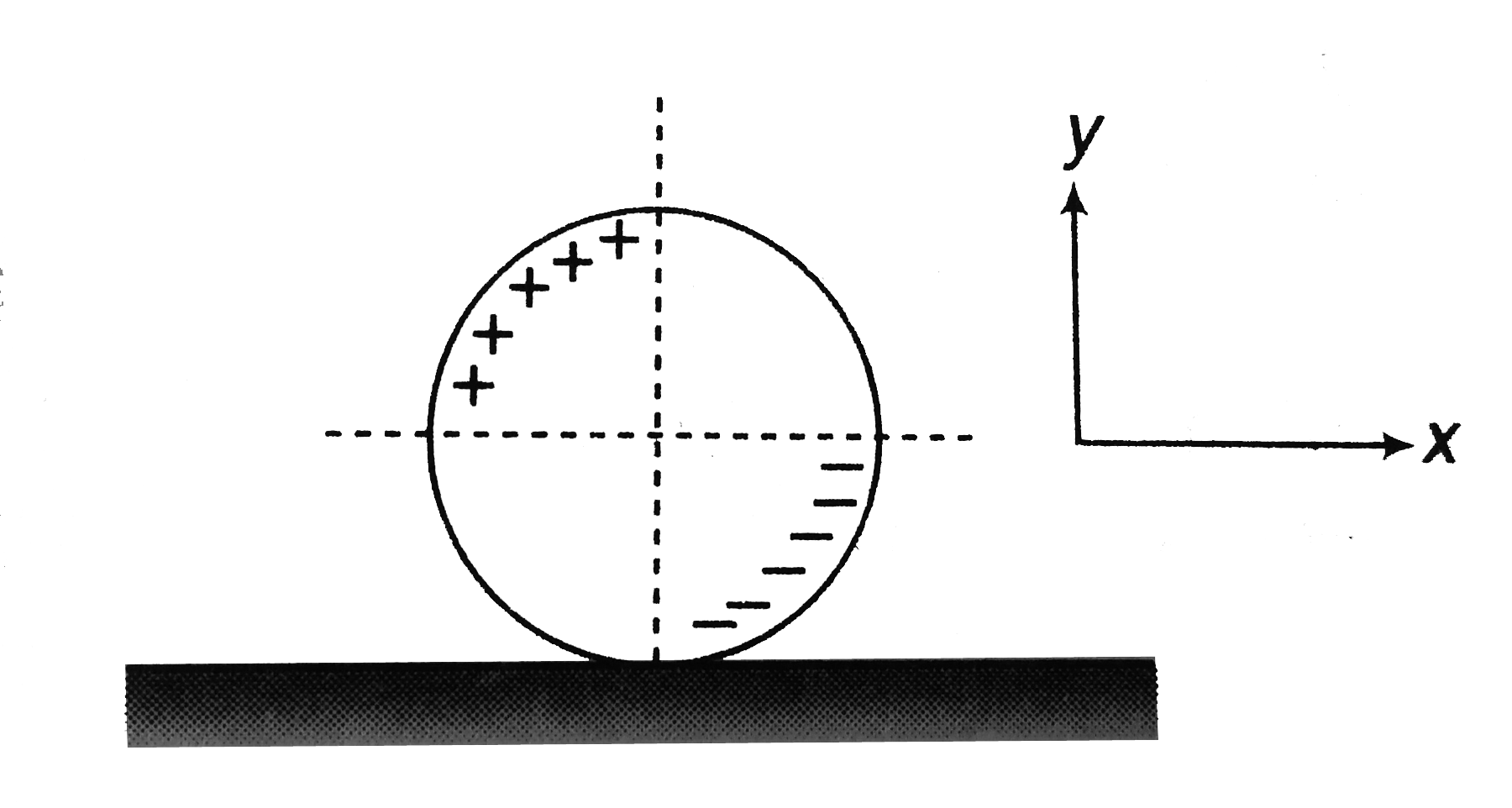
A non-conducting ring of mass m and radius R is charged as shown. The charge density, i.e. charge per unit length is `lamda`. It is then placed on a rough non-conducting horizontal plane. At time `t = 0`, a uniform electric field `E = E_0hati` is switched on and the ring starts rolling without sliding. Determine the friction force (magnitude and direction) acting on the ring when it starts moving.

A

`lambdaR E_(0)i`

B

`3lambdaRE_(0)hati`

C

`sqrt2lambdaRE_(0)hati`

D

`(2)/(lambda RE_(0))hati`

Text Solution

Verified by Experts

The correct Answer is:

A
Promotional Banner

Similar Questions

Explore conceptually related problems

A nonconducting ring of mass m and radius R, with charge per unit length lambda is shown in fig. It is then placed on a rough nonconducting horizontal plane. At time t=0, a uniform electric field vecE =E_(0)hati is switched on and the ring starts rolling without sliding. Determine the friction force (magnitude and direction ) acting on the ring.

A non conducting solid sphere of mass m and radius R having uniform charge density +rho and -rho as shown in figure. It is then placed on a rough non conducting horizontal plane. At t=0 a uniform electric field vecE=E_(0)hati N//C is switched on and the solid sphere starts rolling with sliding. The magnitude of frictional force at t=0 is (2rhopiR^(3)E_(0))/K . Find the value of K

A non-conducting ring of mass m and radius R has a charge Q uniformly distributed over its circumference. The ring is placed on a rough horizontal surface such that plane of the ring is parallel to the surface. A vertical magnetic field B = B_0t^2 tesla is switched on. After 2 a from switching on the magnetic field the ring is just about to rotate about vertical axis through its centre. (a) Find friction coefficient mu between the ring and the surface. (b) If magnetic field is switched off after 4 s , then find the angle rotated by the ring before coming to stop after switching off the magnetic field.

A uniform nonconducting rod of mass ma and length l, with charge density lambda as shown in fig. is hanged at the midpoint at origin so that it can rotate in a horizontal plane without any friction. A uniform electric field E exists parallel to x axis in the entire region. Calculated the period of small oscillation of the rod .

A non - conducting ring of mass m = 4 kg and radius R = 10 cm has charge Q = 2 C uniformly distributed over its circumference. The ring is placed on a rough horizontal surface such that the plane of the ring is parallel to the surface. A vertical magnetic field B=4t^(3)T is switched on at t = 0. At t = 5 s ring starts to rotate about the vertical axis through the centre. The coefficient of friction between the ring and the surface is found to be (k)/(24) . Then the value of k is

A strong magnet is placed under a horizontal conducting ring of radius r that carries current i as shown in Fig. If the magnetic field makes an angle theta with the vertical at the ring's location, what are the magnitude and direction of the resultant force on the ring?

A non-conducting ring having q uniformly distributed over its circumference is placed on a rough horizontal surface. A vertical time varying magnetic field B = 4t^(2) is switched on at time t = 0. Mass of the ring is m and radius is R. The ring starts rotating after 2 s, the coefficient of friction between the ring and the table is

A non-conducting ring having q uniformly distributed over its circumference is placed on a rough horizontal surface. A vertical time varying magnetic field B = 4t^(2) is switched on at time t = 0. Mass of the ring is m and radius is R. The ring starts rotating after 2 s, the coefficient of friction between the ring and the table is

A solid non-conduction cylinder of radius R is charge such that volume charge density is proporation to r where r is distance from axis. The electric field E at a distance r(r lt R) well depend on r as.

A uniform solid sphere of mass m and radius 'R' is imparted an initial velocity v_(0) and angular omega_(0) = (2v_(0))/(R ) and then placed on a rough inclined plane of inclination 'theta' and coefficient of friction mu = 2 tan theta as shown. The time after which the sphere will start rolling without slipping is
