Home
Class 12
CHEMISTRY
Compound (A) C(8)H(9)Br. Gives a white p...

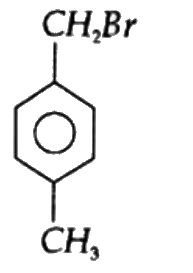
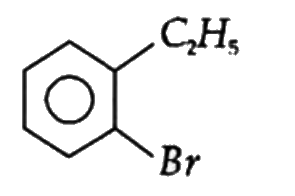
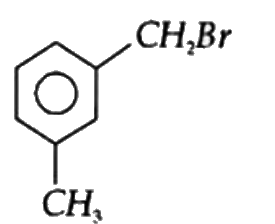
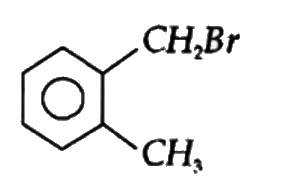
Compound (A) `C_(8)H_(9)Br`. Gives a white precipitate when warmed with alcoholic `AgNO_(3)`. Oxidation of (A) gives an acid (B). `C_(8)H_(6)O_(4)`. (B) easily forms anhydride on heating. Identify the compound (A)

A

B

C

D

Text Solution

AI Generated Solution

The correct Answer is:

To identify compound (A) with the molecular formula \( C_8H_9Br \), we can follow these steps: ### Step 1: Determine the Degree of Unsaturation The degree of unsaturation can be calculated using the formula: \[ \text{Degree of Unsaturation} = C - \frac{H}{2} - \frac{X}{2} + \frac{N}{2} + 1 \] Where: - \( C \) = number of carbon atoms - \( H \) = number of hydrogen atoms - \( X \) = number of halogens (bromine in this case) - \( N \) = number of nitrogen atoms For compound (A): - \( C = 8 \) - \( H = 9 \) - \( Br = 1 \) (which counts as one halogen) Plugging in the values: \[ \text{Degree of Unsaturation} = 8 - \frac{9}{2} - \frac{1}{2} + 1 = 8 - 4.5 - 0.5 + 1 = 4 \] This indicates that compound (A) has a degree of unsaturation of 4, which suggests it contains either one ring and three double bonds, or other combinations of rings and double bonds. ### Step 2: Analyze the Reaction with Alcoholic AgNO3 When warmed with alcoholic \( AgNO_3 \), compound (A) gives a white precipitate of \( AgBr \). This indicates that (A) likely contains a bromine atom that can be replaced by a silver ion, suggesting that (A) is likely a brominated aromatic compound. ### Step 3: Identify the Oxidation Product (B) The oxidation of compound (A) yields an acid (B) with the formula \( C_8H_6O_4 \). The presence of two additional oxygen atoms compared to (A) suggests that (B) is a carboxylic acid. The fact that (B) can easily form an anhydride upon heating indicates that it is likely phthalic acid. ### Step 4: Determine the Structure of Compound (A) Given that (B) is likely phthalic acid, we can deduce that compound (A) is likely a brominated derivative of phthalic acid. The structure of phthalic acid is: \[ \text{Phthalic Acid: } C_6H_4(COOH)_2 \] If we consider a bromine substituent on the aromatic ring, we can suggest that compound (A) could be 4-bromophthalic acid or a similar structure. ### Conclusion Based on the analysis, compound (A) is likely **4-bromophthalic acid**.
Promotional Banner

Similar Questions

Explore conceptually related problems

C Cl_4 gives a white precipitate when treated with AgNO_3 .

Compound (A) ( C_(6)H_(8))overset([o])(rarr) Malonic acid only. Identify compound (A) .

An organic compound (A) (C_(8)H_(14)O) forms an oxime and gives a positive haloform reaction. On ozonolysis, it gives acetone and a compound (B) (C_(5)H_(8)O_(2)) . (B) forms a dioxime and on subjecting to oxidation reaction gives an acid (C ) (C_(4)H_(6)O_(4)) . On treatment with excess of ammonia and strong heating, (C ) gives a neutral compound (D) (C_(4)H_(5)O_(2)N) . (D) on distillation with zinc dust forms pyrrloe. Suggest the possible structures of (A), (B), (C ), and (D). Explain the chemical reactions involved.

A compound (C_(5)H_(8)) reacts with ammoniacal AgNO_(3) to give a white precipitate and reacts with excess of KMnO_(4) solution to give (CH_(3))_(2)CH-COOH . The compound is

Compound 'A' with the formula C_(3)H_(8)O on vigorous oxidation produces an acid C_(3)H_(6)O_(2) . 'A' is

Compound A(C_(9)H_(10)O) shows positive iodoform test. Oxidation of A with KMnO_(4)//KOH gives acid B(C_(8)H_(6)O_(4)) . Anhydride of B is used for the preparation of phenolphthalein. Compound A is:

An organic compound (A) (C_(8)H_(8)O_(3)) was insoluble in water, dilute HCI, and NaHCO_(3) . It was soluble in NaOH. A solution of (A) in dilute NaOH was boiled and steam distilled and distillate was reacted with NaOH to give a yellow precipitate. The alkaline residue is acidifield to give a solid (B) (C_(7)H_(6)O_(3)) . (B) dissolves in aqueous NaHCO_(3) with the evolution of gas. Identify (A) and (B).

Compound (C_(9)H_(10)O) shows positive iodoform test. Oxidation of A with KMnO_(4)//KOH gives acid B(C_(8)H_(6)O_(4)) anhydride of B is used for the preparation of phenolphthalein compound is

The compound C_8H_9Cl(A) on treatments with KCN followed by hydrolysis gives C_9H_10O_2(B) .Ammonium salt of B on dry distillation yields C.Which reacts with alkaline solution of bromine to gives C_8H_11N .(D),Another compound E (C_6H_10O) is obtained by the action of nitrous acid on D. or by the action of aquouspotash on A,E on oxidation gives F(C_8H_10O) Which gives the inner anhydride G on heating. The compound D is reaction with CHCl_3+NaOH gives a compound H. The compound A on reaction with AgCN gives :

The compound C_8H_9Cl(A) on treatments with KCN followed by hydrolysis gives C_9H_10O_2(B) .Ammonium salt of B on dry distillation yields C.Which reacts with alkaline solution of bromine to gives C_8H_11N .(D),Another compound E (C_6H_10O) is obtained by the action of nitrous acid on D. or by the action of aquouspotash on A,E on oxidation gives F(C_8H_10O) Which gives the inner anhydride G on heating. The compound D is reaction with CHCl_3+NaOH gives a compound H.The structure of H.
