Home
Class 12
PHYSICS
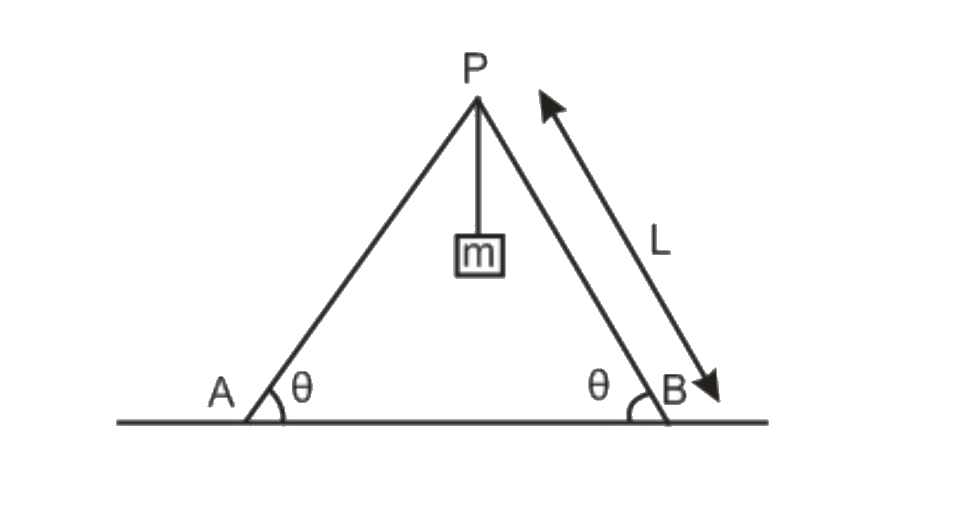
Two identical ladders are arranged as sh...

Two identical ladders are arranged as shown in the figure. Mass of the block is m and the mass of each ladder is M. The length of each of the ladder is L. The system is in equilibrium. What is the magnitude of frictional force acting at A or B?

A

`(mg)/(2)cos theta`

B

`(Mg)/(2) cos theta`

C

`((M-m))/(2)g cos theta`

D

`((M+m)/(2))g cot theta`

Text Solution

Verified by Experts

The correct Answer is:

D
Promotional Banner

Similar Questions

Explore conceptually related problems

Two identical ladders, each of mass M and length L are resting on the rough horizontal surface as shown in the figure. A block of mass m hangs from P. if the system is in equilibrium, find the magnitude and the direction of frictional force at A and B.

Three blocks A,B and C are suspended as shown in the figure. Mass of each block A and C is m. if the system is in equilibrium and mass of B is M, then

Three blocks A,B, and C are suspended as shown in fig. Mass of each of blocks A and B is m. If the system is in equilibrium, and mass of C is M then

Consider the system shown in figure Mass of block A= 3m , Mass of block B= 2m . Find the acceleration of A and B.

Two masses m and M are attached to the strings as shown in the figure. If the system is in equilibrium, then

Two blocks each having a mass M are placed as shown in the figure. The accleration of the system is:-

Four rings each of mass M and radius R are arranged as shown in the figure. The moment of inertia of the system about YY' will be

In the figure the masses of the blocks A and B are same and each equal to m. The tensions in the strings OA and AB are T_(2) and T_(1) respectively. The system is in equilibrium with a constant horizontal force mg on B. The tension T_(1) is :-

Two block each of mass 'm' are attached with two elastic strings as shown in the figure. Masses of strings are negligible in comparison to block of mass 'm' density of material of each string is rho . The whole system is moving vertically upward with an acceleration a = g/2. It is in equilibrium with respect to elevator. Ratio of elongation in rod 1 to that of rod 2 will be

For the system shown in figure , to be in equilibrium , determine mass m .
