Home
Class 12
PHYSICS
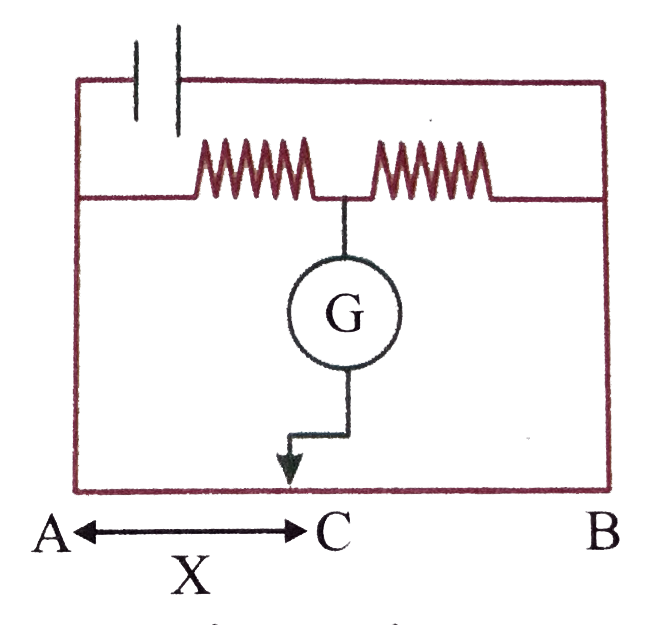
In the given circuit, no current is pass...

In the given circuit, no current is passing through the galvanometer. If the cross sectional diameter of the wire `AB` is doubled, then for null point of galvanometer, the value of `AC` would be:

A

`(x)/(4)`

B

`4x`

C

`2x`

D

`x`

Text Solution

Verified by Experts

The correct Answer is:

D
Promotional Banner

Similar Questions

Explore conceptually related problems

If 2% of the main current is to be passed through the galvanometer of resistance G , the resistance of shunt required is

In the given circuit, find the current in mA) in the wire between points A and B.

In a ammeter 0.2% of main current passes through the galvanometer. If resistance of galvanometer is G , the resistance of ammeter will be

In the circuit in fig. If no current flows through the galvanometer when the key k is closed, the bridge is balanced. The balancing condition for bridge is

In the meter bridge circuit shown, the null point is obtained at C (AC = x) on the wire AB. If the diameter of the wire AB is doubled, the position of the new null point C' will correspond to

A nichrome wire AB, 100 cm long and of uniform cross section cross section is mounted on a meter scale the points A and B coinciding with 0 cm and 100 cm marks respectively. The wire has a resistance S = 50 ohm, Ay point C along this wire, between A and B is called a variable point to which on end of and electrical element is commeted. In the following questions this arrangement will be referred to as 'wire AB'. In the circuit adjacent arrangement it is found that deflection in the galvanometer is 10 divisions. Also the voltage across the 'wire AB' is equal to the across the galvanometer. the current sensitivity of the galvanometer is about.

Statement I: In the meter bridge experiment shown in figure, the balance length AC corresponding to null deflection of the galvanometer is x. If the radius of the wire AB is doubled, the balanced length becomes 4x. Statement II: The resistance of a wire is inversely proportional to the square of its radius.

When 2 amperes current is passed through a tangent galvanometer, it gives a deflection of 30^(@) . For 60^(@) deflection, the current must be

STATEMENT-1 : In the meter bridge experimeter shown in figure the balance length AC corresponding to null deflection of the galvanometer is x. If the radius of the wire AB is doubled, the balance length becomes 4x. and STATEMENT-2 : The resistance of a wire a inversely proportional to the square of its radius.

In the adjacent circuit a resisttance R is used. Initially with 'wire AB' not in the circuit, the galavanometer shhows a deflection of d divisions. Now, the wire AB is conneted parallel to the galvanometer and the galvanometer shows a deflection defiction nearly d/2 divisions. Therefore
