Home
Class 12
PHYSICS
The circuit shown here is used to compar...

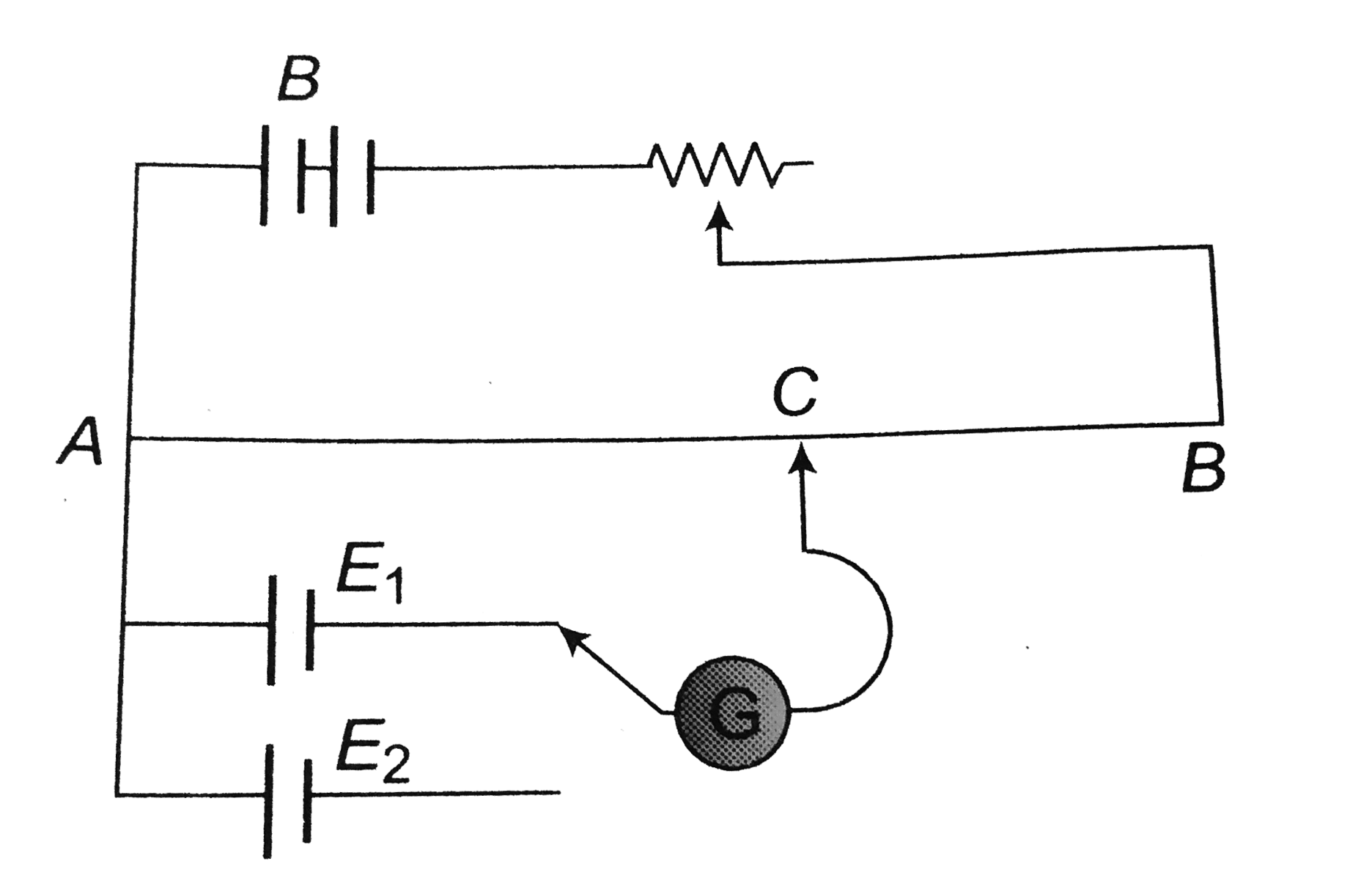
The circuit shown here is used to compare the e.m.f. of the two cells `E_(2) (E)_(1) gt E_(2)`. The null point is at `C` when the galvanometer is connected to `E_(1)`. When the galvanometer is connected to `E_(2)`, the null point will be

A

to the left of C

B

to the right of C

C

at C itself

D

nowhere on AB

Text Solution

Verified by Experts

The correct Answer is:

A
Promotional Banner

Similar Questions

Explore conceptually related problems

A potentiometer is used for the compaisem of e.m.f. of two cells E_(1) and E_(2) . For cell E_(1) the no deflection point os obtained at 20 cm and for E_(2) the no deflection point is obtained at 30 cm . The ratio of their e.m.f.'s will be

In the circuit shown in Fig., the cell is ideal with e.m.f = 2V. The resistance of the coil of the galvanometer G is 1Omega . Then

Two cells of emf E_(1) and E_(2) are to be compared in a potentiometer (E_(1) gt E_(2)) . When the cells are used in series correctly , the balancing length obtained is 400 cm. When they are used in series but E_(2) is connected with reverse polarities, the balancing obtaiend is 200cm. Ratio of emf of cells is

Two cells of emfs E_(1) and (E_(2) (E_(1) gt E_(2)) are connected as shows in Fig. 6.45 . When a potentiometer is connected between A and B , the balancing length of the potentiometer wire is 300 cm . On connecting the same potentiometer between A and C , the balancing length is 100 cm . The ratio E_(1)//E_(2) is

A battery of emf E_(0)=12V is connected across a 4m long uniform wire having resistance 4Omega//m . The cells of small emfs e_(1)=2V and e_(2)=4V having internal resistance 2Omega and 6Omega respectively, are connected as shown in the figure. If galvanometer shows no deflection at the point N, the distance of point N from the point A is equal to

Statement I: In the potentiometer circuit shown in figure. E_1 and E_2 are the emf of cells C_1 and C_2 , repsectively, with E_1gtE_2 . Cell C_1 has negligible internal resistance. For a given resistor R, the balance length is x. If the diameter of the potentiometer wire AB is increased, the balance length x will decrease. Statement II: At the balance point, the potential difference between AD due to cell C_1 is E_2 , the emf of cell C_2 .

In the figure, the potentiometer wire of length l = 100 cm and resistance 9 Omega is joined to a cell of emf cell of emf E_(2) = 5 V and internal resistance r_(2) = 2 V is connected as shown. The galvanometer is show no deflection when the length AC is

In the circuit shown here, E_(1) = E_(2) = E_(3) = 2 V and R_(1) = R_(2) = 4 ohms . The current flowing between point A and B through battery E_(2) is

The balancing lengths of potentiometer wire are 800 cm and 600cm when two cells of emf's E_(1) and E_(2) are connected in the secondary circuit first in series and then terminals of one cell is reversed, E_(1)/E_(2) is equal to

Potentiometer wire PQ of 1 m length is connected to a standard cell E_(1) . Another cell E_(2) of emf 1.02 V is connected with a resistance r and a switch S as shown in the circuit diagram. With switch S open, the null position is obtained at a distance of 51 cm from P . (i) Calculate the potential gradient of the potentiometer wire. (ii) Find the emf of cell E_(1) . (iii) When switch S is closed, will the null point move toward P or toward Q ? Give reason for your answer.
