Home
Class 12
PHYSICS
Two materials having coefficients of the...

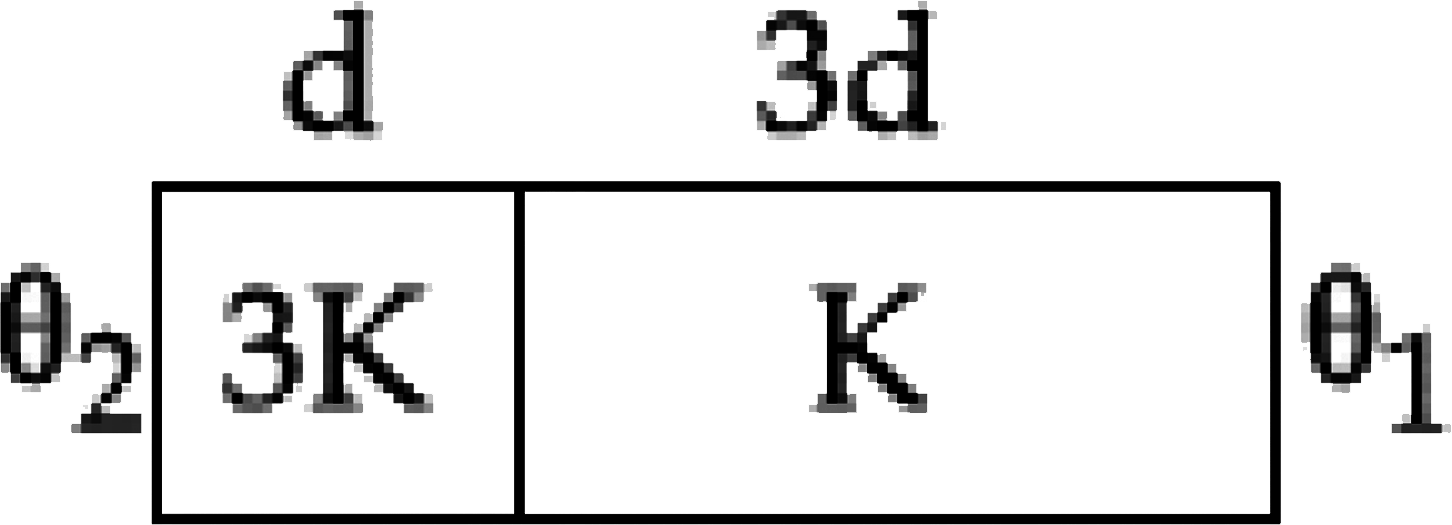
Two materials having coefficients of thermal conductivity '3k' and 'k' and thickness 'd' and '3d' respectively, are joined to form a slab as shown in the figures. The temperatures of the outer surfaces are `theta_(2)` and `theta_(1)` respectively `(theta_(2) gt theta_(2))`. The temperature at the interface is :

A

`(theta_2+theta_1)/2 `

B

`(theta_1)/6+(5theta_2)/6 `

C

`(theta_1)/3+(2theta_2)/3 `

D

`(theta_1)/10+(9theta_2)/10 `

Text Solution

Verified by Experts

The correct Answer is:

D
Promotional Banner

Similar Questions

Explore conceptually related problems

Two bars of thermal conductivities K and 3K and lengths 1 cm and 2 cm respectively have equal cross-sectional area, they are joined lengths wise as shown in the figure. If the temperature at the ends of this composite br is 0^(@)C and 100^(@)C respectively (see figure), then the temperature phi of the interface is

The temperature of the two outer surfaces of a composite slab, consisting of two materials having coefficients of thermal conductivity K and 2K and thickness x and 4x respectively. Temperatures on the opposite faces of composite slab are T_(1) and T_(2) where T_(2)gtT_(1) , as shown in fig. what is the rate of flow of heat through the slab in a steady state?

Two plates eachb of area A, thickness L_1 and L_2 thermal conductivities K_1 and K_2 respectively are joined to form a single plate of thickness (L_1+L_2) . If the temperatures of the free surfaces are T_1 and T_2 . Calculate. (a) rate of flow of heat (b) temperature of interface and (c) equivalent thermal conductivity.

Three rods of the same dimension have thermal conductivity 3K , 2K and K. They are arranged as shown in the figure below Then , the temperature of the junction in steady - state is

The temperature of the two outer surfaces of a composite slab, consisting of two materials having coefficients of thermal conductivity K and 2K and thicknesses x and 4x, respectively are T_(2) and T_(1)(T_(2)gtT_(1)) . The rate of heat of heat transfer through the slab, in ? steady state is [(A(T_(2)-T_(1))/(x)]f , with f equal to :-

Two conducting slabs of heat conductivity K_1 " and " K_2 are joined as shown in fig. The temp. at ends of the slabs are theta_1 " and " theta_2 (theta_1 gt theta_2) the, final temp. (theta_m) of junction is :

Consider the two insulating sheets with thermal resistance R_(1) and R_(2) as shown in figure. The temperature theta is

Three identical solid spheres (1, 2 and 3) are allowed to roll down from three inclined plane of angles theta_(1), theta_(2) and theta_(3) respectively starting at time t = 0, where theta_(1) gt theta_(2) gt theta_(3) , then

Two walls of thickness in the ratio 1:3 and thermal conductivities in the ratio 3:2 form a composite wall of a building. If the free surfaces of the wall be at temperatures 30^@C and 20^@C , respectively, what is the temperature of the interface?

If sintheta_(1)+sintheta_(2)+sintheta_(3)=3, then cos theta_(1)+cos theta_(2)+cos theta_(3)=
