Home
Class 12
PHYSICS
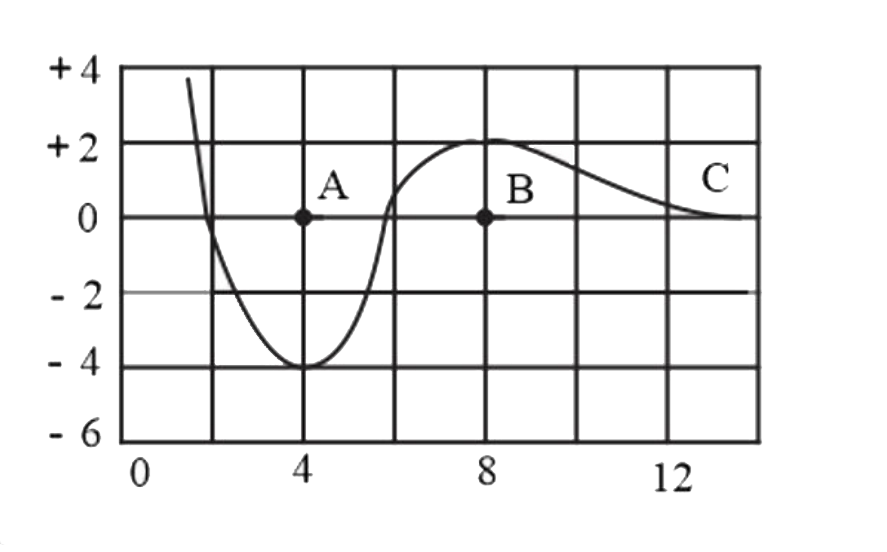
For the potential energy function shown ...

For the potential energy function shown in fig. there will be an unstable equilibrium at position

A

A

B

B

C

C

D

None of the above

Text Solution

Verified by Experts

The correct Answer is:

B
Promotional Banner

Similar Questions

Explore conceptually related problems

In a conservative force field we can find the radial component of force from the potential energy function by using F = -(dU)/(dr) . Here, a positive force means repulsion and a negative force means attraction. From the given potential energy function U(r ) we can find the equilibrium position where force is zero. We can also find the ionisation energy which is the work done to move the particle from a certain position to infinity. Let us consider a case in which a particle is bound to a certain point at a distance r from the centre of the force. The potential energy of the particle is : U(r )=(A)/(r^(2))-(B)/(r ) where r is the distance from the centre of the force and A andB are positive constants. Answer the following questions. The equilibrium distance is given by

In a conservative force field we can find the radial component of force from the potential energy function by using F = -(dU)/(dr) . Here, a positive force means repulsion and a negative force means attraction. From the given potential energy function U(r ) we can find the equilibrium position where force is zero. We can also find the ionisation energy which is the work done to move the particle from a certain position to infinity. Let us consider a case in which a particle is bound to a certain point at a distance r from the centre of the force. The potential energy of the particle is : U(r )=(A)/(r^(2))-(B)/(r ) where r is the distance from the centre of the force and A andB are positive constants. Answer the following questions. The equilibrium is

In a conservative force field we can find the radial component of force from the potential energy function by using F = -(dU)/(dr) . Here, a positive force means repulsion and a negative force means attraction. From the given potential energy function U(r ) we can find the equilibrium position where force is zero. We can also find the ionisation energy which is the work done to move the particle from a certain position to infinity. Let us consider a case in which a particle is bound to a certain point at a distance r from the centre of the force. The potential energy of the particle is : U(r )=(A)/(r^(2))-(B)/(r ) where r is the distance from the centre of the force and A andB are positive constants. Answer the following questions. The work required to move the particle from equilibrium distance to infinity is

STATEMENT-1 : If potential energy of a dipole in stable equilibrium position is zero, its potential energy is unstable equilibrium position will be 2pE, where p and E represent the dipole moment and electric field respectively and STATEMENT-2 : The potential energy of a dipole is minimum in stable equilibruim position and maximum in unstable equilibrium position.

For the potential energy curve shown shown in figure. (a) Find directions of force at points A, B, C,D and E . (b) Find positions of stable, unstable and neutral equilibriums.

For the potential energy curve shown in figure. (a) Determine whether the force F_x is positive, negative, or zero at the five points indicated, (b) Indicate points of stable, unstable, and neutral equilibrium, (c) Sketch the curve for F_x versus x from x=0 to x=8m .

Find the elastic potential energy stored in each spring shown in figure, when the block is in equilibrium. Also find the time period of vertical oscillation of the block.

The force acting on a body moving along x -axis varies with the position of the particle as shown in the fig. The body is in stable equilibrium at.

The potential energy of a harmonic oscillator of mass 2kg in its equilibrium position is 5 joules. Its total energy is 9 joules and its amplitude is 1cm. Its time period will be

The work done in rotating a bar magnet of magnetic moment M from its unstable equilibrium position to its stable equilibrium position in a uniform magnetic field B is
