Home
Class 12
PHYSICS
One end of a thermally insulated rod is ...

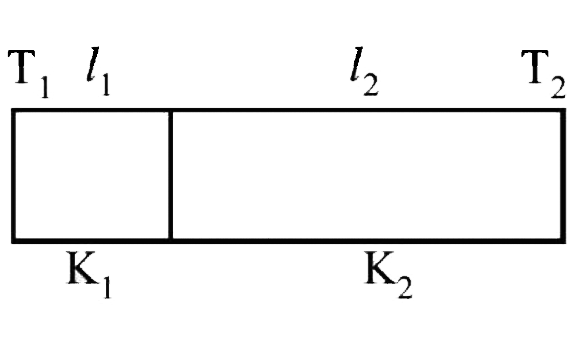
One end of a thermally insulated rod is kept at a temperature `T_1` and the other at `T_2`. The rod is composed of two sections of length `l_1 and l_2` and thermal conductivities `K_1 and K_2` respectively. The temperature at the interface of the two section is

A

`((K_2l_2T_1+K_1l_1T_2))/((K_1l_1+K_2l_2))`

B

`((K_2l_1T_1+K_1l_2T_2))/((K_2l_1+K_1l_2))`

C

`((K_1l_2T_1+K_2l_1T_2))/((K_1l_2+K_2l_1))`

D

`((K_1l_1T_1+K_2l_2T_2))/((K_1l_1+K_2l_2))`

Text Solution

Verified by Experts

The correct Answer is:

C
Promotional Banner

Similar Questions

Explore conceptually related problems

One end of thermally insulated rod is kept at a temperature T_(1) and the other at T_(2) . The rod is composed of two section of length l_(1) and l_(2) thermal conductivities k_(1) and k_(2) respectively. The temerature at the interface of two section is

One end of thermally insulated rod is kept at a temperature T_(1) and the other at T_(2) . The rod is composed of two section of length l_(1) and l_(2) thermal conductivities k_(1) and k_(2) respectively. The temerature at the interface of two section is

Two conducting cylinders of equal length but different radii are connected in series between two heat baths kept at temperatures T_(1) = 300K and T_(2) = 100 K , as shown in the figure. The radius of the bigger cylinder is twice that of the smaller one and the thermal conductivities of the materials of the smaller and the larger cylinders are K_(1) and K_(2) respectively. If the temperature at the junction of the two cylinders in the steady state is 200 K, then K_(1)//K_(2)= __________.

Two rods A and B are of equal lengths. Their ends of kept between the same temperature and their area of cross-section are A_(1) and A_(2) and thermal conductivities K_(1) and K_(2) . The rate of heat transmission in the two rods will be equal, if

One end of a rod of length L and crosssectional area A is kept in a furnace at temperature T_(1) . The other end of the rod is kept at a temperature T_(2) . The thermal conductivity of the matrieal of the rod is K and emissivity of the rod is e. It is gives that T_(!)=T_(s)+DeltaT , where DeltaTltlt T_(s),T_(s) is the temperature of the surroundings. If DeltaTprop(T_(1)-T_(2)) find the proportional constant, consider that heat is lost only by rediation at the end where the temperature of the rod is T_(1) .

Two metal rods 1 and 2 of the same length have same temperature difference between their ends. Their thermal conductivities are K_1 and K_2 and cross-section areas A_1 and A_2 respectively. What is the required condition for the same rate of heat conduction in them?

A composite slab is prepared by pasting two plates of thickness L_(1) and L_(2) and thermal conductivities K_(1) and K_(2) . The slab have equal cross-sectional area. Find the equivalent conductivity of the composite slab.

Two rods of length l_(1) and l_(2) and coefficients of thermal conductivities k_(1) and K_(2) are kept touching each other. Both have the same area of cross-section. The equivalent of thermal conductivity is

One end of rod of length L and cross-sectional area A is kept in a furance of temperature T_(1) . The other end of the rod is kept at at temperature T_(2) . The thermal conductivity of the material of the rod is K and emissivity of the rod is e . It is given that T_(2)=T_(S)+DeltaT where DeltaT lt lt T_(S) , T_(S) being the temperature of the surroundings. If DeltaT prop (T_(1)-T_(S)) , find the proportionality constant. Consider that heat is lost only by radiation at the end where the temperature of the rod is T_(2) .

There are two rods of length l_1 and l_2 and coefficient of linear expansions are alpha_1 and alpha_2 respectively. Find equivalent coefficient of thermal expansion for their combination in series.
