Home
Class 12
PHYSICS
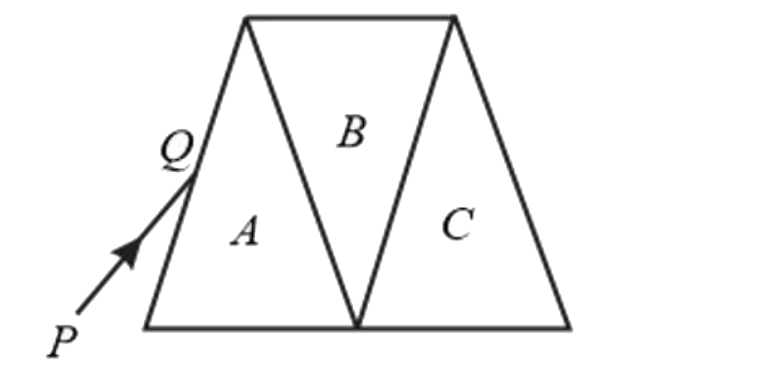
The ray PQ shown in the figure , surface...

The ray PQ shown in the figure , surface minimum deviation in an equilateral prism A. Two more identical prism B and C and of the same material as A are now placed in contact as. Show in the figure . If prism A produces a minimum deviation `delta_m`, the deviation produced by the combination of prisms A, B and C will be

A

`3delta_m`

B

`2delta_m`

C

`delta_m`

D

zero

Text Solution

Verified by Experts

The correct Answer is:

C
Promotional Banner

Similar Questions

Explore conceptually related problems

A given ray of light suffers minimum deviation in an equilateral prism P. Additional prism Q and R of identical shape and of the same material as P are now added as shown in figure. The ray will now suffer

If the angle of minimum deviation is of 60^@ for an equilateral prism , then the refractive index of the material of the prism is

The angle of minimum deviation produced by an equilateral prism is 46^@ The refractive index of material of the prism.

Two prisms A and B have dispersive powers of 0.012 and 0.018 respectively. The two prisms are in contact with each other. The prism A produces a mean deviation of 1.2^(@) , the mean deviation produced by B if the combination is achromatic is

An equilateral prism produces a minimum deviation of 30^(@) . The angle of incidence is

A ray of light suffers a minimum deviation when incident on equilateral prism of refractive index sqrt2 The angle of deviation is

A thin prism of angle A=6^(@) produces a deviation d=3^(@) . Find the refractive index of the material of prism.

n number of identical equilateral prisms are kept in contact as shown in figure. If deviation through a single prism is delta. Then, (n,m are integers)

n number of identical equilateral prisms are kept in contact as shown in figure. If deviation through a single prism is delta . Then (n,m are integers)

Find the angle of minimum deviation for an equilateral prism made of a material of refractive index 1.732. What is the angle of incidence for this deviation ?
