Home
Class 12
PHYSICS
A positive charge is released from rest ...

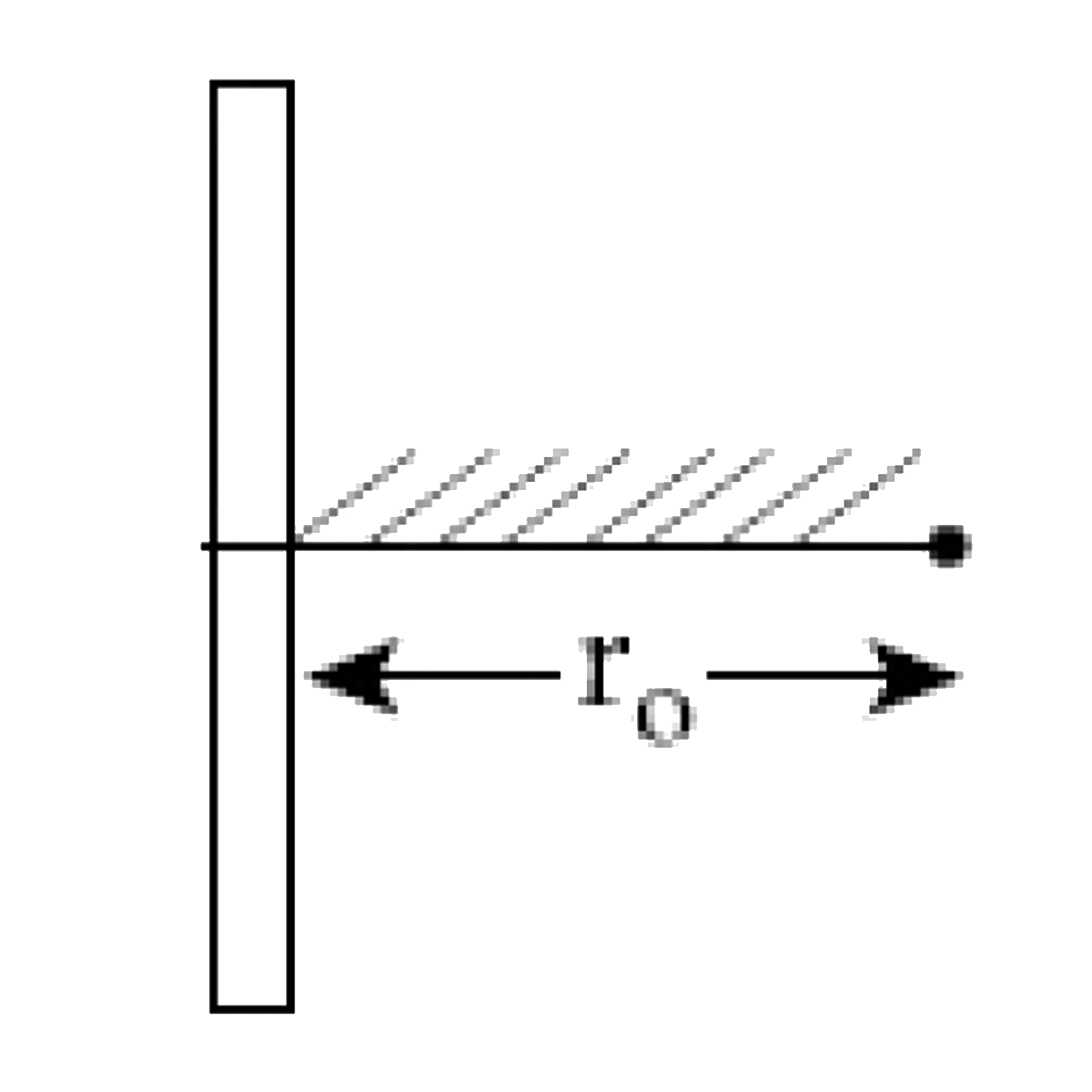
A positive charge is released from rest at a distance `r_(0)` from a positive line charge with uniform density . The speed (v) of the point charge , as a function of instantaneous distance r from line charge, is proportional to:

A

`vprop(r/r_0)`

B

`vpropsqrt(ln(r/r_0))`

C

`vpropln(r/r_0)`

D

`vprope^(+r//r_0)`

Text Solution

Verified by Experts

The correct Answer is:

B
Promotional Banner

Similar Questions

Explore conceptually related problems

A proton is fixed at origin. Another proton is released from rest, from a point at a distance r from origin. Taking charge of portion as e and mass as m , find the speed of the proton (i) at a distance 2r from origin (ii) at large distance from origin.

A charge particle q is released at a distance R_(@) from the infinite long wire of linear charge density lambda . Then velocity will be proportional to (At distance R from the wire)

There is an infinite line of uniform linear density of charge +lamda . A particle of charge -q & mass m is projected with initial velocity v_(0) at an angle theta with the line of charge from a distance a from it. The point charge moves in plane containing line charge and point of projection The speed of the particle of found to be minimum when it's distance from the line of charge is ae^((npimepsilon_(0)^(2)//qlamda)) . The value of n is (ingnore gravity)

A positively charged particle is released from rest in a uniform electric field. The electric potential energy of the charge.

A positively charged particle is released from rest in a uniform electric field. The electric potential energy of the charge.

A positively charged particle is released from rest in a uniform electric field. The electric potential energy of the charge.

A point charge q is located at a distance l from an infinite conduting plane. Determine the surface density of charges induced on the plane as a function of separaction r from the base of the perpendicular drawn to the plane from the chagre.

An infinite line charge produces a field of 18xx10^(4) N/C at a distance of 2 metre from it. The linear charge density is

The electric field at distance .r. from infinte line of charge ("having linear charge density" lambda) is

The work done in bringing a unit positive charge from infinite distance to a point at distance x from a positive charge Q is W. Then the potential phi at that point is
