Home
Class 12
BIOLOGY
The diagram shows the effect of an enzy...

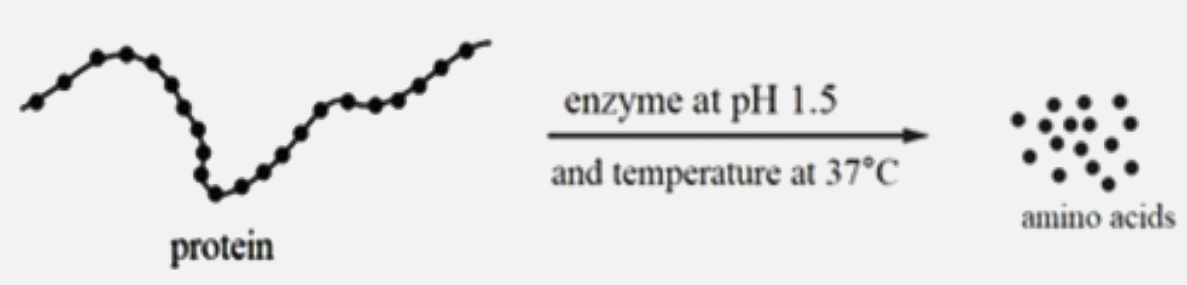
The diagram shows the effect of an enzyme working in the human digestive system .
`underset("and temperature at" 37^@C)overset("enzyme at PH1.5)rarr`
What would reduce the rate of production of amino acids ?

A

removing the amino acids as they are formed

B

increasing the amount of protein

C

raising the temperature to `37.1^@C`

D

raising the pH to 4.5

Text Solution

Verified by Experts

The correct Answer is:

D
Promotional Banner

Similar Questions

Explore conceptually related problems

The graph shows the effect of temperature on the rate at which the enzyme in a biological washing powder digests and removes fruit juice stains . Which statements explain the shape of the graph at temperatures higher than X ? I. Bonds are broken between the R groups of the amino acids in the polypeptide chains of the enzyme. II. There are more collisions between the enzyme and its substrate. III. The tertiary structure of the enzyme is altered. Iv. The shapes of the active site and the substrate are no longer complementary .

Enzymes work at optimum temperature. Over a range 0-40^(@)C , what would happen to the rate of enzyme controlled reactions for every 10^(@)C rise in temperature ?

Following are two first order reaction with their half times given at 25^(@)C . A overset(t_(1//2) = 30 min)rarr Products B overset(t_(1//2)=40 min)rarr Products The temperature coefficients of their reactions rates are 3 and 2 , respectively, beween 25^(@)C and 35^(@)C . IF the above two resctions are carried out taking 0.4 M of each reactant but at different temperatures: 25^(@)C for the first order reaction and 35^(@)C for the second order reaction, find the ratio of the concentrations of A and B after an hour.

Fig shows a cylindrical tube of volume V with adiabatic walls containing an ideal gas. The internal energy of this ideal gas is given by 1.5nRT. The tube is divided into two equal parts by a fixed diathermic wall. Initially, the pressure and the temperature are p_(1), T_(1) on the left and p_(2), T_(2) on the right. the system is left for sufficient time so that the temperature becomes equal on the two sides. (a) how much work has been done by the gas on the left part ? (b) find the final pressures on the two sides. (c ) find the final equilibrium temperature. (d) how much heat has flown from the gas on the right to the gas on the left ?

During the process of digestion, the proteins present in food materials are hydrolysed to amino acids. The two enzymes involved in the process are: overset("Enzyme (A)")(rarr) Polypeptides underset("Enzyme (B)")(rarr) Amino acids

The first order reaction has k=1.5xx10^(-6) per second at 200^(@)C . If the reaction is allowed to ruf for 10 hours at the same temperature, what percentage of the initial concentration would have changed into the product? What is the half life period of this reaction ?

The given diagram is an outline of human body showing the posttion of certain organs. In this diagram (I) Name the parts labelled 1-5. (ii) Name the hormone released from 1 that influences the working of part 2. (iil) How do part labelled as 3 differs from parts labelled as 1 and 2 in general? Name the endocrine cells present in part 3. (iv) What will happen if the part labelled as 4 is removed ? (11) Name the hormones released by part 5. (VI) Why the part labelled as 1 called master gland? Which part of the forebrain controls the gland labelled 1 ? (vii) Name the gland that secretes 'emergency hormone.

CO_2 and H_2 O absorbs strongly in the infrared rrgion and its presence in the atmospheere dectrases the loss fo heat form the enrth by radistiion . This global warming is called the greenhouse effect (other gases , including the oxides of nitraongen form car exhauset freons from aerosols and refrigeratirs and methane from bacteria in the soil and in the rument cows , also add to the reeenhouse effect ). The concentration fo atmospheric CO_2 has increased by 10% . The is rsulting in the increase in the mean temperature fo the earth by 2. 5^@ C , varying form 2^@ C t the equlator to 4^@ C at the poles . This could have dramatic effects on the climate. The equilibrium constant (K_(p)) for the reaction 2CO_((g))underset(larr)(rarr)2CO_(2(g)) is 1.4xx10^(90) at 25^(@)C . Given this enormous value, why does not CO convert totally into CO_(2) in the troposphere?.

The following is not an appropriate reaction for the preparation of t-butyl ethyl ether. C_(2)H_(5)ONa+CH_(3)-overset(CH_(3))overset("| ")underset(CH_(3))underset("| ")(C )-Cl rarr CH_(3)overset(CH_(3))overset("| ")underset(CH_(3))underset("| ")(C )-OC_(2)H_(5) (i) What would be the major product of this reaction ? (ii) Write a suitable reaction for the preparation of t-butylethyl ether.

When pinacol is treated with dilute H_(2)SO_(4) , a re-arangement reaction takes place which leads to the formation of a ketone. CH_(3)-underset(CH_(3))underset(|)overset(OH)overset(|)C-underset(CH_(3))underset(|)overset(OH)C-CH_(3)overset(H_(2)SO_(4))rarrCH_(3)-underset(CH_(3))underset(|)overset(O)overset(||)C-overset(CH_(3))overset(|)C-CH_(5) This reaction involves re-arrangement of carbocation Step 1: CH_(3)-underset(CH_(3))underset(|)overset(OH)overset(|)C-underset(CH_(3))overset(+)overset(OH_(2))overset(|)C-CH_(2)rarrCH_(3)-underset(CH_(3))underset(|)overset(OH)overset(|)C-underset(CH_(3))underset(|)overset(OH)overset(|)C-underset(CH_(3))underset(|)overset(+)C-CH_(3) Step 2: Carbocation rearrange by hydride, alkyl shift to get as stable as they can. Stability is the driving force for re-arrangement migration of bond may also oC Cur. Where by ring expansion and ring contraction takes place. The relief of strain can provide a powerful driving force for re-arrangement. What will be the product of following reaction R is:
