Home
Class 12
PHYSICS
An ideal gas (1 mol ,monatomic) is in th...

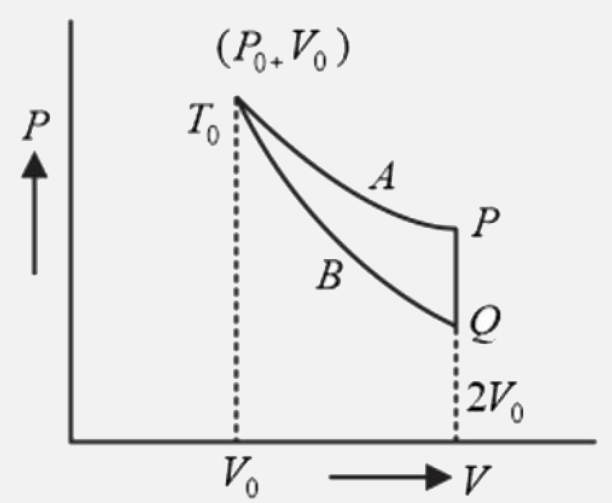
An ideal gas (1 mol ,monatomic) is in the initial state P (see diagram) on an isothermal curve A at a temperature `T_0` . It is brought under a constant volume `(2V_0)` process to Q which lies on an adiabatic curve B intersecting the isothermal curve A at `(P_0,V_0,T_0)` . The change in the internal energy of the gas (in terms of `T_0` ) during the process is `(2^(2//3)=1.587)`

A

`2.3T_0`

B

`-4.6T_0`

C

`-2.3T_0`

D

`4.6T_0`

Text Solution

Verified by Experts

The correct Answer is:

B
Promotional Banner

Similar Questions

Explore conceptually related problems

An ideal gas (1 mol, monatomic) is in the intial state P (see Fig.) on an isothermal A at temperature T_(0) . It is brought under a constant volume (2V_(0)) process to Q which lies on an adiabatic B intersecting the isothermal A at (P_(0),V_(0),T_(0)) . The change in the internal energy of the gas during the process is (in terms of T_(0)) (2^(2//3) = 1.587)

One mole of hydrogen, assumed to be ideal, is adiabatically expanded from its initial state (P_(1), V_(1), T_(1)) to the final state (P_(2), V_(2), T_(2)) . The decrease in the internal energy of the gas during this process will be given by

A gas is expanded from volume V_(0) = 2V_(0) under three different processes. Process 1 is isobaric process, process 2 is isothermal and process 3 is adiabatic. Let DeltaU_(1), DeltaU_(2) and DeltaU_(3) be the change in internal energy of the gas in these three processes. then

A gas is expanded form volume V_(0) to 2V_(0) under three different processes as shown in the figure . Process 1 is isobaric process process 2 is isothermal and and process 3 is adiabatic . Let DeltaU_(1),DeltaU_(2) and DeltaU_(3) be the change in internal energy of the gas in these three processes then

The state of an ideal gas is changed through an isothermal process at temperature T_0 as shown in figure. The work done by the gas in going from state B to C is double the work done by gas in going from state A to B. If the pressure in the state B is (p_0)/(2) , then the pressure of the gas in state C is

The state of an ideal gas is changed through an isothermal process at temperature T_0 as shown in figure. The work done by the gas in going from state B to C is double the work done by gas in going from state A to B. If the pressure in the state B is (p_0)/(2) , then the pressure of the gas in state C is

A quantity of gas occupies an initial volume V_(0) at pressure p_(0) and temperature T_(0) . It expands to a volume V (a) constant temperature and (b) constant pressure. In which case does the gas do more work ?

Two different adiabatic parts for the same gas intersect two isothermals at T_(1) "and" ^ T_2 as shown in P-V diagram . Then the ratio of (V_(a))/(V_(b)) will be

Two moles of an ideal monoatomic gas, initially at pressure p_1 and volume V_1 , undergo an adiabatic compression until its volume is V_2 . Then the gas is given heat Q at constant volume V_2 . (i) Sketch the complete process on a p-V diagram. (b) Find the total work done by the gas, the total change in its internal energy and the final temperature of the gas. [Give your answer in terms of p_1,V_1,V_2, Q and R ]

If 2 mol of an ideal monatomic gas at temperature T_(0) are mixed with 4 mol of another ideal monatoic gas at temperature 2 T_(0) then the temperature of the mixture is
