Home
Class 12
PHYSICS
A solid sphere has linear velocity v(0)=...

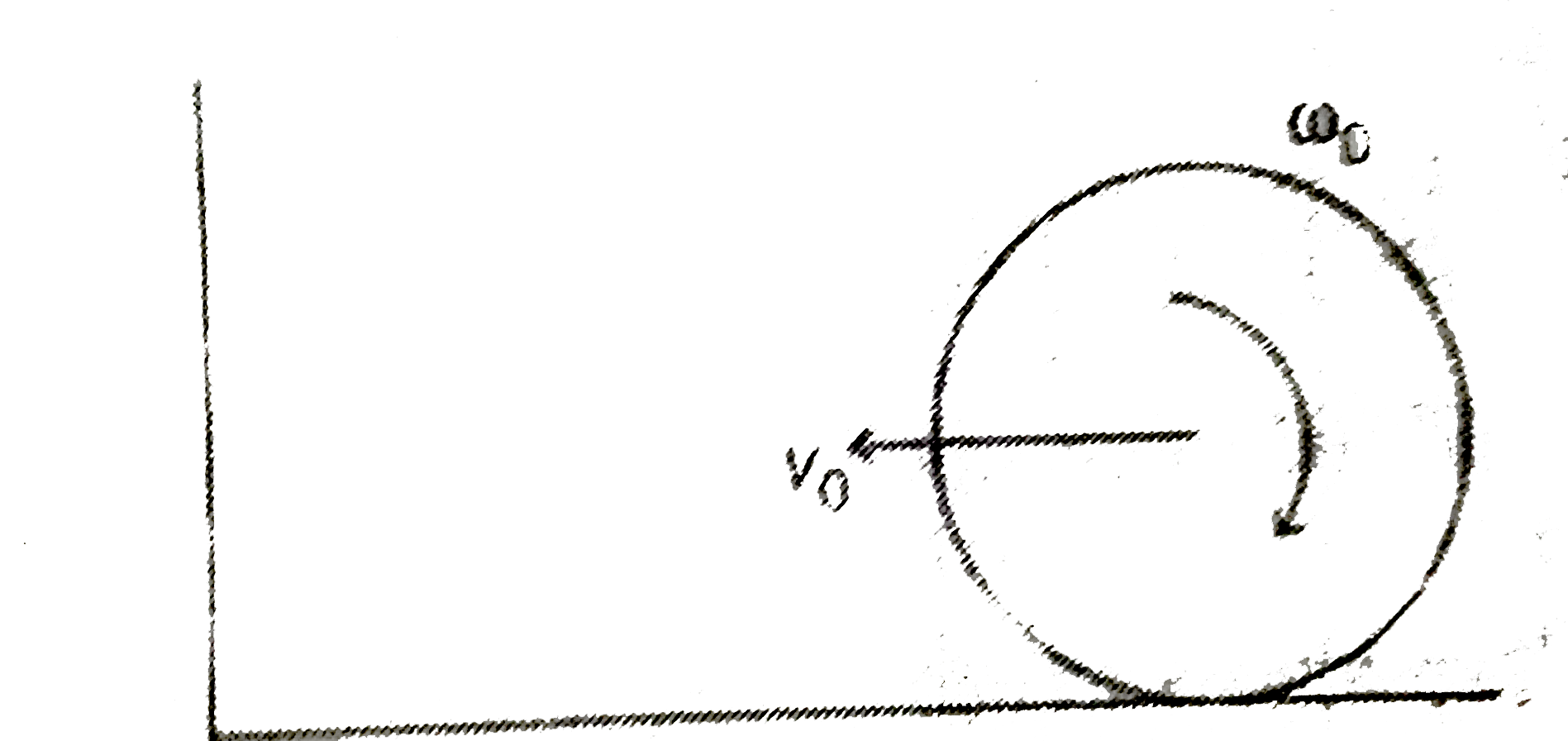
A solid sphere has linear velocity `v_(0)=4` m/s and angular velocity `omega_(0)=9` rad/s as shown. Ground on which it is moving , is smooth . It collides elastically with a rough wall of coefficient of friction `mu` . Radius of the sphere is 1m and mass is 2 kg .

If the sphere after colliding with the wall rolls without slipping on opposite direction, then coefdicient of friction `mu` is

A

`1/2`

B

`2/3`

C

`1/3`

D

`1/4`

Text Solution

Verified by Experts

The correct Answer is:

D
Promotional Banner

Similar Questions

Explore conceptually related problems

A solid sphere has linear velocity v_(0)=4 m/s and angular velocity omega_(0)=9 rad/s as shown. Ground on which it is moving , is smooth . It collides elastically with a rough wall of coefficient of friction mu . Radius of the sphere is 1m and mass is 2 kg . What is net linear impulse imparted by the wall on the sphere during impact ?

A solid sphere is rolling without slipping on rough ground as shown in figure. If collides elastically with an identical another sphere at rest. There is no friction between the two spheres . Radius of each sphere is R and mass is m. Linear velocity of first sphere after it again starts rolling without slipping is

A uniform solid sphere of mass m and radius 'R' is imparted an initial velocity v_(0) and angular omega_(0) = (2v_(0))/(R ) and then placed on a rough inclined plane of inclination 'theta' and coefficient of friction mu = 2 tan theta as shown. The time after which the sphere will start rolling without slipping is

A solid sphere is rolling without slipping on rough ground as shown in figure. If collides elastically with an identical another sphere at rest. There is no friction between the two spheres . Radius of each sphere is R and mass is m. What is the net angular impulse imparted to second sphere by the external forces?

A disc is given an angular velocity omega_(0) and a linear velocity v_(0) as shown in the figure. It is released on a rough horizontal surface of friction coefficient mu. Mark the correct statement (omega_(0)=3v_(0)//R)

A ball of mass 1kg moving with 4m^-1 along +x-axis collides elastically with an another ball of mass 2kg moving with 6m//s is opposite direction. Find their velocities after collision.

A solid sphere of mass m is lying at rest on a rough horizontal surface. The coefficient of friction between the ground and sphere is mu . The maximum value of F , so that the sphere will not slip, is equal to

A small uniform solid sphere A rolls down a fixed surface starting at a height h and collides elastically with a sphere B which is identical in size to A but has twice its mass. The speed of the sphere B, just after the collision is

A uniform solid sphere of radius r is rolling on a smooth horizontal surface with velocity V and angular velocity omega(V=omegar) . The sphere collides with a sharp edge on the wall as shown in Fig. The coefficient of friction between the sphere and the edge mu = 1//5 . Just after the collision the angular velocity of the sphere becomes equal to zero. The linear velocity of the sphere just after the collision is equal to

A solid sphere rolling on a rough horizontl surface with a lilner speed v collides elastically with a fixed, smooth, vertical wall. Find the speed of the sphere after it has started pure rolling in the backward direction.
