Home
Class 12
CHEMISTRY
For an ideal gas, consider only P-V work...

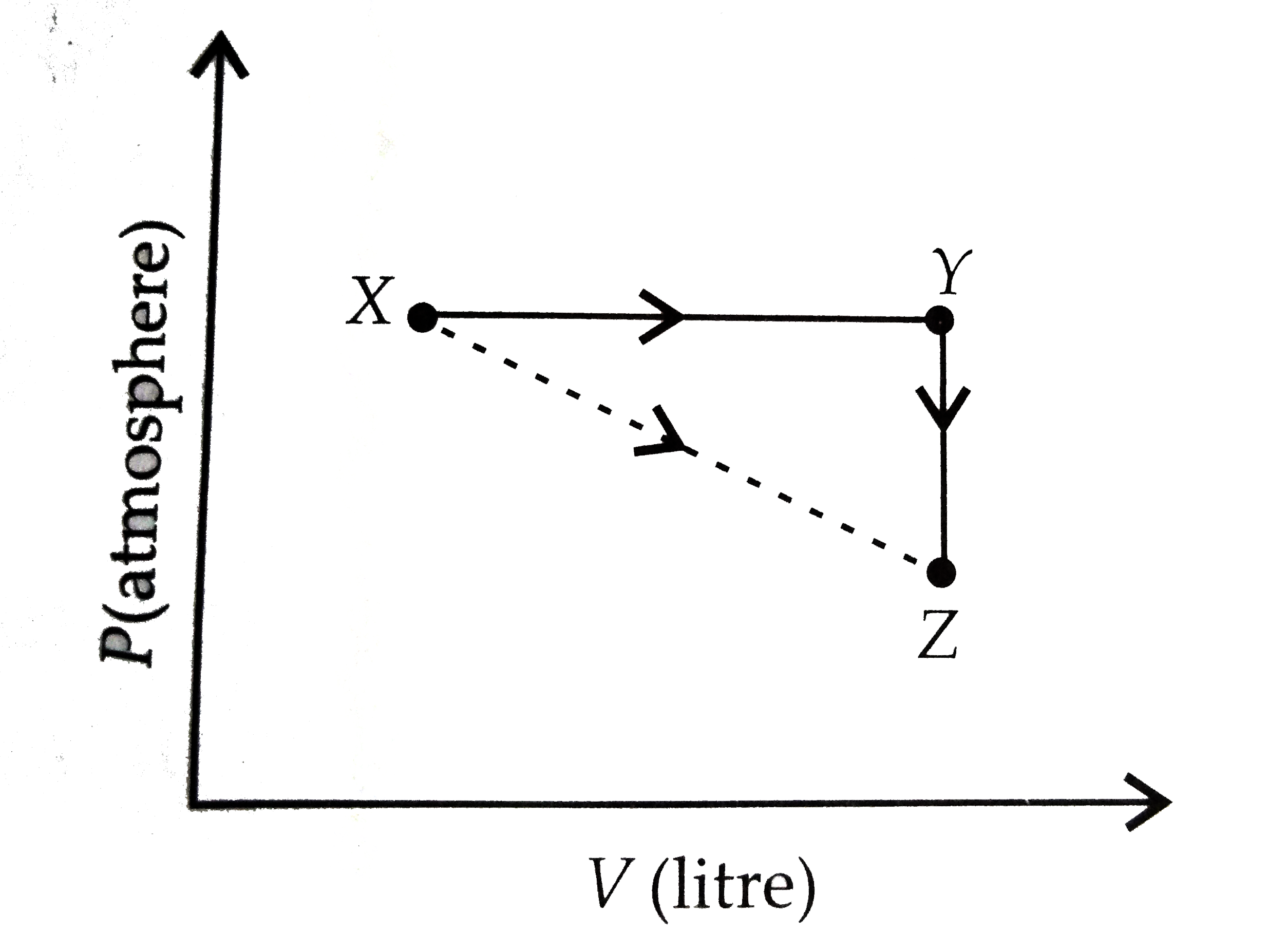
For an ideal gas, consider only P-V work in going from an initial state X to the final state Z. The final state Z can be reached by either of the two paths shown in the figure. Which of the following choice(s) is(are) correct? [Take `DeltaS` as change in entropy and w as work done]

A

1,2

B

1,3

C

2,3

D

1,2,3

Text Solution

Verified by Experts

The correct Answer is:

B
Promotional Banner

Similar Questions

Explore conceptually related problems

An ideal gas is taken from an initial state i to a final state f in such a way that the ratio of the pressure to the absolute temperature remains constant. What will be the work done by the gas ?

P - V diagram of an ideal gas is shown. The gas undergoes from initial state A to final state B such that initial and final volumes are same. Select the correct alternative for given process AB.

A system can be taken from the initial state p_(1),V_(1) to the final state p_(2,V_(2) by two different methods, let DeltaQ and DeltaW represent the heat given to the system and the work done by the system. Which of the following must be the same in both the method?

shows three paths through which a gas can be taken from the state A to the state B. calculate the work done by the gas in each of the three paths.

An ideal gas change from state a to state b as shown in Fig. what is the work done by the gas in the process?

An ideal gas can be taken form initial state 1 to final state 2 by two different process. Let DeltaQ and W represent the heat given and work done by the system. Then which quantities is/are same in both process (where DeltaU = internal energy of gas)

When a sample of ideal gas is changed from an initial state to a final state, various curves can be plotted for the process like P-V curve, V-T curve,P-T curve etc. For example, P-V curve for a fixed amount of an ideal gas at constant temperature is a rectangular hyperbola, V-T curve for a fixed amount of an ideal gas at constant volume is again a straight line. However, the shapes may vary if the constant parameters are also changed. Now, answer the following questions : Which of the following graphs is not possible for a fixed amount of ideal gas upon moving from initial state A to final state B :

An ideal gas is undergoing a cyclic thermodynamic process in different ways as shown in the corresponding P-V diagrams in column 3 of the table. Consider only the path from state 1 to state 2. W denotes the corresponding work done on the system. The equations and plots in the table have standard notations as used in thermodynamic process. Here is the ratio of heat capacities at constant pressure and constant volume. The number of moles in the gas in n. Which of the following options is the only correct representation of a process in which Delta U = Delta Q - P Delta V ?

1 mol of a gas is changed from its initial state (15 L, 2 atm) to final state (4 L, 10 atm) . If this change can be represented by a straight line in P-V curve, calculate the maximum temperature that, the gas attained.

When an ideal gas is taken from state a to b , along a path acb, 84 kJ of heat flows into the gas and the gas does 32 kJ of work. The following conclusions are drawn. Mark the one which is not correct.
