Home
Class 12
PHYSICS
Consider a concave mirror and a convex l...

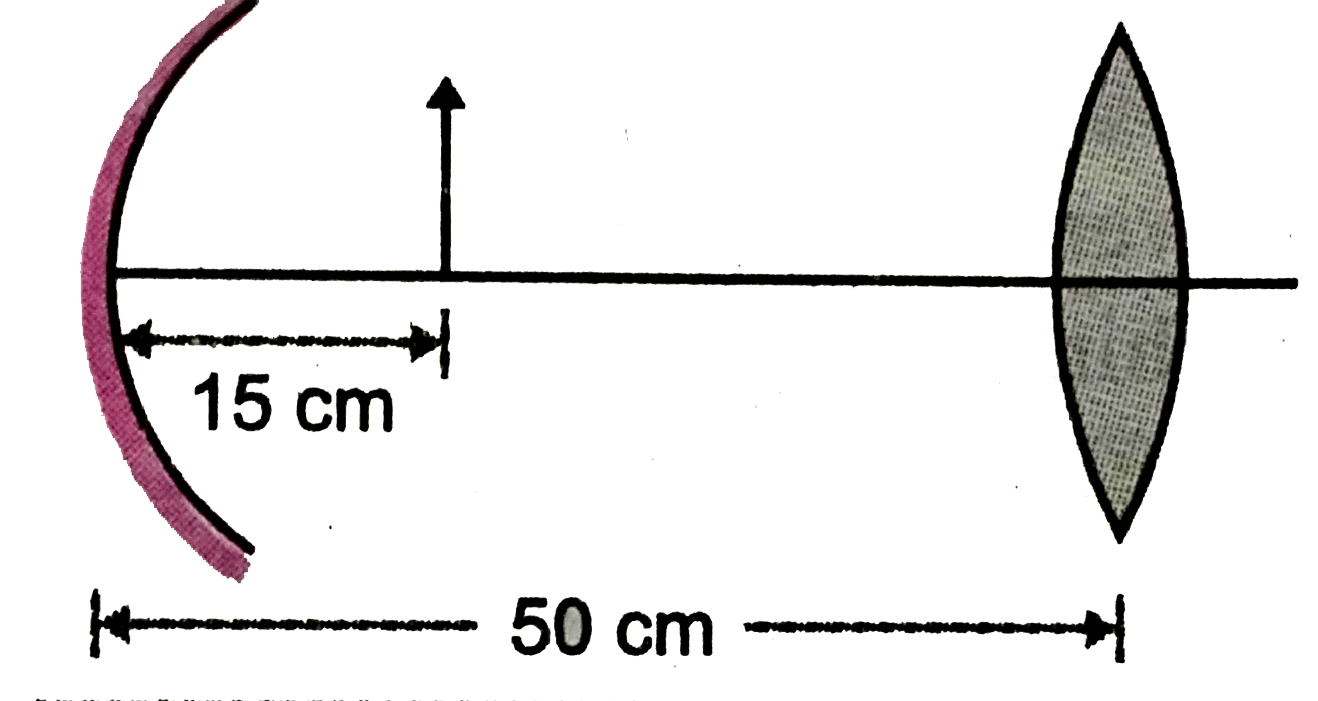
Consider a concave mirror and a convex lens (refractive index 1.5) of focal length `10 cm` each separated by a distance of `50 cm` in air (refractive index = 1) as shown in the Fig. An object is placed at a distance of `15 cm` from the mirror. Its erect image formed by this combination has magnification `M_1`. When this set up is kept in a medium of refractive index `7//6`, the magnification becomes `M_2`. The magnitude `((M_2)/(M_1))` is :
.

A

7

B

5

C

3

D

6

Text Solution

Verified by Experts

The correct Answer is:

A
Promotional Banner

Similar Questions

Explore conceptually related problems

Focal length of a convex lens of refractive index 1.5 is 2 cm. Focal length of lens when immersed in a liquid of refractive index 1.25 will be

An object is placed at a distance of 30 cm from a concave mirror and its real image is formed at a distance of 30 cm from the mirror. The focal length of the mirror is

A thin lens of refractive index 1.5 has focal length of 15 cm in air. When the lens is placed is a medium of refractive index (4)/(3), its focal length will become …..cm.

A double convex lens made of glass of refractive index 1.56 has both radii of curvature of magnitude 20 cm . If an object is placed at a distance of 10 cm from this lens, find the position of image formed.

A concave mirror and a convex mirror of focal lengths 10cm and 15cm are places at a distance of 70cm. An object AB of height 2cm is places at a distance of 30cm from the concave mirror. First ray is incident on the concave mirror then on the convex mirror. Find size, position, and nature of the image.

A thin convex lens of refractive index 1.5cm has 20cm focal length in air. If the lens in completely immersed in a liquid of refractive index. 1.6, then its focal length will be

A convex lens of refractive index 1.5 has a focal length of 20 cm in air. Calculate the change in its focal length when it is immersed in water of refractive index 4/3.

An image is formed at a distance of 100 cm from the glass surface with refractive index 1.5, when a point object is placed in the air at a distance of 100 cm from the glass surface. The radius of curvature is of the surface is

A point object O is placed at a distance of 20 cm is front of a equiconvex lens (.^(a)mu_(g) = 1.5) of focal length 10 cm. The lens is placed on a liquid of refractive index 2 as shown in figure. Image will be formed at a distance h from lens the value of h is

A biconvex lens of focal length 20cm, made of glass or refractive index 1.5, has water (mu=1.33) on one side and air on the other. An object is placed 15 cm form the lens on the side with water. Where is the image formed?
