Home
Class 12
PHYSICS
Consider two solid sphere of radii R(1)=...

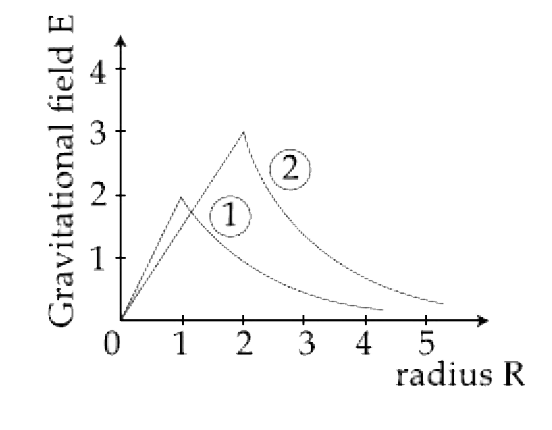
Consider two solid sphere of radii `R_(1)=1m, R_(2)=2m` and masses `M_(1) and M_(2)`, respectively. The gravitational field due to sphere 1 and 2 are shown. The value of `(M_(1))/(M_2))` is:

A

`3/2`

B

`1/6`

C

`1/2`

D

`1/3`

Text Solution

Verified by Experts

The correct Answer is:

B
Promotional Banner

Similar Questions

Explore conceptually related problems

The figure represents two concentric shells of radii R_(1) and R_(2) and masses M_(1) and M_(2) respectively. The gravitational field intensity at the point A at distance a (R_(1) lt a lt R_(2)) is

Two spherical bodies of mass m_1 & m_2 are having radius 1 m & 2 m respectively. The gravitational field of the two bodies with their radial distance is shown below. The value of (m_1)/(m_2) is -

Two concentric spherical shells of masses and radii m_(1), r_(1) and m_(2), r_(2) respectively are as shown. The gravitational field intensity at point P is

Two bodies of masses m_1 and m_2(

The gravitational field due to an uniform solid sphere of mass M and radius a at the centre of the sphere is

Two concentric shells of masses M_(1) and M_(2) are concentric as shown. Calculate the gravitational force on m due to M_(1) at points P,Q and R .

Two planets of radii R_(1) and R_(2 have masses m_(1) and M_(2) such that (M_(1))/(M_(2))=(1)/(g) . The weight of an object on these planets is w_(1) and w_(2) such that (w_(1))/(w_(2))=(4)/(9) . The ratio R_(1)/R_(2)

The slope of graph as shown in figure at points 1,2 and 3 is m_(1), m_(2) and m_(3) respectively then

Assertion : The centres of two cubes of masses m_(1) and m_(2) are separated by a distance r. The gravitational force between these two cubes will be (Gm_(1)m_(2))/(r^(2)) Reason : According to Newton's law of gravitation, gravitational force between two point masses m_(1) and m_(2) separated by a distance r is (Gm_(1)m_(2))/(r^(2)) .

A planet of mass M, has two natural satellites with masses m1 and m2. The radii of their circular orbits are R_(1) and R_(2) respectively. Ignore the gravitational force between the satellites. Define v_(1), L_(1), K_(1) and T_(1) to be, respectively, the orbital speed, angular momentum, kinetic energy and time period of revolution of satellite 1 , and v_(2), L_(2), K_(2) and T_(2) to be he corresponding quantities of satellite 2. Given m_(1)//m_(2) = 2 and R_(1)//R_(2) = 1//4 , match the ratios in List-I to the numbers in List-II.
