Home
Class 12
CHEMISTRY
If the reactivity factor for chlorine su...

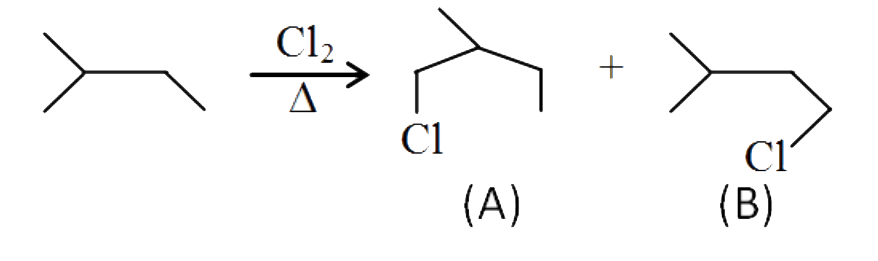
If the reactivity factor for chlorine substitution through free radical by abstracting a primary H - atom is 1 then the ratio of the amount of product A and B is -

A

`1:1`

B

`1:2`

C

`2:1`

D

`3:1`

Text Solution

Verified by Experts

The correct Answer is:

C
Promotional Banner

Similar Questions

Explore conceptually related problems

It we see the reaction of methane with halogen, the rate determining step for chlorination is, endothermic reaction of the chlorine atom with methane to form methyl radical and a molecule of HCl. So free radical is the intermediate of the reaction. Formation of free radical depends upon the energy required to break a bond between a hydrogen atom and a carbon atom. Chlorination of propane and Bromination of propane. when compared it is found that bromination is more selective than chlorination. The probability factor for 3^(@),2^(@),1^(@)H atom is 5.0:3.8:1.0 at 25^(@)C for chlorination. Isobutane when reacts with chlorine in presence of ultra violet radiations yield 2 products primary hydrogen substituted and 3^(@) hydrogen substituted Find their % in product mixture

The pre-exponential factor for the free radical addition of chloring is 2xx10^(13)s^(-1) . Find the rate constant of this reaction at STP .

A plane II passes through the point (1,1,1).If b,c,a are the direction ratios of a normal to the plane where a,b,c(altbltc) are the prime factors of 2001, then the equation of the plane II is

A sample contains 10^(-2)kg each of two substances A and B with half lives 4 sec and 8 sec respectively. Their atomic weights are in the ratio 1:2 . Find the amounts of A and B after an interval of 16 seconds.

Through a coil of resistance R charge is flowing in such a manner that in every time interval t_(0) the amount of charge flow is reduced by a factor of 1//2 . If a total of q charge flows through the coil in very long time, then the total amount of heat generated in the coil will be

A curve passing through (1, 0) is such that the ratio of the square of the intercept cut by any tangent on the y-axis to the Sub-normal is equal to the ratio of the product of the Coordinates of the point of tangency to the product of square of the slope of the tangent and the subtangent at the same point, is given by

Calculate the ratio of the radius of 1^(st) orbit of H atom to that of 4^(th) orbit. Hint : r_(n) prop ( n)^(2)

"Equivalent mass" =("Molecular mass/Atomic mass" )/("n-factor") n-factor is very important in redox as well as non-redox reactions.With the help of n-factor we can predict the molar ratio of the reactant species specis taking part in reactions. The reciprocal of n-factor's ratio of the reactions is the molar ratio of the reactants. In general n-factor of acid/base is number of moles of H^(+)//OH^(-) furnished per mole of acid/base n-factor of a reactant is number of moles electrons lost or gained per mole of reactant. Example 1: (1)In acidic medium : KMnO_(4) (n=5)to Mn^(2+) (2) In neutral medium : KMnO_(4)(n=3) to Mn^(2+) (3) In basic medium : KMnO_(4)(n=1) to Mn^(6+) Example 2 : FeC_(2)O_(4)to Fe^(3+)+2CO_(2) Total number of moles e^(-) lost by 1 mole of FeC_(2)O_(4) =1+1xx2 implies 3 Consider the following reaction. H_(3)PO_(2)+NaOH to NaH_(2)PO_(2)+H_(2)O What is the equivalent mass of H_(3)PO_(2) ?(mol.Wt.is M)

Which of the following alkanes is the least reactive towards free-radical substitution reactions ?
