Home
Class 12
PHYSICS
A 90^@ corner is made from a transparen...

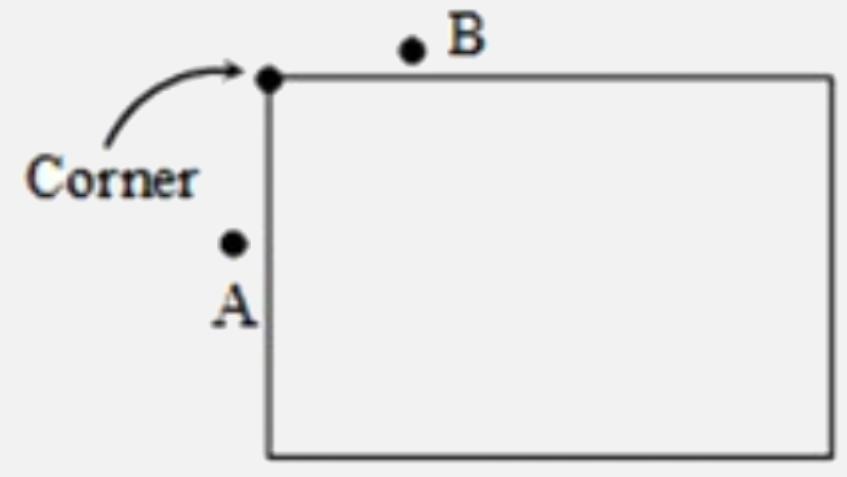
A `90^@` corner is made from a transparent optical material with a refractive index such that A cannot see B when he is standing behind the corner. Minimum value of refractive index is

A

`sqrt(3)`

B

`sqrt(2)`

C

`sqrt(5)`

D

`sqrt(7)`

Text Solution

Verified by Experts

The correct Answer is:

B
Promotional Banner

Similar Questions

Explore conceptually related problems

A thin lens made of a material of refractive index mu_(0) has a focal length f_(0) in air. Find the focal length of this lens if it is immersed in a liquid of refractive index mu .

Refractive index of a transparent material is :

The refractive index of the material of prism sqrt3, then the angle of minimum deviation of prism is

A lens is made of flint glass (refractive index =1.5 ). When the lens is immersed in a liquid of refractive index 1.25 , the focal length:

A hollow sphere made of a transparent material of refractive index 1.5 has a small mark on its surface as shown. The mark is observed from the farther side. Find the distance of the image of mark from the centre of the sphere.

A thin prism of 6^(@) is made of material of refractive index 5/3 . The deviation caused by it is

An equilateral glass prism has a refractive index 1.6 in air. Calculate the angle of minimum deviation of the prism when kept in a medium of refractive index (4sqrt(2))/(5) .

Two transparent slabs have the same thickness as shown in figure. One in made of material A of refractive index 1.5. The other is made of two materilas B and C with thickness in the ratio 1:2. The refractive index of C is 1.6. If a monochromatic parallel beam passing through the slabs has the same number of wavelengths inside both, the refractive index of B is

A double convex thin lens made of glass of refractive index 1.6 has radii of curvature 15 cm each. The focal length of this lens when immersed in a liquid of refractive index 1.63 is :

A diverging lens is made of material with refractive index 1.3 and has identical concaves surfaces of radius 20 cm. The lens is immersed in a transparent medium with refractive index 1.8. (a) What is now the focal length of the lens? (b) What is the minimum distance taht an immersed object must be from the lens so that a real image is formed?
