Home
Class 12
PHYSICS
Two identical blocks each of mass 1kg ar...

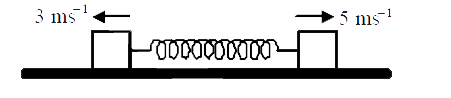
Two identical blocks each of mass 1kg are joined together with a compressed spring. When the system is released the two blocks appear to be moving with unequal speeds in the opposite directions as shown in fig.

Choose the correct statement -

A

it is not possible

B

whatever may be the speed of the blocks the centre of mass will remain stationary

C

the centre of mass of the system is moving with a velocity of `2 ms ^(-1)`

D

the centre of mass of the system is moving with a velocity of `1 ms ^(-1)`

Text Solution

Verified by Experts

The correct Answer is:

D
Promotional Banner

Similar Questions

Explore conceptually related problems

Two blocks A and B are joined together with a compressed spring. When the system is released, the two bloks appear to be moving with unequal speeds in the opposite directions as shown in figure. Select incorrect statements(s) :

Two unequal masses are ties together with a cord with a compressed spring in between. Which one is correct?

Two identical blocks A and B of mass m joined together with a massless spring as shown in figure are placed on a smooth surface. If the block A moves with an acceleration a_0 , then the acceleration of the block B is

Two unequal masses are ties together with a cord with a compressed spring in between. When the cord is burnt with a match releasing the spring, the two masses fly apart with equal

Choose the correct option: A small block of mass 'm' is placed on bigger block of mass M_(1) which is placed on a frictionless horizontal surface. The two blocks are given equal speed u_(1) but opposite directions, as shown in the figure. After sometime, it is observed that both blocks are moving in the direction of motion of the lower block, with a speed greater than (u)/(2) . It can be concluded that -

Two unequal masses are tied together with a cord with a compressed spring in between. The cord is burned. Which of the following energies is conserved for the system?

Two identical blocks A and B of mass m each are connected to each other by spring of spring constant k. Block B is initially shifted to a small distance x_(0) to the left and then released. Choose the correct statements for this problem, after the spring attains it's natural length.

Two blocks each of mass m are joined together using an ideal spring of force constant K and natural length l_(0) . The blocks are touching each other when the system is released from rest on a rough horizontal surface. Both the blocks come to rest simultaneously when the extension in the spring is (l_(0))/4 . The coefficient of friction between each block and the surface (assuming it to be same between any of the blocks and the surface) is :

Two blocks each of mass m are joined together using an ideal spring of force constant K and natural length l_(0) . The blocks are touching each other when the system is released from rest on a rough horizontal surface. Both the blocks come to rest simultaneously when the extension in the spring is (l_(0))/4 . The coefficient of friction between each block and the surface (assuming it to be same between any of the blocks and the surface) is :

Two identical blocks each of mass M=9kg are placed on a rough horizontal surface of frictional coefficient mu=0.1 . The two blocks are joined by a light spring and block B is in contact with a vertical fixed wall as shown in figure. A bullet of mass m=1kg and v_0=10m//s hits block A and gets embedded in it. Find the maximum compression of spring. (Spring constant =240N//m, g=10m//s^2 )
