Home
Class 12
PHYSICS
Two identical balls A and B are released...

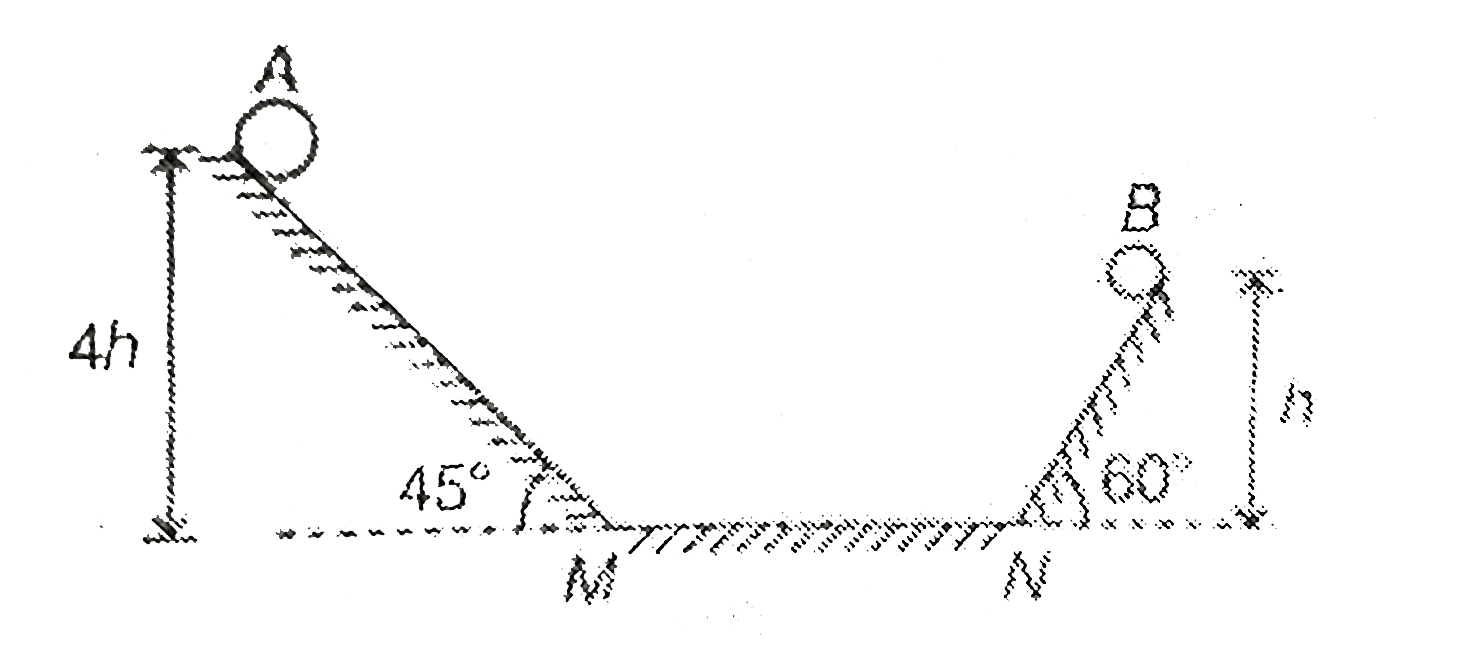
Two identical balls A and B are released from the positions shown in figure . They collide elastically on horizontal portion MN . The ratio of heights attained by A and B after collision will be (neglect friction)

A

`1:4`

B

`2:1`

C

`4:13`

D

`2:5`

Text Solution

Verified by Experts

The correct Answer is:

C
Promotional Banner

Similar Questions

Explore conceptually related problems

Two identical balls A and B are released from the position shown in Fig. They collide elastically with each other on the horizontal portion. The ratio of heights attained by A and B after collision is (neglect friction)

Two identical balls A and B are released from the position shown in Fig. They collide elastically with each other on the horizontal portion. The ratio of heights attained by A and B after collision is (neglect friction)

Two identiacal balls A and B having velocities of 0.5 m/s and 0.3" m"//"s" respectively collide elastically in one dimension. The velocities of B and A after the collision respectively will be

Two identical balls A and B moving with velocities + 0.5 m/s and -0.3 .m/s respectively collide head-on elastically. The velocities of the ball A and B after collision will be respectively

Two identical balls A and B having velocity of 0.5 m//s and -0.3 m//s respectively collide elastically in one dimension. The velocities of B and A after the collision respectively will be

A small ball of mass m moving with speed v collides elastically with a simple pendulum with bob of mass m at rest. The maximum height attained by the bob after collision is

A ball is released from point A as shown in figure. The ball leaves the track at B. All surfaces are smooth. If track makes an angle 30^(@) with horizontal at B, then maximum height attained by ball will be

A ball is released from point A as shown in figure. The ball leaves the track at B. All surfaces are smooth. Let h be the maximum height from ground reached by ball after leaving track at B. Then,

Two identical balls are dropped from the same height onto a hard surface, the second ball being released exactly when the first ball bollides with the surface. If the first ball has made two more collisions by the time the second one collides. Then the coefficient of restitution between the ball and the surface satisfies :

A ball of mass 'm is released from the top of a smooth movable wedge of mass 'm'. When the ball collides with the floor, velocity is 'v'. Then the maximum height attained by the ball after an elastic collision with the floor is : (Nelect any edge at the lower end of the wedge)
