Home
Class 12
PHYSICS
The variation of photocurrent with colle...

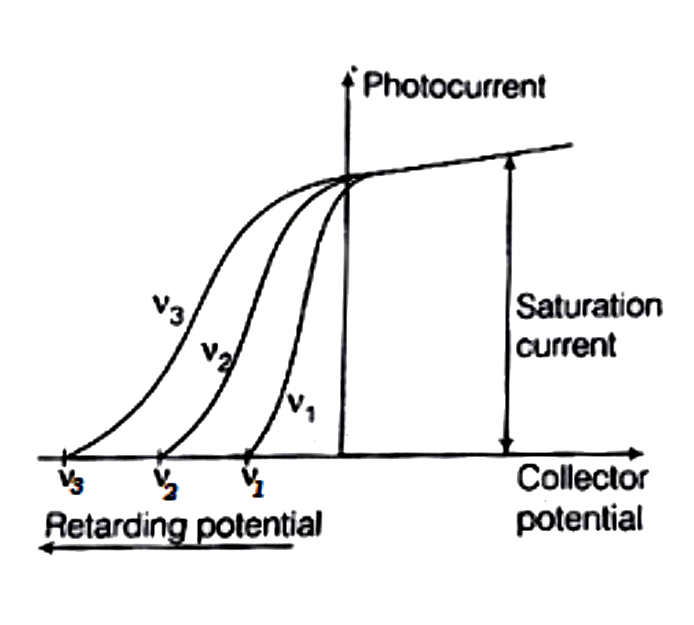
The variation of photocurrent with collector potential for different frequencies of incident radiation `v_1,v_2,v_3` is as shown in the the graph , then

A

`v_1=v_2=v_3`

B

`v_1gtv_2gtv_3`

C

`v_1ltv_2ltv_3`

D

`v_3=(v_1+v_2)/2`

Text Solution

Verified by Experts

The correct Answer is:

C
Promotional Banner

Similar Questions

Explore conceptually related problems

Draw a plot showing the variation of photoelectric current with collector plate potential for two different frequencies, v_1gtv_2 of incident radiation having the same intensity. In which case will the stopping potential be higher? Justify your answer.

The slope of the graph drawn between stopping potential and frequency of incident radiation will be

The figure shows a plot of three curves a, b, c, showing variation of photocurrent vs collector plate potential for three different intensities I_(1), I_(2) and I_(3) having frequencies v_(1), v_(2) and v_(3) respectively incident on a photosensitive surface. Point out the two curves for which the incident radioations have same frequency but different intensities.

What is the photoelectric effect? With the help of suitable graph show the variation of photocurrent with (i) the intensity of incident radiation. (ii) the voltage applied between cathode and anode. (iii) the frequency of incident radiation.

From the following graph of photocurrent against collector plate potential for two different intensities of light I_1 and I_2 one can , conclude

In photoelectric effect , the curve between photoelectric current and anode potential V (for different frequencies ) is shown in figure , then

(i) Plot a labelled graph of |V_(s)| where V_(s) is stopping potential versus frequency f of the incident radiation. (ii) State how will you use this graph to determine the value of Planck.s constant.

The graph shows variation of stopping potential V_(0) versus frequency of incident radiation v for two photosensitive metals A and B . Which of two metals has higher threshold frequency and why?

Sketch the graphs, showing the variation of stopping potential V_s with frequency v of the incident radiations for two photosensitive materials A and B having threshold frequencies v_0gtv'_0 respectively. (i) which of the two metals A or B has higher work function? (ii) What information do you get from the slope of the graphs? (iii) What does the value of the intercept of graph A on the potential axis represent?
