Home
Class 12
PHYSICS
The ends of a rod of length l and mass ...

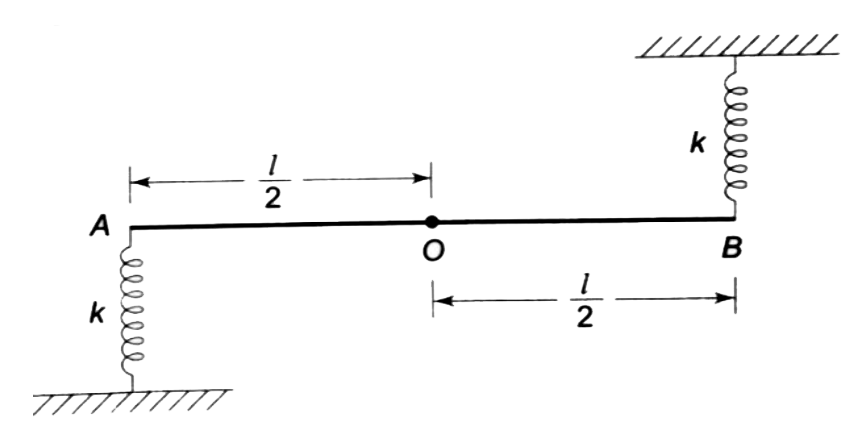
The ends of a rod of length l and mass m are attached to two identical springs as shown in the figure. The rod is free to rotate about its centre O . The rod is depressed slightly at end A and released . The time period of the oscillation is

A

`2pisqrt(m/(2k))`

B

`2pisqrt(2m/(k))`

C

`pisqrt(2m/(3k))`

D

`pisqrt(3m/(2k))`

Text Solution

Verified by Experts

The correct Answer is:

C
Promotional Banner

Similar Questions

Explore conceptually related problems

There is a rod of length l and mass m . It is hinged at one end to the ceiling. The period of small oscillation is

A uniform rod of length l and mass M is pivoted at the centre. Its two ends are attached to two ends are attached to two springs of equal spring constant k. the springs are fixed to rigid support as shown in figure and the rod is free to oscillate in the horizontal plane. the rod is gently pushed through a small angle theta in one direction and released. the frequency of oscillation is

A rod of mass m and length L is kept on a horizontal smooth surface. The rod is hinged at its one end A . There are two springs, perpendicular to the rod, kept in the same horizontal plane. The spring of spring constant k is rigidly attached to the lower end of rod and spring of spring constant 12k just touches the rod at its midpoint C , as shown in the figure. If the rod is slightly displaced leftward and released then, the time period for small osciallation of the rod will be

A uniform rod of length L and mass m is free to rotate about a frictionless pivot at one end as shown in figure. The rod is held at rest in the horizontal position and a coin of mass m is placed at the free end. Now the rod is released The reaction on the coin immediately after the rod starts falling is

A massless rod S having length 2l has equal point masses attached to its two ends as shown in figure. The rod is rotating about an axis passing through its centre and making angle alpha with the axis. The magnitude of change of momentum of rod i.e., |(dL)/(dt)| equals

A uniform rod of mass m and length l is fixed from Point A , which is at a distance l//4 from one end as shown in the figure. The rod is free to rotate in a vertical plane. The rod is released from the horizontal position. What is the reaction at the hinge, when kinetic energy of the rod is maximum?

A uniform rod of mass m and length L is hinged at one of its end with the ceiling and another end of the rod is attached with a thread which is attached with the horizontal ceiling at point P. If one end of the rod is slightly displaced horizontally and perpendicular to the rod and released. If the time period of small oscillation is 2pisqrt((2lsintheta)/(xg)) . Find x.

A horizontal rod of mass M and length L is tied to two verticle string symmetrically as shown in the figure. One of the strings at end Q is cut at t=0 and the rod starts rotating about the other and P then

A uniform rod of length l and mass m is free to rotate in a vertical plane about A as shown in Fig. The rod initially in horizontal position is released. The initial angular acceleration of the rod is

A metal rod of length 'L' and mass 'm' is pivoted at one end. A thin disc of mass 'M' and radius 'R' (ltL) is attached at its center to the free end of the rod. Consider two ways the disc is attached : (case A). The dise is not free to rotate about its centre and (case B) the disc is free to rotate about its centre. The rod disc system perfoms (SHM) in vertical plane after being released from the same displacement position. Which of the following statement (s) is (are) true ? .
