Home
Class 12
PHYSICS
A conductor of length L is placed along ...

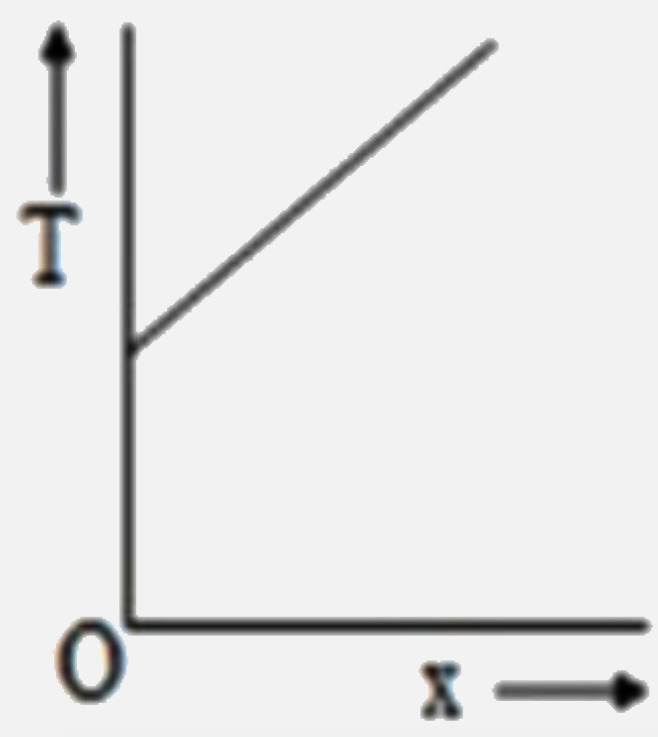
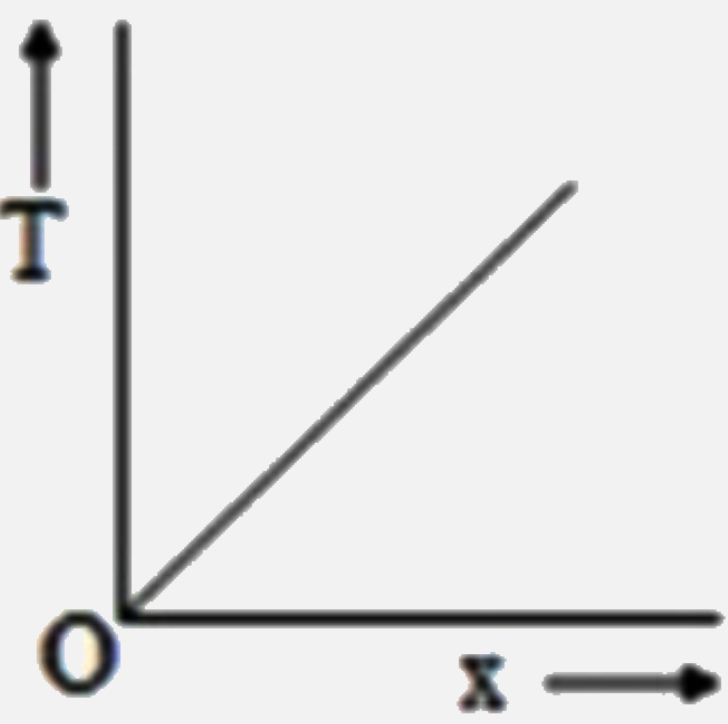
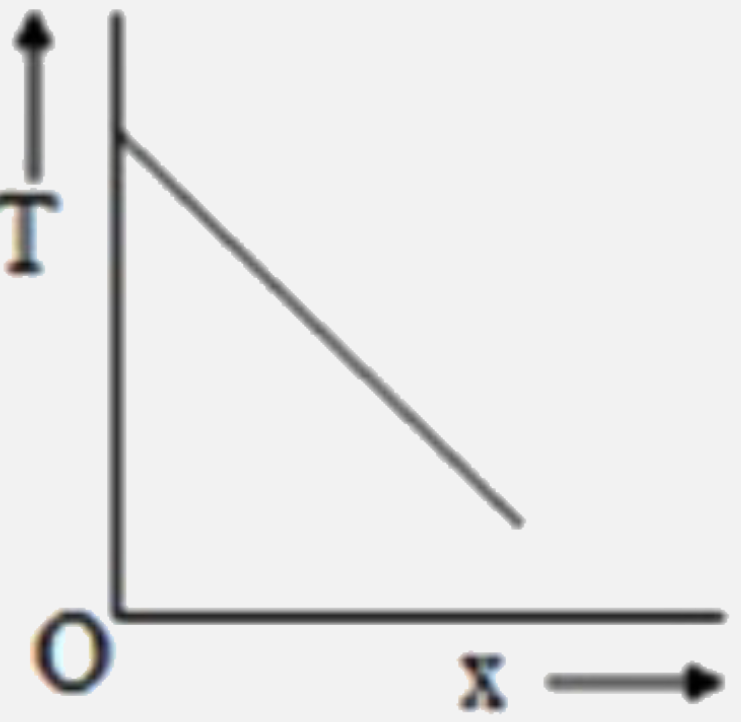
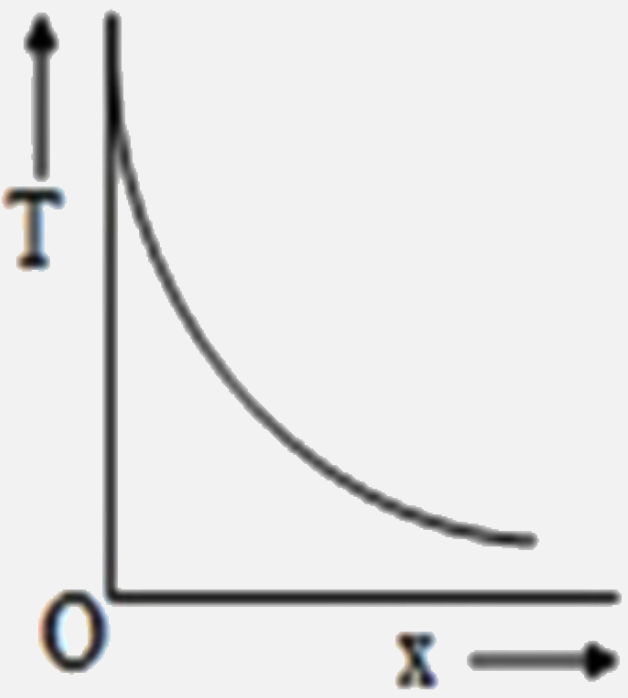
A conductor of length L is placed along the x - axis , with one of its ends at x = 0 and the other at x = L. If the rate of flow of heat energy through the conduct is constant and its thermal resistance per unit length is also constant , then Which of the following graphs is/are correct ?

A

B

C

D

Text Solution

AI Generated Solution

The correct Answer is:

To solve the problem, we need to analyze the situation of heat transfer through a conductor and how it relates to temperature distribution along the length of the conductor. ### Step-by-Step Solution: 1. **Understanding the Setup**: - We have a conductor of length \( L \) placed along the x-axis, with one end at \( x = 0 \) and the other at \( x = L \). - The rate of heat flow (H) through the conductor is constant, and the thermal resistance per unit length is also constant. 2. **Heat Transfer Equation**: - The rate of heat transfer \( H \) can be expressed using Fourier's law of heat conduction: \[ H = K A \frac{dT}{dx} \] where: - \( K \) is the thermal conductivity, - \( A \) is the cross-sectional area, - \( \frac{dT}{dx} \) is the temperature gradient. 3. **Constant Thermal Resistance**: - The thermal resistance \( R \) of the conductor can be defined as: \[ R = \frac{L}{K A} \] - Given that the thermal resistance per unit length is constant, it implies that \( K A \) is also constant. 4. **Finding the Temperature Gradient**: - Since \( H \) is constant and \( K A \) is constant, it follows that \( \frac{dT}{dx} \) must also be constant. - Therefore, we can express this as: \[ \frac{dT}{dx} = -\text{constant} \] - The negative sign indicates that as \( x \) increases, the temperature \( T \) decreases. 5. **Graphical Representation**: - The relationship \( \frac{dT}{dx} = -\text{constant} \) implies that the temperature \( T \) decreases linearly with \( x \). - This results in a straight line graph with a negative slope. 6. **Conclusion**: - The correct graph representing the temperature distribution along the conductor will show a straight line with a negative slope, indicating a linear decrease in temperature from \( T(0) \) at \( x = 0 \) to \( T(L) \) at \( x = L \).
Promotional Banner

Similar Questions

Explore conceptually related problems

When a steel wire fixed at one end is pulled by a constant force F at its other end , its length increases by l.Which of the following statements is not correct?

A straight rod of length L has one of its end at the origin and the other at X=L . If the mass per unit length of the rod is given by Ax where A is constant, where is its centre of mass?

A straight rod of length L has one of its end at the origin and the other at X=L . If the mass per unit length of the rod is given by Ax where A is constant, where is its centre of mass?

A straight rod of length L has one of its end at the origin and the other at X=L . If the mass per unit length of the rod is given by Ax where A is constant, where is its centre of mass?

A thin rod of length L is lying along the x-axis with its ends at x=0 and x=L its linear (mass/length) varies with x as k(x/L)^n , where n can be zero of any positive number. If to position x_(CM) of the centre of mass of the rod is plotted against 'n', which of the following graphs best apporximates the dependence of x_(CM) on n?

A conductor is made of an isotropic material and has shape of a truncated cone. A battery of constant emf is connected across it and its left end is earthed as shown. If at a certain section at a distance x form left end, electric field intensity and the rate of generation of heat per unit length are E and H respectively, which of the following graphs is (are) correct?

A rod of length 'l' is placed along x-axis. One of its ends is at the origin. The rod has a non-uniform charge density lambda= a, a being a positive constant. Electric potential at P as shown in the figure is -

A rod of length l is placed along x - axis. One of its ends is at the origin. The rod has a non - uniform charge density lambda=(a)/(x) , a being a positive constant. The electric potential at the point P (origin) as shown in the figure is

A rod length L and mass M is placed along the x -axis with one end at the origin, as shown in the figure above. The rod has linear mass density lamda=(2M)/(L^(2))x, where x is the distance from the origin. Which of the following gives the x -coordinate of the rod's center of mass?

Two conductors made of the same material have lengths L and 2L but have equal resistance. The two are connected in series in a circuit which current is flowing. Which of the following is/are correct?
