Home
Class 12
PHYSICS
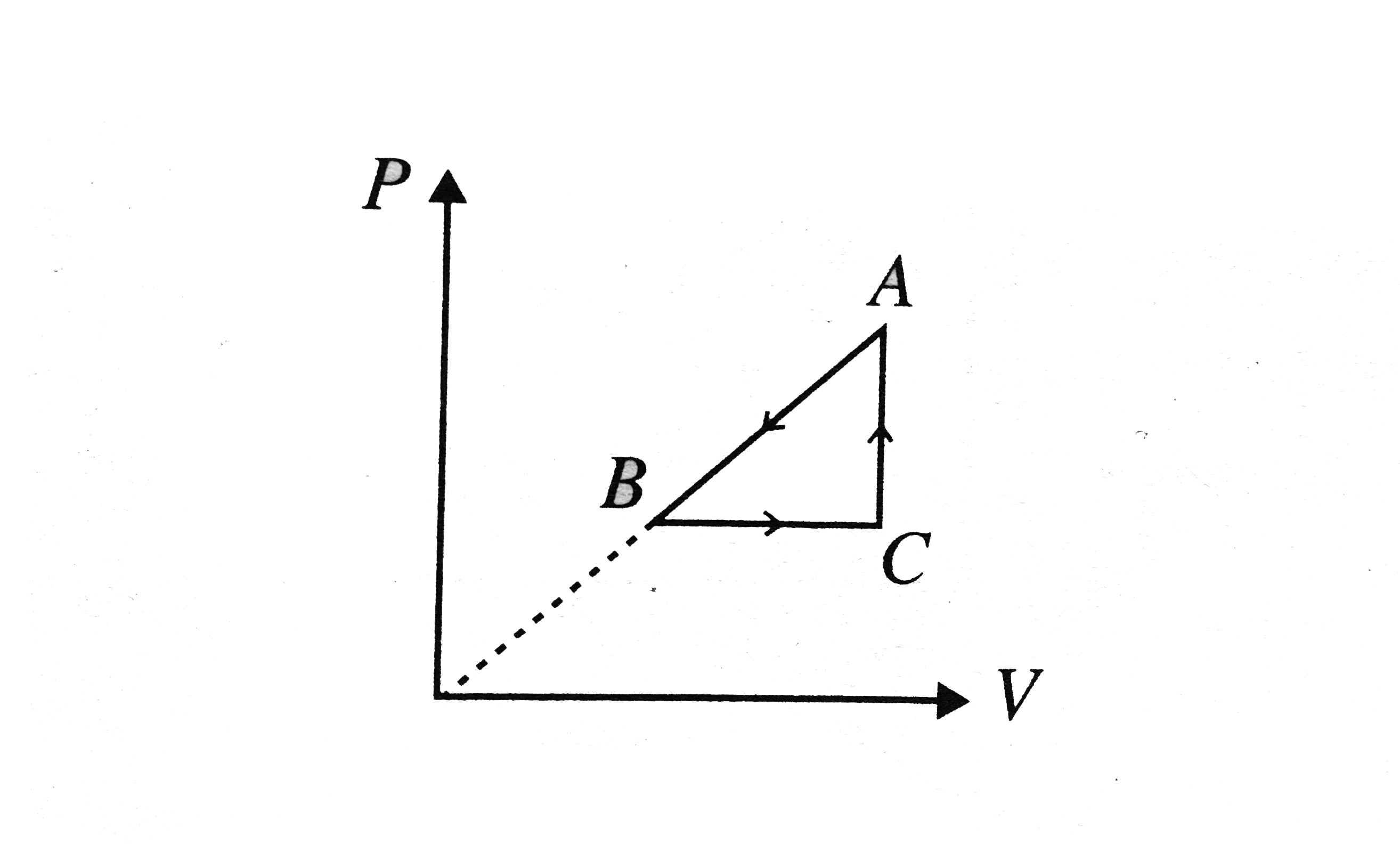
P - V diagram of a cyclic process ABCA i...

`P - V` diagram of a cyclic process `ABCA` is as shown in Fig. Choose the correct alternative

(A)`Delta Q_(ArarrB)=` negative (B)`Delta U_(BrarrC)=` positive (C)`DeltaU_(CrarrA)=` negative (D)`DeltaW_(CAB)=` negative

A

`DeltaQ _(ArarrB)` is negative

B

`DeltaU_(BrarrC)` is positive

C

`DeltaW_(CAB)` is negative

D

all of these

Text Solution

Verified by Experts

The correct Answer is:

D
Promotional Banner

Similar Questions

Explore conceptually related problems

In the (p - V) diagram shown in figure, choose the correct options for the the process (a - b) : .

A point charge Q is placed at the point O as shown in Fig. Is the potential difference (V)_(A) - V_(B)) positive, negative or zero if Q is (i) positive (ii) negative ?

A point charge Q is placed at the point O as shown in Fig. Is the potential difference (V)_(A) - V_(B)) positive, negative or zero if Q is (i) positive (ii) negative ?

If a, b, c are positive and unequal, show that value of the determinant Delta=|a b c b c a c a b| is negative.

Which of the following is true during adsorption? a. DeltaG , DeltaH , and DeltaS all are negative. b. DeltaG is negative, but DeltaH and DeltaS is positive. c. DeltaG and DeltaH are negative, but DeltaS is positive. d. DeltaG and DeltaS are negative, but DeltaH is positive.

An ideal gas undergoes an expansion from a state with temperature T_(1) and volume V_(1) through three different polytropic processes A, B and C as shown in the P - V diagram. If |Delta E_(A)|, |Delta E_(B)| and |Delta E_(C )| be the magnitude of changes in internal energy along the three paths respectively, then :

Apply the first law of thermodynamics to a resistor carrying a current i . Identify which of the quantities DeltaQ , Delta U and DeltaW are zero, wheich are positive and which are negative.

Chemical reactions are invariably associated with the transfer of energy either in the form of hear or light. In the laboratory, heat changes in physical and chemical processes are measured with an instrument called calorimeter. Heat change in the process is calculated as: q= ms Delta T , s= Specific heat = c Delta T = Heat capacity. Heat of reaction at constant pressure is measured using simple or water calorimeter. Q_(v)= Delta U = Internal energy change, Q_(P) = DeltaH, Q_(P) = Q_(V) + P Delta V and DeltaH = Delta U+ Delta nRT . The amount of energy released during a chemical change depends on the physical state of reactants and products, the condition of pressure, temperature and volume at which the reaction is carried out. The variation of heat of reaction with temperature and pressure is given by Kirchoff's equation: (DeltaH_(2) - DeltaH_(1))/(T_(2)-T_(1))= Delta C_(P) (At constant pressure), (DeltaU_(2) - DeltaU_(1))/(T_(2)-T_(1)) = DeltaC_(V) (At constant volume) The enthalpy change (DeltaH) for the reaction N_(2) (g) + 3H_(2)(g) rarr 2NH_(3)(g) is -92.38kJ at 298 K. The internal energy change DeltaU at 298 K is

Consider a box with three terminals on top of it as shown in figure. Three components namely, two germanium diodes and one resistor are connected across these three terminals in some arrangement A student performs an experiment in which any two of these three terminals are connected in the circuit shown in figure. The student obtains graphs of current-voltage characteristics for unknown combination of components between the two terminals connected in the circuit. The graphs are (i) When A is positive and B is negative (ii) When A is negative and B is positive (iii) When B is negative and C is positve (iv) When B is positive and C is neagtive (v) When A is positive and C is negative (vi) When A is negative and C is positive From these graphs of current - voltage characteristic shown in fig. (c) to (h) determine the arrangement of components between A, B and C.

Chemical reactions are invariably associated with the transfer of energy either in the form of hear or light. In the laboratory, heat changes in physical and chemical processes are measured with an instrument called calorimeter. Heat change in the process is calculated as: q= ms Delta T , s= Specific heat = c Delta T = Heat capacity. Heat of reaction at constant pressure is measured using simple or water calorimeter. Q_(v)= Delta U = Internal energy change, Q_(P) = DeltaH, Q_(P) = Q_(V) + P Delta V and DeltaH = Delta U+ Delta nRT . The amount of energy released during a chemical change depends on the physical state of reactants and products, the condition of pressure, temperature and volume at which the reaction is carried out. The variation of heat of reaction with temperature and pressure is given by Kirchoff's equation: (DeltaH_(2) - DeltaH_(1))/(T_(2)-T_(1))= Delta C_(P) (At constant pressure), (DeltaU_(2) - DeltaU_(1))/(T_(2)-T_(1)) = DeltaC_(V) (At constant volume) The specific heat of I_(2) in vapoour and solid state are 0.031 and 0.055 cal/g respectively. The heat of sublimation of iodine at 200^(@)C is 6.096 kcal mol^(-1) . The heat of sublimation of iodine at 250^(0)C will be
