Home
Class 12
PHYSICS
A parabolic bow1 with its bottom at orig...

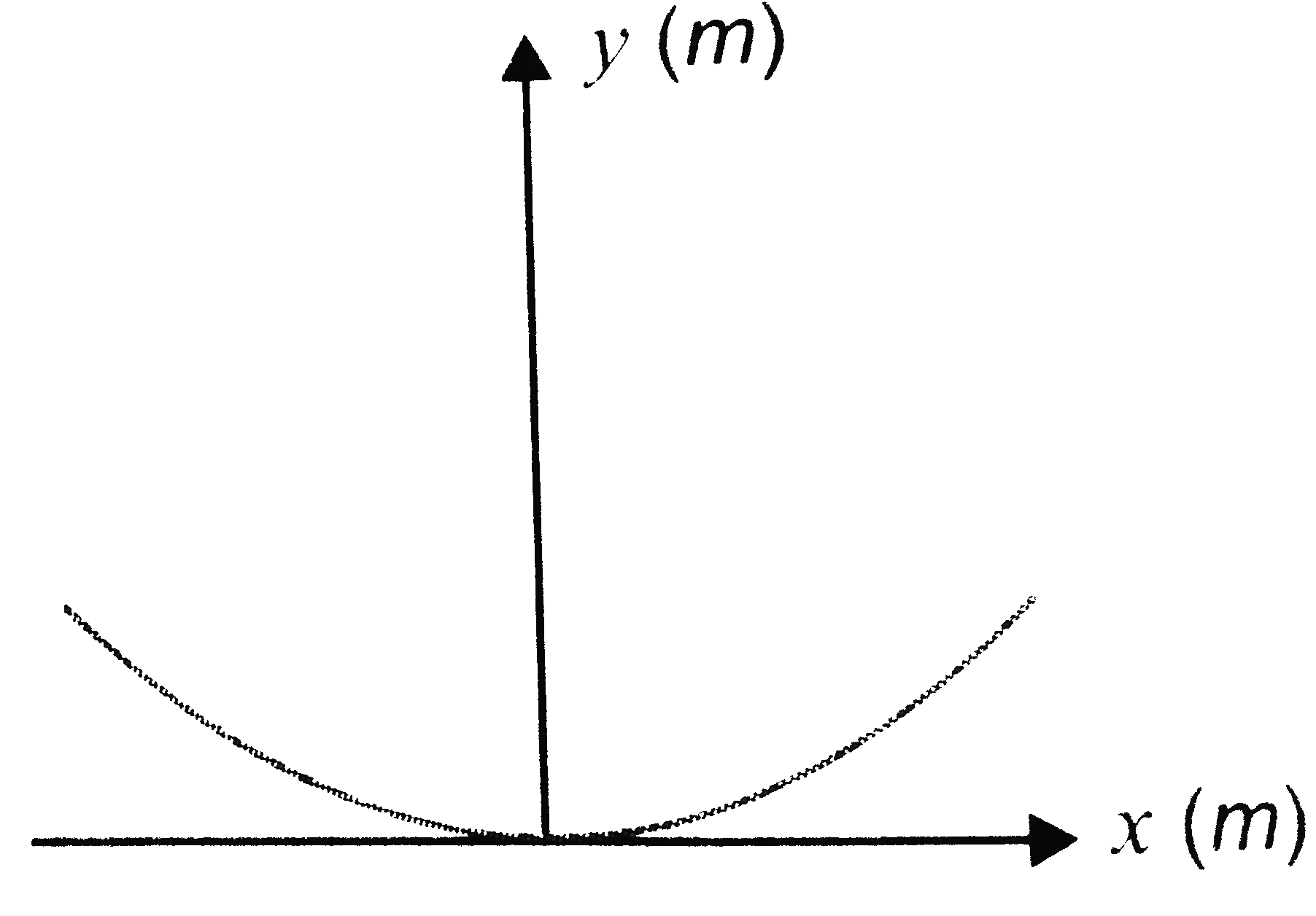
A parabolic bow1 with its bottom at origin has the shape `y = (x^(2))/(20)` where `x` and `y` are in metre The maximum height at which a small mass m can be placed on the bowl without slipping is (coeff of static friction `0.5`
.

A

2.5 m

B

1.25 m

C

1.0 m

D

4.0 m

Text Solution

Verified by Experts

The correct Answer is:

B
Promotional Banner

Similar Questions

Explore conceptually related problems

A vessel whose , bottom has round holes with diameter 0.1 mm , is filled with water. The maximum height up to which water can be filled without leakage is

A particle of mass 1 kg is moving along the line y = x + 2 (here x and y are in metres) with speed 2 m//s . The magnitude of angular momentum of paticle about origin is -

A block of mass is placed on a surface with a vertical cross section given by y=x^3/6 . If the coefficient of friction is 0.5, the maximum height above the ground at which the block can be placed without slipping is:

A block of mass is placed on a surface with a vertical cross section given by y=x^3/6 . If the coefficient of friction is 0.5, the maximum height above the ground at which the block can be placed without slipping is:

A block of mass is placed on a surface with a vertical cross section given by y=x^3/6 . If the coefficient of friction is 0.5, the maximum height above the ground at which the block can be placed without slipping is:

At t=0, the shape of a travelling pulse is given by y(x,0)=(4xx10^(-3))/(8-(x)^(-2) where x and y are in metres. The wave function for the travelling pulse if the velocity of propagation is 5 m//s in the x direction is given by

A particle mass 1 kg is moving along a straight line y=x+4 . Both x and y are in metres. Velocity of the particle is 2m//s . Find the magnitude of angular momentum of the particle about origin.

A particle of mass m=3kg moves along a straight line 4y-3x=2 where x and y are in metre, with constant velocity v=5ms^(-1) the magnitude of angular momentum about the origin is

If the equation of motion of a projectile is y=3x -1/8 x^(2) the range and maximum height are respectively (y and x are in metres)

A particle of mass 5 kg moving in the x-y plane has its potential energy given by U=(-7x+24y)J where x and y are in meter. The particle is initially at origin and has a velocity vec(i)=(14 hat(i) + 4.2 hat (j))m//s
