Home
Class 12
CHEMISTRY
for the given PV isotherms , which of th...

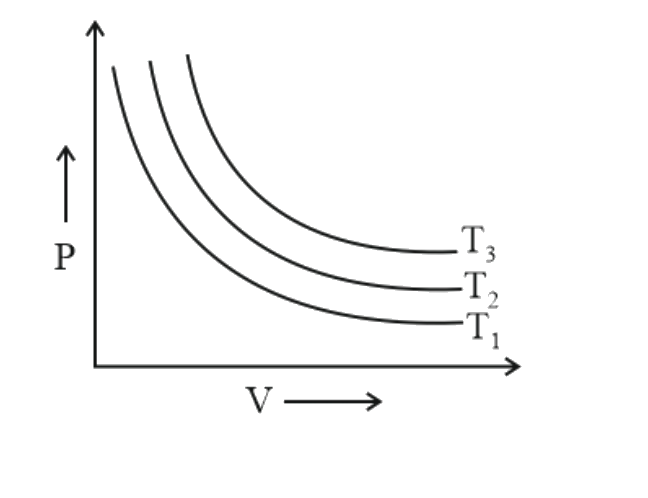
for the given PV isotherms , which of the following is correct for `T_1 ,T_2,T_3` ?

A

`T_1 lt T_2 lt T_3`

B

`T_3 lt T_2 lt T_1`

C

`T_2 lt T_3 lt T_1`

D

`T_1 lt T_3 lt T_2`

Text Solution

Verified by Experts

The correct Answer is:

A
Promotional Banner

Similar Questions

Explore conceptually related problems

The initial velocity of a particle is x ms^(-1) (at t=0) and acceleration a is function for time, given by, a= 6t. Which of the following relation is correct for final velocity y after time t?

A particle moves in x-y plane and at time t is at the point (t^2, t^3 -2 t), then which of the following is/are correct?

If T_(1),T_(2) "and" T_(3) are boiling points of component A, Component B and azeotropic mixture then which of the following relation is correct for a minimum boiling azeotrope :-

The x-coordinate of a particle moving on x-axis is given by x = 3 sin 100 t + 8 cos^(2) 50 t , where x is in cm and t is time in seconds. Which of the following is/are correct about this motion

The x-coordinate of a particle moving on x-axis is given by x = 3 sin 100 t + 8 cos^(2) 50 t , where x is in cm and t is time in seconds. Which of the following is/are correct about this motion

All reactions are of 1st order . At time t=t_1(t_1gt0) ([B])/([C])=alpha Therefore at time t=t_2 (where t_2get_1 ) ([C])/([D])=beta Which of the following is correct ?

The product (PV) is plotted against P at two temperature T_1 and T_2 and the result is given in following figure What is correct about T_1 and T_2 ?

Graphs between pressure and volume are plotted at different temperatures . Which of the following isotherms represents Boyle's law as PV = constant ? (T_(1) gt T_(2) gt T_(3))

For any arbitrary motion in space, which of the following relations are true? a) v_("average") = (1//2)(v(t_(1) + v(t_(2)) b) v_("average") = [r(t_(2))-r(t_(1)]/(t_(2)-t_(1) v(t) = v(0) + at d) a_("average") = [v(t_(2))-v(t_(1))/[t_(2)-t_(1)) The average stands for average of the quantity over time interval t_(1) to t_(2)
