Home
Class 12
PHYSICS
In photoelectric effect the slope of str...

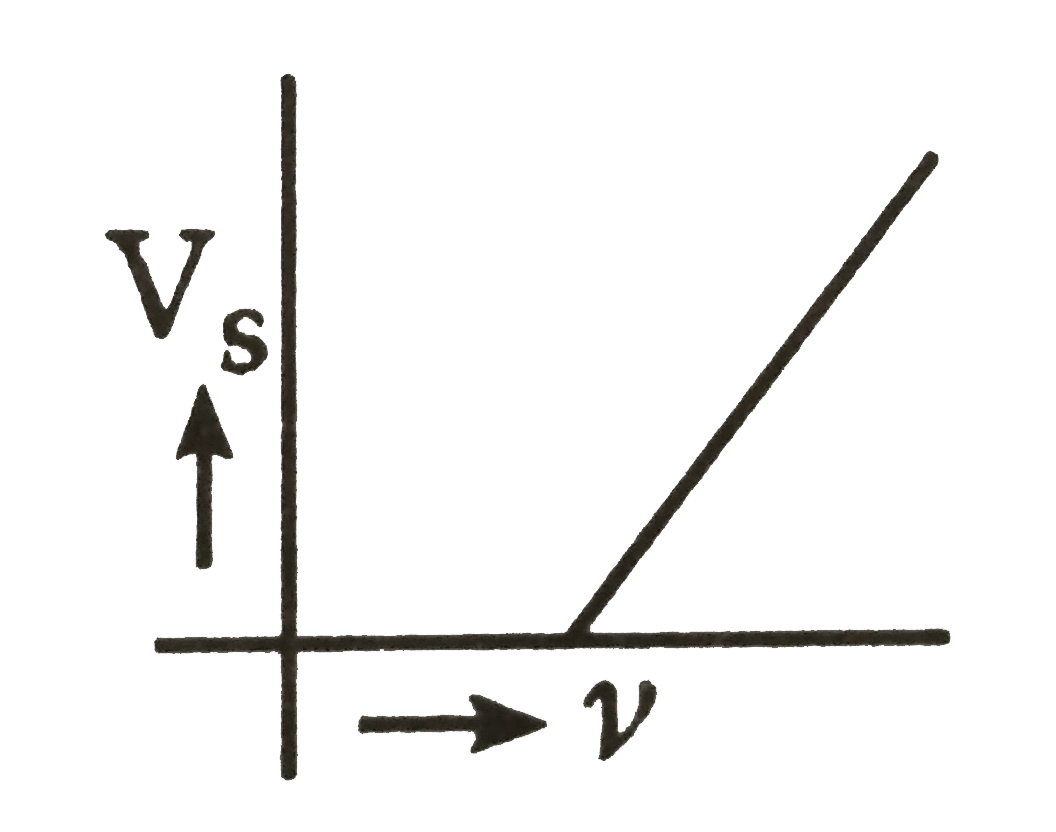
In photoelectric effect the slope of straight line graph between stopping potential `(V_(s))` and frequency of incident light (v) gives

A

charge on electrons

B

work function of emitter

C

Planck's constant

D

ratio of Planck 's constant to charge on electron

Text Solution

Verified by Experts

The correct Answer is:

D
Promotional Banner

Similar Questions

Explore conceptually related problems

The emission of electrons from a metal surface exposed rto light radaition of appropriate wavelength is called photoelectric effect .The emmited electron are called photo=-weklectron work function of threshold energy may be defined as the minimum amount of energy required to ejected electron from a most surface .According to Einstein Maximum kinetic energy of ejected electron = Absorbed energy - Work function (1)/(2) mv_(max)^(2) = h(v) - h(v_(n)) = hv [(1)/(lambda) - (1)/(lambda_(n))] Where v_(n) and lambda_(0) are thereshold frequency and threshold wavelength respectively Sopping potential : it is the miximum potential at which the photoelectric current becomes zero if V_(0) is the stopping potential eV_(0) = h(v- v_(0)) In the photoelectric currect effect the shape of strainght line graph between stopping potential (V_(0)) and frequency of incident light (V) gves

The slope of the graph drawn between stopping potential and frequency of incident radiation will be

In photoelectric effect the slope of stop of stopping potential versus frequency of incident light for a given surface will be

In photoelectric effect experiment, the slope of the graph of the stopping potential versus frequency gives the value of :

In the study of a photoelectric effect the graph between the stopping potential V and frequency nu of the incident radiation on two different metals P and Q is shown in fig. (i) which one of two metals have higher threshold frequency (ii) Determine the work function of the metal which has greater value (iii) Find the maximum kinetic energy of electron emitted by light of frequency 8xx10^(14) Hz for this metal.

Graph between stopping potential and frequency of light as shown find the work function

In a photoelectric experiment , the stopping potential V_s is plotted against the frequency v of the incident light . The resulting curve is a straight line which makes an angle theta with the v - axis. Then tan theta will be equal to (Here E_0 = work function of the surface_

In photoelectric effect, stopping potential depends on

When a high frequency electromagnetic radiation is incident on a metallic surface, electrons are emitted from the surface. Energy of emitted photoelectrons depends only on the frequency of incident electromagnetic radiation and the number of emitted electrons depends only on the intensity of incident light. Einstein's protoelectron equation [K_(max)=hv-phi] correctly ecplains the PE, where upsilon= frequency of incident light and phi= work function. Q. For photoelectric effect in a metal, the graph of the stopping potential V_0 (in volt) versus frequency upsilon (in hertz) of the incident radiation is shown in Fig. The work function of the metal (in eV) is.

In an experiment on photoelectric effect the frequency f of the incident light is plotted against the stopping potential V_(0) . The work function of the photoelectric surface is given by ( e is the electronic charge)
