Home
Class 12
PHYSICS
A vertical spring of force cosntant 100 ...

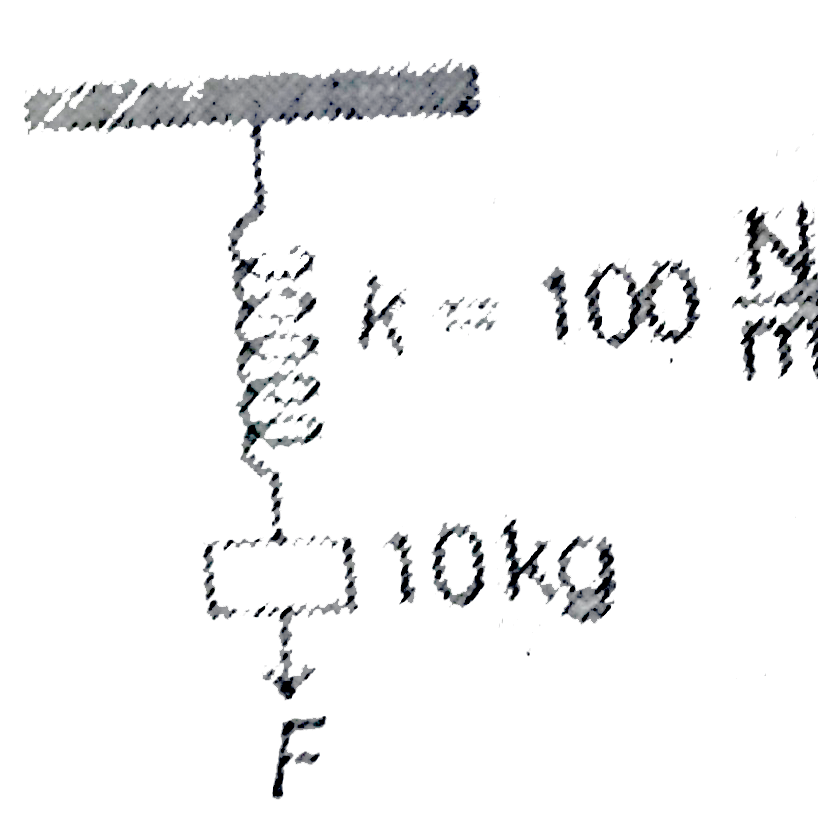
A vertical spring of force cosntant `100 N//m` is attached with a hanging mass of 10 kg. Now an external force is applied on the mass so that the spring is stretched by additional 2m. The work done by the force F is `(g = 10 m//s^(2))`

A

200 J

B

400 J

C

450 J

D

600 J

Text Solution

Verified by Experts

The correct Answer is:

A
Promotional Banner

Similar Questions

Explore conceptually related problems

A 2 kg block is connected with two springs of force constants k_(1)=100 N//m and k_(2)=300 N//m as shown in figure. The block is released from rest with the springs unstretched. The acceleration of the block in its lowest postion is (g=10 m//s^(2))

A vertical spring with force constant k is fixed on a table. A ball of mass m at a height h above the free upper end of the spring falls vertically on the spring , so that the spring is compressed by a distance d . The net work done in the process is

Certain force acting on a 20 kg mass changes its velocity from 5m//s to 2m//s . calculate the work done by the force.

A body of mass 10 kg is dropped to the ground from a height of 10 metres. The work done by the gravitational force is (g=9.8m//sec^(2))

A 10 N force is applied on a body which produces in it an acceleration of 1 m//s^(2) . The mass of other body is

A vertical spring carries a 5kg body and is hanging in equilibrium an additional force is applied so that the spring is further stretched. When released from this position. It performs 50 complete oscillation in 25 s, with an amplitude of 5 cm. The additional force applied is

A block of mass m welded with a light spring of stiffness k is in equilibrium on an smooth inclined plane with angle of inclination theta . If a variable external force is applied slowly till the spring comes to its relaxed position, find the work done by spring force.

Consider a block connected to a light spring of spring constant 100Nm^(-1) . Now the block is displaced by applying a constant force F which gives zero resultant force when spring is stretched through 10 cm. Evaluate (i) Work done by the spring force when the block attains equilibrium. (ii) Net work done on the block when it attains maximum speed.

Figure a) shows a spring of force constant k clamped rigidly at once end and a mass m attached to its free end. A force F applied at the free end stretches the spring. Figure b) shows the same spring with both ends free and attached to a mass m at either end. Each end of the spring in figure is stretched by the same force F. (a) What is the maximum extension of the spring in the two cases ? (b) If the mass in figure and the two masses in figure are released free, what is the period of oscillation in each case?

Figure a) shows a spring of force constant k clamped rigidly at once end and a mass m attached to its free end. A force F applied at the free end stretches the spring. Figure b) shows the same spring with both ends free and attached to a mass m at either end. Each end of the spring in figure is stretched by the same force F. (a) What is the maximum extension of the spring in the two cases ? (b) If the mass in figure and the two masses in figure are released free, what is the period of oscillation in each case?
