Home
Class 12
PHYSICS
Two particles of mass m and 2m have thei...

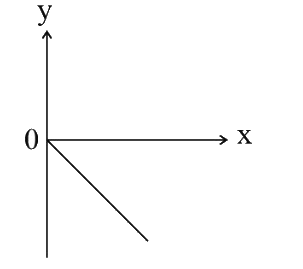
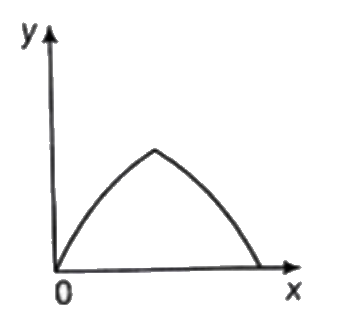
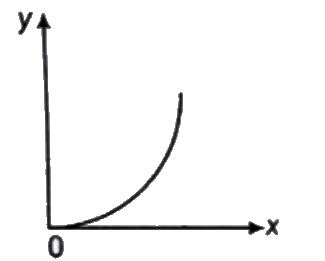
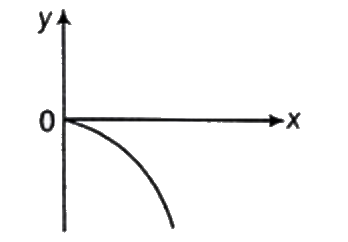
Two particles of mass m and 2m have their position vectors as a function of time as `r_(1) (t) = hat I - t^(3) hat(j) +2t^(2)hat(k) and r_(2) (t) = t hat (i) -t^(3)hat(j) -t^(2) hatk` respectively (where t is the time). Which one of the following graphs represents the path of the centre of mass ?

A

B

C

D

Text Solution

AI Generated Solution

The correct Answer is:

To find the path of the center of mass of the two particles with given position vectors, we can follow these steps: ### Step 1: Identify the position vectors The position vectors of the two particles are given as: - For particle 1 (mass m): \[ \mathbf{r}_1(t) = \hat{i} - t^3 \hat{j} + 2t^2 \hat{k} \] - For particle 2 (mass 2m): \[ \mathbf{r}_2(t) = t \hat{i} - t^3 \hat{j} - t^2 \hat{k} \] ### Step 2: Write the formula for the center of mass The position vector of the center of mass \(\mathbf{r}_{\text{com}}\) is given by: \[ \mathbf{r}_{\text{com}} = \frac{m_1 \mathbf{r}_1 + m_2 \mathbf{r}_2}{m_1 + m_2} \] where \(m_1 = m\) and \(m_2 = 2m\). ### Step 3: Substitute the values into the formula Substituting the values of \(m_1\), \(m_2\), \(\mathbf{r}_1\), and \(\mathbf{r}_2\): \[ \mathbf{r}_{\text{com}} = \frac{m \mathbf{r}_1 + 2m \mathbf{r}_2}{m + 2m} \] This simplifies to: \[ \mathbf{r}_{\text{com}} = \frac{m (\hat{i} - t^3 \hat{j} + 2t^2 \hat{k}) + 2m (t \hat{i} - t^3 \hat{j} - t^2 \hat{k})}{3m} \] ### Step 4: Simplify the expression Now, we can simplify the numerator: \[ = \frac{m \hat{i} - mt^3 \hat{j} + 2m \cdot 2t^2 \hat{k} + 2mt \hat{i} - 2mt^3 \hat{j} - 2mt^2 \hat{k}}{3m} \] Combining like terms: \[ = \frac{(m + 2mt) \hat{i} + (-mt^3 - 2mt^3) \hat{j} + (2mt^2 - 2mt^2) \hat{k}}{3m} \] This simplifies to: \[ = \frac{(1 + 2t) \hat{i} - 3t^3 \hat{j}}{3} \] ### Step 5: Write the components of the center of mass From the above expression, we can identify the components: - \(x = \frac{1 + 2t}{3}\) - \(y = -t^3\) ### Step 6: Analyze the path To analyze the path, we can express \(y\) in terms of \(x\): From \(x = \frac{1 + 2t}{3}\), we can express \(t\) as: \[ t = \frac{3x - 1}{2} \] Substituting this into the equation for \(y\): \[ y = -\left(\frac{3x - 1}{2}\right)^3 \] This indicates that the path is a cubic curve in the fourth quadrant since \(y\) will be negative for positive \(x\). ### Conclusion The graph representing the path of the center of mass is a curve in the fourth quadrant, which corresponds to option D. ---
Promotional Banner

Similar Questions

Explore conceptually related problems

The position vectors of three particles of mass m_(1) = 1kg, m_(2) = 2kg and m_(3) = 3kg are r_(1) = ((hat(i) + 4hat(j) +hat(k)) m, r_(2) = ((hat(i)+(hat(j)+hat(k)) m and r_(3) = (2hat(i) - (hat(j) -(hat(2k)) m, respectively. Find the position vector of their center of mass.

Prove that lines vec( r)= (hat(i)+ hat(j) + hat(k))+ t(hat(i) - hat(j) + hat(k)) and vec(r ) = (3hat(i) - hat(k)) + s(4hat(j) - 16hat(k)) intersect. Also find the position vector of their point of intersection

Find the shortest distance between the lines whose vector equations are -> r=(1-t) hat i+(t-2) hat j+(3-2t) hat k and -> r=(s+1) hat i+(2s-1) hat j-(2s+1) hat k

Find the Cartesian form the equation of the plane vec r=(s-2t) hat i+(3-t) hat j+(2s+t) hat kdot

Find the image of the point having position vector hat(i) + 3hat(j) + 4hat(k) in the plane vec(r ).(2hat(i) - hat(j) + hat(k))+ 3=0

Find the value of lamda , if the points with position vectors 3hat(i)- 2hat(j)- hat(k), 2hat(i) + 3hat(j)- 4hat(k), -hat(i) + hat(j) + 2hat(k), 4hat(i) + 5hat(j) + lamda hat(k) are coplanar.

A particle is moving with a position vector, vec(r)=[a_(0) sin (2pi t) hat(i)+a_(0) cos (2pi t) hat(j)] . Then -

A particle move in x-y plane such that its position vector varies with time as vec r=(2 sin 3t)hat j+2 (1-cos 3 t) hat j . Find the equation of the trajectory of the particle.

Prove that the following vectors are coplanar: hat i+ hat j+ hat k ,\ 2 hat i+3 hat j- hat k\ a n d- hat i-2 hat j+2 hat k

The position vector of a particle vec(R ) as a funtion of time is given by: vec(R )= 4sin(2pit)hat(i)+4cos(2pit)hat(j) Where R is in meters, t is in seconds and hat(i) and hat(j) denote until vectors along x-and y- directions, respectively Which one of the following statements is wrong for the motion of particle ?
