Home
Class 12
PHYSICS
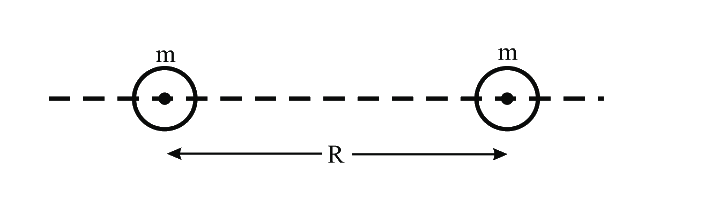
Two balls of radius r each are placed at...

Two balls of radius r each are placed at a distance R and released . The speed of each ball when they collide

A

`v = sqrt(2-Gm((1)/(R)+1/r))`

B

`v = sqrt(-Gm(1/R-1/(2r)))`

C

`v=sqrt(-2Gm(1/R+1/(2r)))`

D

`v=sqrt(-Gm(1/(2R)+1/(2r)))`

Text Solution

Verified by Experts

The correct Answer is:

B
Promotional Banner

Similar Questions

Explore conceptually related problems

Two protons are separated by a distance R. What will be the speed of each proton when they reach infinity under their mutual repulsion?

Two thin rings each of radius R are placed at a distance 'd' apart. The charges on the rings are +q and -q. The potential difference between their centres will be -

Two point charges, each of mass m and charge q are released when they are at a distance d from each other. What is the speed of each charged particle when they are at a distance 2r ?

Two point charges placed at a distance r in air exert a force F on each other. The value of distance R at which they experience force 4F when placed in a medium of dielectric constant K = 16 is :

Two identical balls , each having a charge q and mass m , are suspended from a common point by two insultating strings each of length L . The balls are held at a separation x and then released. Find (a) the electric force on each ball (b) the component of the resultant force on a ball along and perpendicular to string (c ) the tension in the string (d) the acceleration of one of the balls. Consider the situation only for the instant just after the release.

Two similar conducting balls having charges + q and - q are placed at a separation d from each other in air. The radius of each ball is r and the separation between their centres is d (d gt gt r ). Calculate the capacitance of the two ball system

A disc of mass m and radius R is free to rotate in a horizontal plane about a vertical smooth fixed axis passing through its centre. There is a smooth groove along the diameter of the disc and two small balls of mass m//2 each are placed in it on either side of the centre of the disc as shown in Fig. The disc is given an initial angular velocity omega_(0) and released. The speed of each ball relative to the ground just after they leave the disc is

A disc of mass m and radius R is free to rotate in a horizontal plane about a vertical smooth fixed axis passing through its centre. There is a smooth groove along the diameter of the disc and two small balls of mass m//2 each are placed in it on either side of the centre of the disc as shown in Fig. The disc is given an initial angular velocity omega_(0) and released. The angular speed of the disc when the balls reach the end of the disc is

A smooth ball 'A' moving with velocity 'V' collides with another smooth identical ball at rest. After collision both the balls move with same speed with angle between their velocities 60^(@) . No external force acts on the system of balls. The speed of each ball after the collision is

In the figure shown, the two identical balls of mass M and radius R each, are placed in contact with each other on the frictionless horizontal surface. The third ball of mass M and radius R//2 , is coming down vertically and has a velocity = v_(0) when it simultaneously hits the two balls and itself comes to rest. Then, each of the two bigger balls will move after collision with a speed equal to
