Home
Class 12
BIOLOGY
Study the graph given below and choose t...

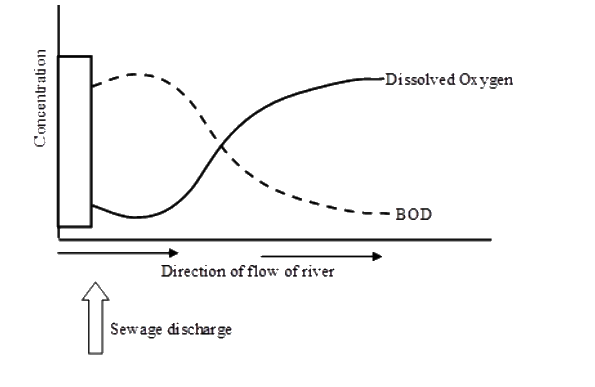
Study the graph given below and choose the option that is correctly describing the relationship between dissolved oxygen (DO) and biochemical oxygen demand (BOD) :

(a) `DO prop 3BOD`
(b) `DO prop 2BOD`
(c) `DO prop 1/(BOD)`
(d) `DO prop BOD`

A

`DO prop 3BOD`

B

`DO prop 2BOD`

C

`DO prop 1/(BOD)`

D

`DO prop BOD`

Text Solution

Verified by Experts

The correct Answer is:

C
Promotional Banner

Similar Questions

Explore conceptually related problems

What do you mean by Biochemical Oxygen Demand (BOD)?

Study the graph given below and answer the question that follow ? (i) What is relationship between dissolved oxygen and biochemical oxygen Demand (BOD) ? (ii) Mention their effect on aquatic life in the river.

Study the graph given below and answer the question that follow ? (i) What is relationship between dissolved oxygen and biochemical oxygen Demand (BOD) ? (ii) Mention their effect on aquatic life in the river.

Observe the graphs given below and choose the options correctly describing the color of pigments 1,2,and 3 in a chromatogram .

Relationship between DO and BOD is that they:

Biochemical oxygen demand (BOD) is defined as ............ in ppm of O_2 .

Study the diagram given below and answer the questions that follow : What do we observe with regard to the level of water when this set-up is placed in (1) bright sunlight (2) humid conditions (3) windy day

Name the types of interaction or intermolecular forces of which potential energy-distance function are given below (a) Eprop (1)/ (r ) (b) E prop (1)/(r^(2)) (c ) E prop (1)/(r^(3)) (d) E prop (1)/(r^(4)) (e) E prop (1)/(r^(6)) .

Facultative anaerobes : (a) are photosynthetic (b) do not always need oxygen (c) are killed in an oxygenated environment (d) require a constant supply of oxygen

The electirc potential between a proton and an electron is given by V = V_0 ln (r /r_0) , where r_0 is a constant. Assuming Bhor model to be applicable, write variation of r_n with n, being the principal quantum number. (a) r_n prop n (b) r_n prop (1)/(n) (c ) r_n^2 (d) r_n prop (1)/(n^2)
