Home
Class 12
PHYSICS
From the following graph of photocurrent...

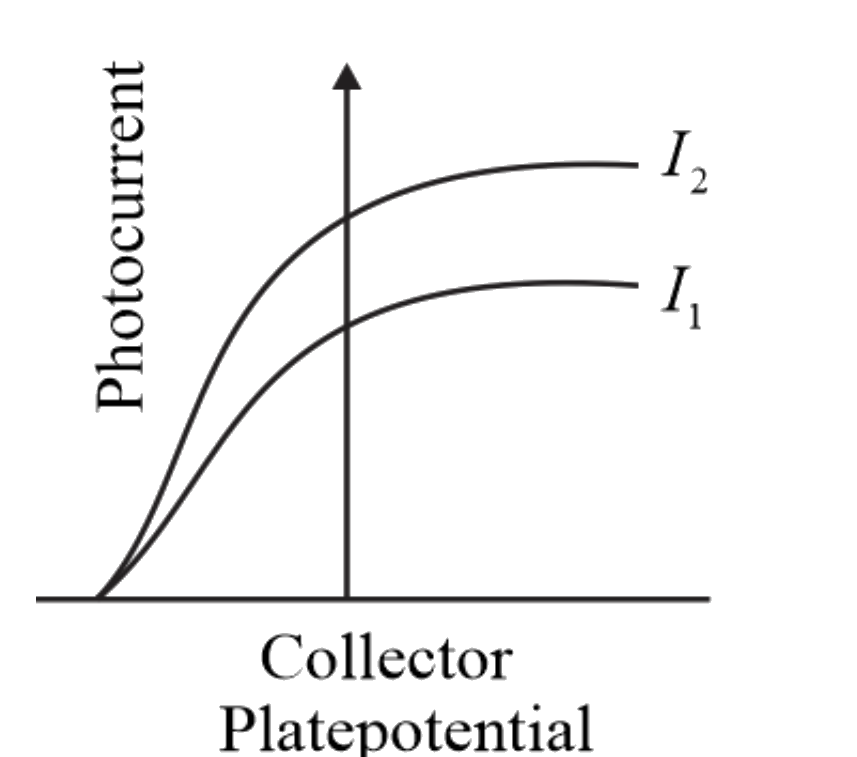
From the following graph of photocurrent against collector plate potential for two different intensities of light `I_1 and I_2` one can , conclude

A

`I_1=I_2`

B

`I_1gtI_2`

C

`I_1ltI_2`

D

Comparison is not possible

Text Solution

Verified by Experts

The correct Answer is:

C
Promotional Banner

Similar Questions

Explore conceptually related problems

The figure shows a plot of three curves a, b, c, showing variation of photocurrent vs collector plate potential for three different intensities I_(1), I_(2) and I_(3) having frequencies v_(1), v_(2) and v_(3) respectively incident on a photosensitive surface. Point out the two curves for which the incident radioations have same frequency but different intensities.

Draw a plot showing the variation of photoelectric current with collector plate potential for two different frequencies, v_1gtv_2 of incident radiation having the same intensity. In which case will the stopping potential be higher? Justify your answer.

The variation of photocurrent with collector potential for different frequencies of incident radiation v_1,v_2,v_3 is as shown in the the graph , then

The curves (a) , (b) , ( c ) and (d) show the variation between the applied potential difference (V) and the photoelectric current (i) , at two different intensities of light (I_(1) gt I_(2)) . In which figure is the correct variation shown ?

The graph between photo electric current and cathode potential when the anode is kept at zero potential, for light of two different intensities out of the same frequency looks like the one:

The graph of Fig. shows the variation of photoelectric current (I) versus applied voltage (V) for the two different photosensitive materials for two different intensities of the incident radiation. Identify the pairs of curves that correspond to different materials but same intensity of incident radiation.

The graph shows the variation of photocurrent with the applied voltage in a photoelectric effect experiment for three different beams of light falling on identical metal surfaces, then which among the following is correct ?

The current (I) and voltage (V) graphs for a given metallic wire at two different temperature (T_(1)) and (T_(2)) are shown in fig. It is concluded that

Two parallel large metal plates, each of area A are piaced at a distance d apart. Light of intensity I and wavelength lambda falls on the plate 1 which is photosensitive. The efficiency of photoelectron emission is 100% . The photoelectrons are immediately swept away from plate 1 in such a way that the plate 2 remains neutral. Find the potential difference between the two plates at any time t , if plate 1 is neutral initially.

The maximum intensities produced by two coherent waves of intensity I_(1) and I_(2) will be:
