Home
Class 12
PHYSICS
Two coherent narrow slits emitting light...

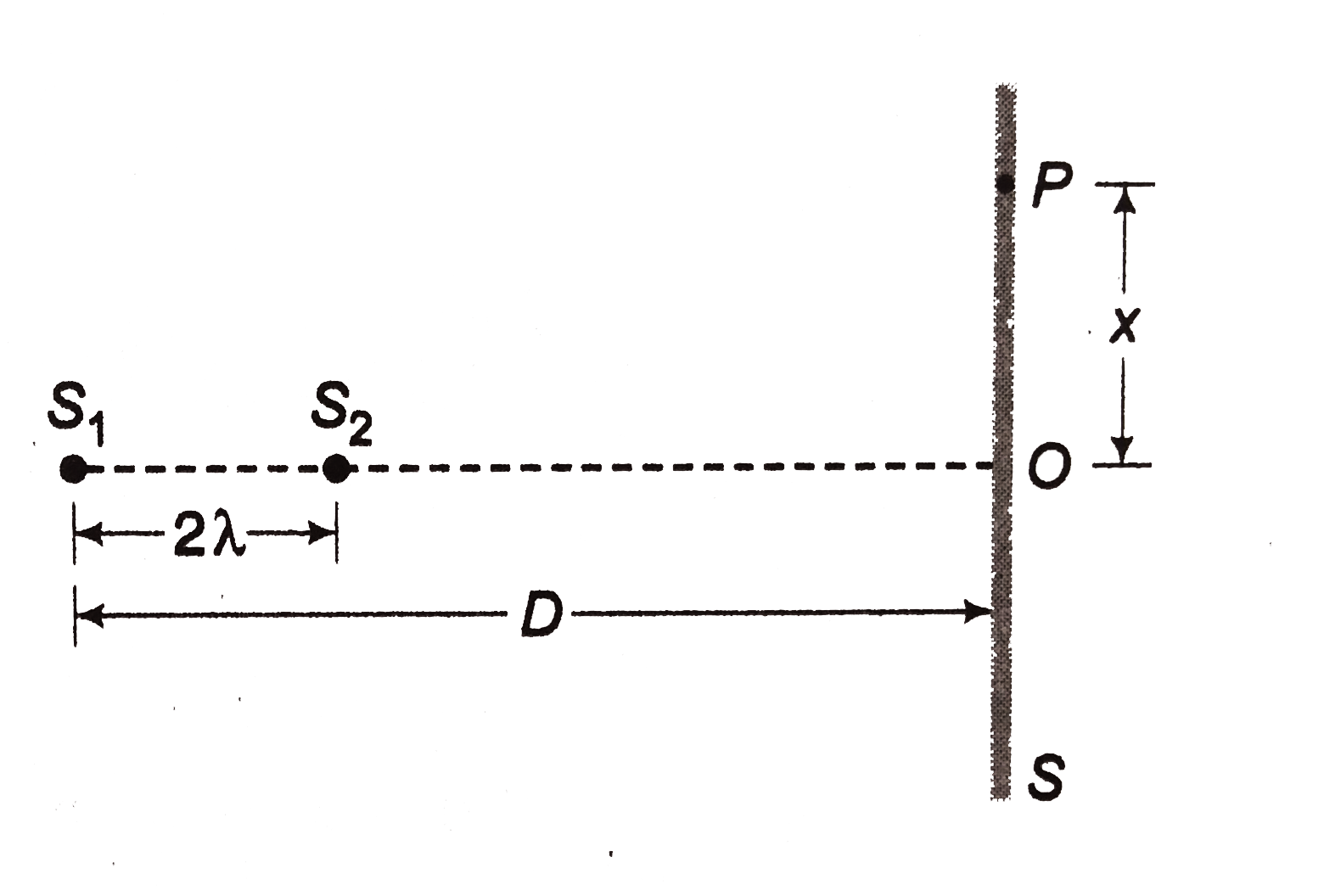
Two coherent narrow slits emitting light of wavelength `lambda` in the same phase are placed parallel to each other at a small separation of `2lambda`. The light is collected on a screen S which is placed at a distance D(`gtgt lambda`) from the slit `S_1` as shown in figure. Find the finite distance x such that the intensity at P is equal to intensity O.
.

A

`sqrt2D/2`

B

`sqrt3D`

C

`sqrt8D`

D

`sqrt5D`

Text Solution

Verified by Experts

The correct Answer is:

B
Promotional Banner

Similar Questions

Explore conceptually related problems

Two coherent narrow slits emitting sound of wavelength lambda in the same phase are placed parallet to each other at a small separation of 2 lambda . The sound is delected by maving a delector on the screen at a distance D(gt gt lambda) from the slit S_(1) as shows in figure. Find the distance y such that the intensity at P is equal to intensity at O .

A narrow slit S transmitting light of wavelength 'lambda' . Is placed at a distance d above a large plane mirror as shown. The light coming directly from the slit and that coming after the reflection interfere at a screen S placed at a distance D from the slit. at what distance from point O, the resultant intensity is maximum ? (there is a phase change of pi of reflection from the mirror)

A narrow slit S transmitting light of wavelength lamda is placed a distance d above a large plane mirror as shown in figure. The light coming directly from the slit and that coming after the reflection interference at a screen sum placed at a distance LD from the slit. a. What will be the intensity at a point just above the mirror. i.e., just above O? b. At what distance from O does the first maximum occur? ?

In a Lloyds's mirror experiment as narrow slit S transmitting a light of wavelength lambda is placed 3 mm above a small plane mirror ( as shown). The light coming directly from the the slit and that coming after the reflection interfere on a screen placed at a distance of 90 cm from the slit. Length of mirror is 2 mm and the middle point of mirror is 2 mm from point P. If the mirror is shifted towards left then how does the fringe pattern on screen changes ?

Two coherent point sources S_1 " and "S_2 vibrating in phase light of wavelength lambda . The separation between them is 2lambda as shown in figure. The first bright fringe is formed at .P. due to interference on a screen placed at a distance .D. from S_(1)" "(D gt gt lambda) , then OP is

Consider the situation shown in figure. The two slite S_1 and S_2 placed symmetrically around the centre line are illuminated by a monochromatic light of wavelength lambda. The separation between the slits is d. The light transmitted by the slits falls on a screen M_1 placed at a distance D from the slits. The slit S_3 is at the centre line and the slit S_4 is at a distance y form S_3 . Another screen M_2 is placed at a further distance D away from M_1 . Find the ration of the maximum to minimum intensity observed on M_2 if y is equal to (dltltD) .

Consider the situation shown in figure. The two slits S_1 and S_2 placed symmetrically around the central line are illuminated by a monochromatic light of wavelength lamda . The separation between the slits is d. The light transmitted by the slits falls on a screen Sigma_1 placed at a distance D from the slits. The slit S_3 is at the placed central line and the slit S_4 , is at a distance z from S_3 . Another screen Sigma_2 is placed a further distance D away from 1,1. Find the ratio of the maximum to minimum intensity observed on Sigma_2 if z is equal to a. z=(lamdaD)/(2d) b. (lamdaD)/d c. (lamdaD)/(4d)

Two identical light sources S_1 and S_2 emit light of same wavelength lambda . These light rays will exhibit interference if

A parallel beam of light of wavelength lambda passes through a slit of width d. The transmitted light is collected on a screen D aways (D gt gt d) . Find the distance between the two second order minima.

The figure shows two points source which emit light of wavelength lambda in phase with each other and are at a distance d = 5.5 lambda apart along a line which is perpendicular to a large screen at a distance L from the centre of the source. Assume that d is much less than L. Which of the following statement is (are) correct ?
