Home
Class 12
PHYSICS
The work functions of three metals A, B ...

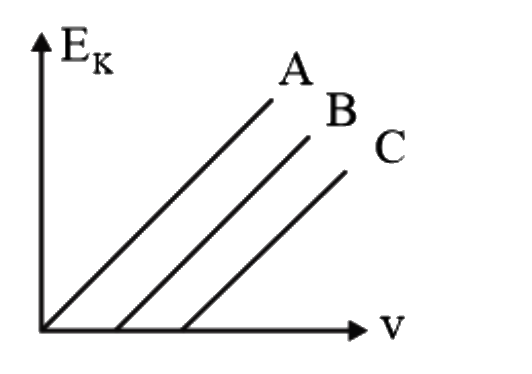
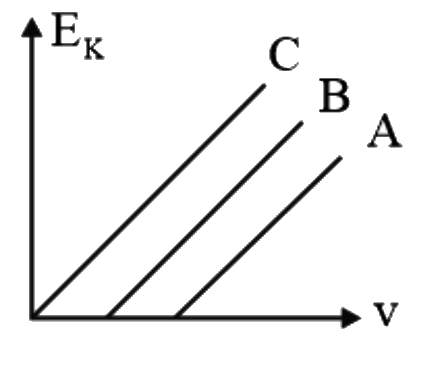
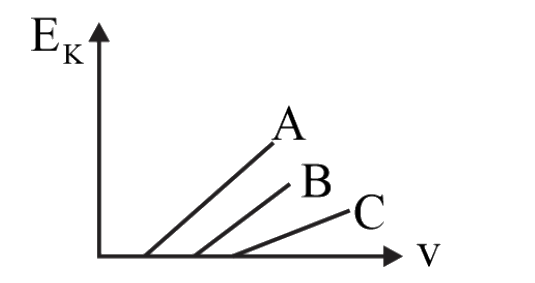
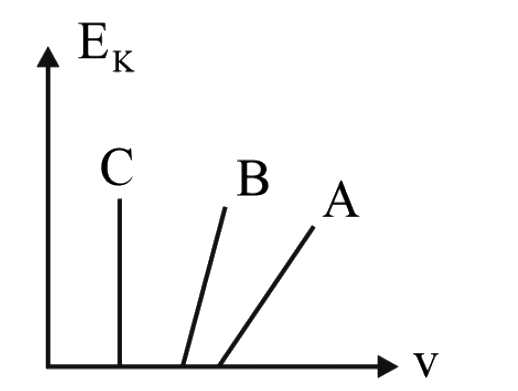
The work functions of three metals A, B and C are `W _A ,W_B and W_C` respectively . They are in decreasing order. The correct graph between kinetic energy and frequency V of incident radiation is

A

B

C

D

Text Solution

AI Generated Solution

The correct Answer is:

To solve the problem, we need to understand the relationship between the kinetic energy of emitted electrons and the frequency of incident radiation based on the photoelectric effect. The work functions of the metals A, B, and C are given, and we know they are in decreasing order: \( W_A > W_B > W_C \). ### Step-by-Step Solution: 1. **Understanding the Photoelectric Effect**: The maximum kinetic energy (K.E.) of the emitted electrons is given by the equation: \[ K.E. = hf - W \] where \( hf \) is the energy of the incident radiation (with \( h \) being Planck's constant and \( f \) the frequency of the radiation), and \( W \) is the work function of the metal. 2. **Identifying the Work Functions**: Given the order of the work functions: \[ W_A > W_B > W_C \] This means that metal A has the highest work function, followed by metal B, and then metal C has the lowest work function. 3. **Graphing Kinetic Energy vs. Frequency**: The equation \( K.E. = hf - W \) can be rearranged to show that the graph of \( K.E. \) versus \( f \) will be a straight line with: - Slope = \( h \) (which is the same for all three metals) - Y-intercept = \( -W \) (which will differ for each metal) 4. **Determining the Y-Intercepts**: - For metal A, the y-intercept will be at \( -W_A \) (the most negative value). - For metal B, the y-intercept will be at \( -W_B \) (less negative than A). - For metal C, the y-intercept will be at \( -W_C \) (least negative). 5. **Plotting the Graph**: - The graph will start from the y-intercept and increase linearly with frequency. - Since \( W_A > W_B > W_C \), the graph for metal A will be the lowest (most negative), followed by B, and then C will be the highest (least negative). 6. **Conclusion**: The correct graph will show three lines: - Line A will be the lowest, intersecting the y-axis at \( -W_A \). - Line B will be in the middle, intersecting at \( -W_B \). - Line C will be the highest, intersecting at \( -W_C \). The correct option for the graph that represents this relationship is option B.
Promotional Banner

Similar Questions

Explore conceptually related problems

According to Einstein's photoelectric equation, the graph between kinetic energy of photoelectrons ejected and the frequency of the incident radiation is :

According to Einstein's photoelectric equation , the graph between the kinetic energy of photoelectrons ejected and the frequency of incident radiation is

The correct graph respectivley the relation between energy (E ) of photoelectrons and frequency v of incident light is

The work function of metal is W and lamda is the wavelength of the incident radiation. There is no emission of photoelecrons when

The work functions of metals A and B are in the ratio 1 : 2 . If light of frequencies f and 2 f are incident on the surfaces of A and B respectively , the ratio of the maximum kinetic energy of photoelectrons emitted is ( f is greater than threshold frequency of A , 2f is greater than threshold frequency of B )

The resistance of the four arms A, B, C and D of a wheatstone bridge as shown in the figure are 10 Omega , 20 Omega , 30 Omega and 60 Omega respectively . The emf and internal resistance of the cell are 15 V and 2.5 Omega respectively . If the galvanometer resistance is 80 Omega then the net current drawn from the cell will be

In an electrical circuit three incandescent bulbs A,B and C of rating 40 W, 60 W and 100 W respectively are connected in parallel to an electric source. Which of the following is likely to happen regarding their brightness ?

Explain giving reasons for the following : (a) Photoelectric current in a photocell increases with the increase in intensity of the incident radiation. (b) The stopping potential V_0 varies linearly with the frequency nu of the incident radiation for a given photosensitive surface with the slope remaining the same for different surfaces. (c) Maximum kinetic energy of the photoelectrons is independent of the intensity of incident radiation.

In a photoelectric experiment set up, photons of energy 5 eV falls on the cathode having work function 3 eV (a) if the saturation current is i= 4 mu A for intensity 10^(-5) W//m^(2) , then plot a graph between anode potential and current (b) Also draw a graph for intensity of incident radiation 2 xx 10^(-5) W//m^(2)

When a high frequency electromagnetic radiation is incident on a metallic surface, electrons are emitted from the surface. Energy of emitted photoelectrons depends only on the frequency of incident electromagnetic radiation and the number of emitted electrons depends only on the intensity of incident light. Einstein's protoelectron equation [K_(max)=hv-phi] correctly ecplains the PE, where upsilon= frequency of incident light and phi= work function. Q. For photoelectric effect in a metal, the graph of the stopping potential V_0 (in volt) versus frequency upsilon (in hertz) of the incident radiation is shown in Fig. The work function of the metal (in eV) is.
