Home
Class 12
PHYSICS
An ideal fluid flows through a pipe of c...

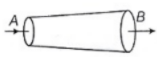
An ideal fluid flows through a pipe of circular cross - section with diameters 5 cm and 10 cm as shown in the figure. The ratio of velocities of fluid at A and B is

A

`4:1`

B

`1:4`

C

`2:1`

D

`1:2`

Text Solution

Verified by Experts

The correct Answer is:

A
Promotional Banner

Similar Questions

Explore conceptually related problems

An ideal fluid flows through a pipe of circular cross-section made of two sections with diameters 2.5 cm and 3.75 cm . The ratio of the velocities in the two pipes is

An ideal fluid flows through a pipe of circular cross-section made of two sections with diameters 2.5 cm and 3.75 cm . The ratio of the velocities in the two pipes is

An ideal fluid flows through a pipe of circular cross-section made of two sections with diameters 2.5 cm and 3.75 cm . The ratio of the velocities in the two pipes is

In this figure, an ideal liquid flows through the tube having uniform area of cross-section and is held in vertical plane. Find the ratio of speed of liquid at A and B and also find the pressure difference between- these points.

Assertion : When an ideal fluid flows through a pipe of non-uniform cross-section, then pressure is more at that section where area is more if the pipe is horizontal. Reason : According to Bernoulli's theorem speed at broader cross-section will be less.

A pipe of constant cross - section is bent in a horizontal plane as shown in the figure . Points A and B are located on two different streamlines . Then

A non-viscous liquid is flowing through a non-uniform pipe from section A to section B as shown in the figure. Cross sectional area of the pipe at A is less than that at B . Which of the following statements are correct?

It water flows horizontally through a pipe of varying cross section and the pressure of water equals 10 cm of g at a point where the velocity of flow is 40 cm//s , what is the pressure at another point where the velocity of flow is 50 cm//s ?

Two water pipes of diameters 2 cm and 4 cm are connected with the main supply line. The velocity of flow of water in the pipe of 2 cm

Figure shows an ideal fluid flowing through a uniform cross-sectional tube in the vertical tube with liquid velocities v_(A) and v_(B) and pressure P_(A) and P_(B) . Knowing that offers no resistance to fluid flow then which of the following is true.
