Home
Class 12
PHYSICS
Three identical rods AB, CD and PQ are j...

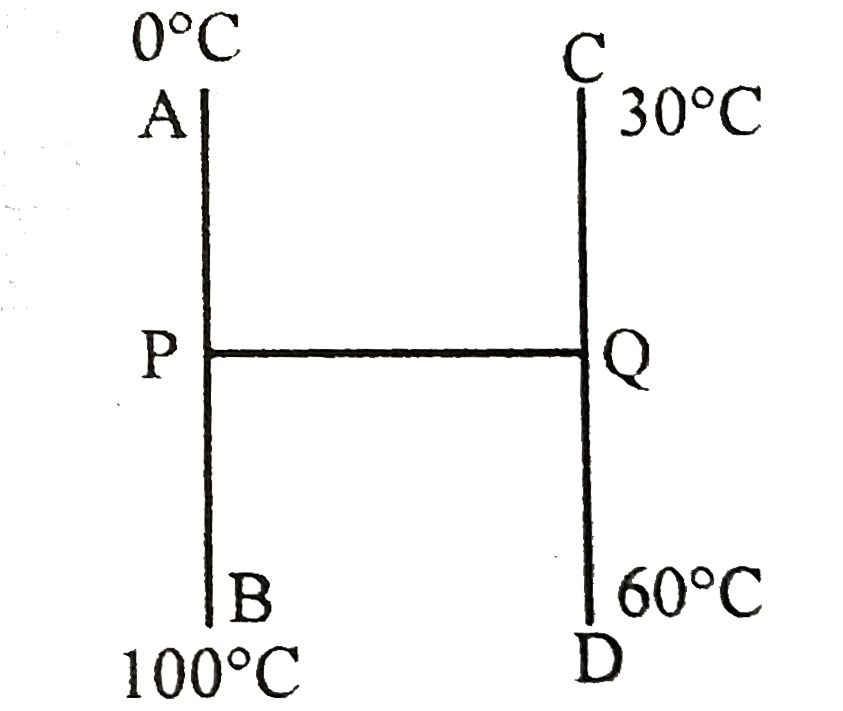
Three identical rods `AB`, `CD` and `PQ` are joined as shown. `P` and `Q` are mid points of `AB` and `CD` respectively. Ends `A`, `B`, `C` and `D` are maintained at `0^(@)C`, `100^(@)C`, `30^(@)C` and `60^(@)C` respectively. The direction of heat flow in `PQ` is

A

From P to Q

B

From Q to P

C

Heat does not flow in PQ

D

Data not sufficient

Text Solution

Verified by Experts

The correct Answer is:

A
Promotional Banner

Similar Questions

Explore conceptually related problems

A rod CD of thermal resistance 5.0KW^(-1) is joined at the middle of an identical rod AB as shown in figure. The ends A, B and D are maintained at 100^(@)C , 0^(@)C and 25^(@)C respectively. Find the heat current in CD.

A rod CD of thermal resistance 5.0KW_(-1) is joined at the middle of an identical rod AB as shown in figure. The ends A , B and D are maintained at 100^(@)C , 0^(@)C and 25^(@)C respectively. Find the heat current in CD .

Four identical rods AB, CD, CF and DE are joined as shown in figure. The length, cross-sectional area and thermal conductivity of each rod are l, A and K respectively. The ends A, E and F are maintained at temperature T_(1) , T_(2) and T_(3) respectively. Assuming no loss of heat to the atmosphere, find the temperature at B.

Four identical rods AB, CD, CF and DE are joined as shown in figure. The length, cross-sectional area and thermal conductivity of each rod are l, A and K respectively. The ends A, E and F are maintained at temperature T_(1) , T_(2) and T_(3) respectively. Assuming no loss of heat to the atmosphere, find the temperature at B .

Five rods of same material and same cross-section are joined as shown. Lengths of rods ab, ad and bc are l, 2l and 3l respectively. Ends a and c are maintained at temperatures 200^(@)C and 0^(@)C respectivelly. For what length x of rod dc there will be no heat flow through rod bd ?

In A B C ,\ D and E are the mid-points of A B and A C respectively. Find the ratio of the areas of A D E and A B C .

ABCD is a square. P, Q and Rare the points on AB, BC and CD respectively, such that AP = BQ = CR. Prove that: PQ = QR

Two ends of a conducting rod of varying cross-section are maintained at 200^(@)C and 0^(@)C respectively. In steady state:

Six identical cunducting rods are joined as shown in Fig. Points A and D are maintained at temperatures 200^@C and 20^@C respectively. The temperature of junction B will be

Six identical cunducting rods are joined as shown in Fig. Points A and D are maintained at temperatures 200^@C and 20^@C respectively. The temperature of junction B will be
