Home
Class 12
PHYSICS
Two springs with negligible massess and ...

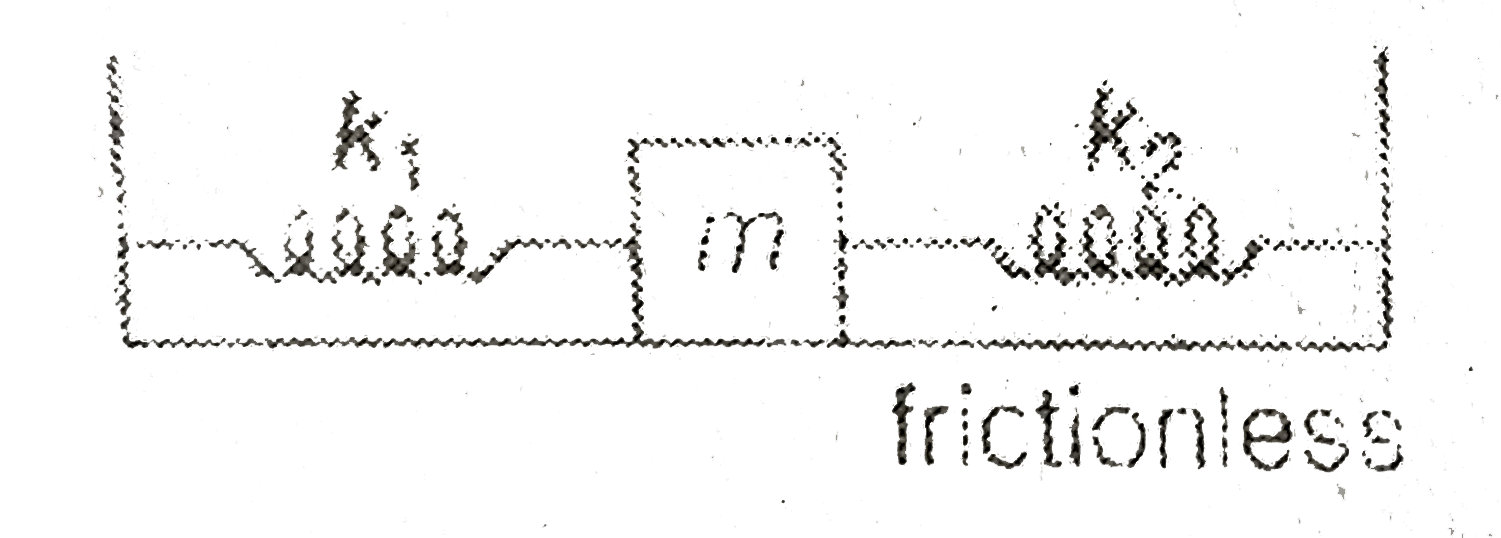
Two springs with negligible massess and force constant of `k_(1)= 200 Nm^(-1)` and `k_(2)=160Nm^(-1)` are attached to the block of mass m = 10kg as shown in the figure. Initially the block is at rest at the equilibrium position the block is at rest at the equilibrium position ir. Which both springs are neither stretched nor compressed. At time t = 0, sharp impulse of 50 N-s is given to the block in horizontal direction.

A

Period of oscillations for the mass m is `pi/6` s

B

Maximum velocity of the mass m during its oscillation is `10 ms ^(-1)`

C

Data are insufficient to determine maximum velocity

D

Amplitude of oscillation is 0.83 m

Text Solution

Verified by Experts

The correct Answer is:

D
Promotional Banner

Similar Questions

Explore conceptually related problems

Two springs with negligible massess and force constant of k_(1)= 200 Nm^(-1) and k_(2)=160Nm^(-1) are attached to the block of mass m = 10kg as shown in the figure. Initially the block is at rest at the equilibrium position the block is at rest at the equilibrium position nor compressed. At time t=0, sharp impulse of 50 N-s is given to the block.

A block of mass m hangs from a vertical spring of spring constant k. If it is displaced from its equilibrium position, find the time period of oscillations.

A constant force F is applied on a spring block system as shown in figure. The mass of the block is m and spring constant is k. The block is placed over a smooth surface. Initially the spring was unstretched. Choose the correct alternative(s)

A block of mass m compresses a spring iof stifffness k through a distacne l//2 as shown in the figure .If the block is not fixed to the spring the period of motion of the block is

A mass of 1.5 kg is connected to two identical springs each of force constant 300 Nm^(-1) as shown in the figure. If the mass is displaced from its equilibrium position by 10cm, then the period of oscillation is

Two identical springs of spring constant k are attached to a block of mass m and to fixed supports as shown in the figure. The time period of oscillation is

A block of mass m is suspended through a spring of spring constant k and is in equilibrium. A sharp blow gives the block an initial downward velocity v. How far below the equilibrium position, the block comes to an instantaneous rest?

Two springs are in a series combination and are attached to a block of mass 'm' which is in equilibrium. The spring constants and extension in the springs are as shown in the figure. Then the force exerted by the spring on the block is :

A 2 kg block is connected with two springs of force constants k_(1)=100 N//m and k_(2)=300 N//m as shown in figure. The block is released from rest with the springs unstretched. The acceleration of the block in its lowest postion is (g=10 m//s^(2))

A block of mass m, lying on a smooth horizontal surface, is attached to a spring (of negligible mass) of spring constant k. The other end of the spring is fixed, as shown in the figure. The block is initally at rest in its equilibrium position. If now the block is pulled withe a constant force F, the maximum speed of the block is :
