Home
Class 12
PHYSICS
Two identical narrow slits S1 and S2 ar...

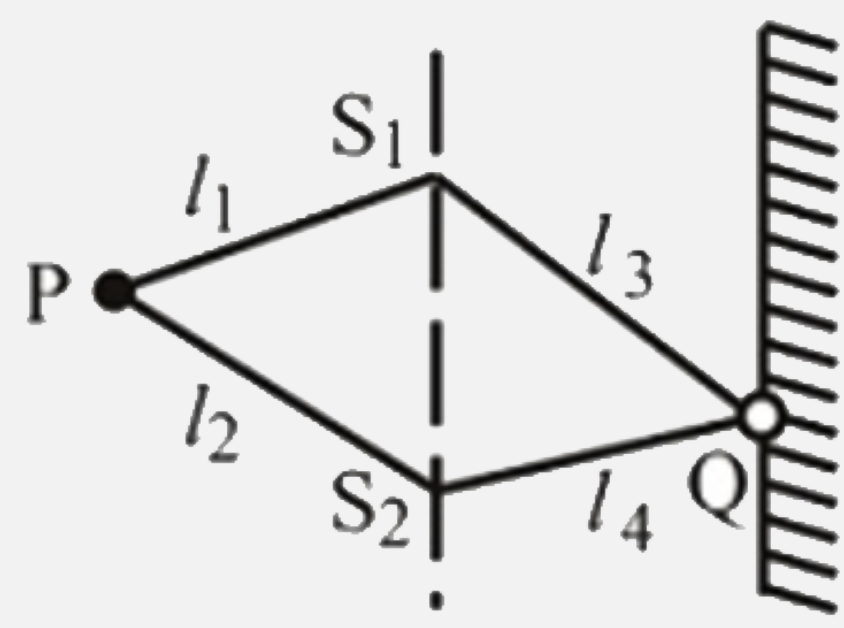
Two identical narrow slits `S_1 and S_2` are illuminated by the light of a wavelength`lamda` from a point source P.

If , as shown in the diagram above , the light is then allowed to fall on a screen , and if n is a positive integer , the condition for destructive interference at Q is

A

(a)`(l_1-l_2) =(2n+1)lamda//2`

B

(b)`(l_3-l_4) =(2n+1)lamda//2`

C

(c)`(l_1+l_2)-(l_3+l_4) =nlamda`

D

(d)`(l_1+l_3)-(l_2+l_4) =(2n+1)lamda//2`

Text Solution

Verified by Experts

The correct Answer is:

D
Promotional Banner

Similar Questions

Explore conceptually related problems

Two identical narrow slits S_(1) and S_(2) are illuminated by light of wavelength lambda from a point source P. If, as shown in the diagram above the light is then allowed to fall on a scree, and if n is a positive integer, the condition for destructive interference at Q is that

Two identical light sources S_1 and S_2 emit light of same wavelength lambda . These light rays will exhibit interference if

Consider the situation shown in figure. The two slite S_1 and S_2 placed symmetrically around the centre line are illuminated by a monochromatic light of wavelength lambda. The separation between the slits is d. The light transmitted by the slits falls on a screen M_1 placed at a distance D from the slits. The slit S_3 is at the centre line and the slit S_4 is at a distance y form S_3 . Another screen M_2 is placed at a further distance D away from M_1 . Find the ration of the maximum to minimum intensity observed on M_2 if y is equal to (dltltD) .

Two ideal slits S_(1) and S_(2) are at a distance d apart, and illuninated by light of wavelength lambda passing through an ideal source slit S placed on the line through S_(2) as shown. The distance between the planes of slits and the source slit is D.A screen is held at a distance D from the plane of the slits. The minimum value of d for which there is darkness at O is (dlt lt D)

A narrow slit of width 2 mm is illuminated by monochromatic light fo wavelength 500nm. The distance between the first minima on either side on a screen at a distance of 1 m is

A narrow slit of width 1 mm is illuminated by monochromatic light of wavelength 600 nm. The distance between the first minima on either side of a screen at a distance of 2 m is

Light of wavelength lambda from a point source falls on a small circular rings around a central bright spot are formed on a screen beyond the obstacle The distance between the screen and obstacle is D. Then, the condition for the formation of rings, is

Consider the situation shown in figure. The two slits S_1 and S_2 placed symmetrically around the central line are illuminated by a monochromatic light of wavelength lamda . The separation between the slits is d. The light transmitted by the slits falls on a screen Sigma_1 placed at a distance D from the slits. The slit S_3 is at the placed central line and the slit S_4 , is at a distance z from S_3 . Another screen Sigma_2 is placed a further distance D away from 1,1. Find the ratio of the maximum to minimum intensity observed on Sigma_2 if z is equal to a. z=(lamdaD)/(2d) b. (lamdaD)/d c. (lamdaD)/(4d)

Two slits, 4 mm apart, are illuminated by light of wavelength 6000 Å . What will be the fringe width on a screen placed 2 m from the slits

Figure shows a narrow slit S illuminated b a monochromatic light of wavelength lambda in a double-slit experiment. In the path of the rays reaching the upper slit S_(1) , a tube to length L is interposed in which the index of reflection of the medium varies linearly as shown in figure . The position of the central maximum in the interference pattern on the screen was displaceed by N fringes. Find the value of N in terms of mu_(0) , L and lambda .
