Home
Class 12
PHYSICS
A positive charge particle having change...

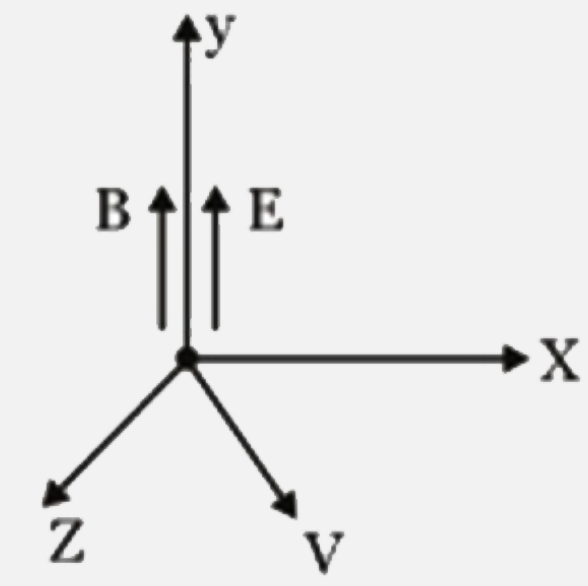
A positive charge particle having change q and mass m has velocity `vecv = v((hati+hatk)/sqrt2)` in the magnetic field B at the origin . Its speed as the function of y is :

A

`sqrt(v^2+(qE)/(2m)y)`

B

`sqrt((B/E)^2+v^2+(qE)/(2m)y) `

C

`sqrt(v^2+(2qE)/my)`

D

None of the above

Text Solution

Verified by Experts

The correct Answer is:

C
Promotional Banner

Similar Questions

Explore conceptually related problems

A particle having charge q=10muC and mass m = 3 mg has a velocity vecv = (10 cm) (hati+2hatj) at t =0 at origin. There exists a uniform magnetic field vecB=0.6 piT hati . Another uncharged particle is moving with a constant velocity along negative x-axis. At t =0 its x coordinate is +50 cm. The two particles collide and stick together and the combined mass goes in a circular path. Find the possible values of the mass of the uncharged particle .

A uniform magnetic field vecB is set up along the positive x-axis. A particle of charge 'q' and mass 'm' moving with a velocity vecv entresthe field at the origin in X-Y plane such that it has velocity companents both along and perpendicular to the magnetic field vecB . Trace, giving reason. the fraectory followed by the particle . Find out the expression for the distance moved by the particle along the magnetic field in one rotation.

A positive charge particle of charge q and mass m enters into a uniform magnetic field with velocity v as shown in Fig. There is no magnetic field to the left of PQ. Find (a) time spent, (b) distance travelled in the magnetic field, (c) impulse of magnetic force.

A positive charge particle of charge q and mass m enters into a uniform magnetic field with velocity v as shown in Fig. There is no magnetic field to the left of PQ. Find (a) time spent, (b) distance travelled in the magnetic field, (c) impulse of magnetic force.

A charged particle of unit mass and unit charge moves with velocity vecv=(8hati+6hatj)ms^-1 in magnetic field of vecB=2hatkT . Choose the correct alternative (s).

A charged particle of unit mass and unit charge moves with velocity vecv=(8hati+6hatj)ms^-1 in magnetic field of vecB=2hatkT . Choose the correct alternative (s).

The magnetic field is confirmed in a square region. A positive charged particle of charge q and mass m the limiting velocities of the particles so that it may come out of face (1), (2), (3), and (4).

A charged particle (charge q, mass m) has velocity v_(0) at origin in +x direction. In space there is a uniform magnetic field B in -z direction. Find the y coordinate of particle when is crosses y axis.

A particle having charge q moves with a velocity v through a region in which both an electric field vecE and a magnetic field B are present. The force on the particle is

A particle of positive charge q and mass m enters with velocity Vhati at the origin in a magnetic field B(-hatk) which is present in the whole space. The charge makes a perfectely inelastic collision with an identical particle (having same charge) ar rest but free to move at its maximum positive y-coordinate. After collision, the combined charge will move on trajectory where r=(mV)/(qB) .
