Home
Class 12
PHYSICS
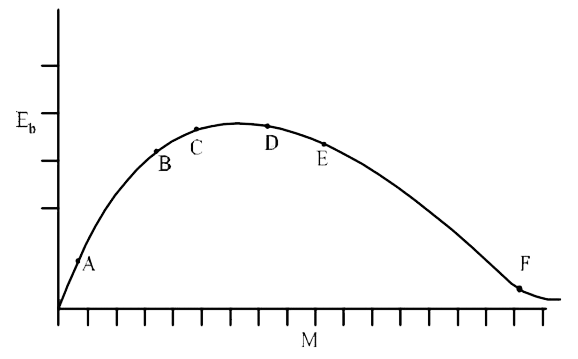
The above is a plate of binding energy p...


The above is a plate of binding energy per nucleon `E_(0)` against the nuclear mass `M, A, B,C,D,E,F` correspond to different nuclei Consider four reactions:

A

`A + B rarr C + epsilon`

B

`C rarrA + B + epsilon `

C

`D + E rarr F + epsilon`

D

`F rarr D + E + epsilon `

Text Solution

Verified by Experts

The correct Answer is:

D
Promotional Banner

Similar Questions

Explore conceptually related problems

The alongside is a plot of binding energy per nucleon E_(b) ,against the nuclear mass M,A,B,C,D,E,F correspond to different nuclei. Consider four reactions. (i) A + B to C + epsilon (ii) C to A + B + epsilon (iii) D + E to F + epsilon (iv) F to D + E + epsilon where epsilon is the energy released. In which reactions , is epsilon positive?

The graph between the binding energy per nucleon (E) and atomic mass number (A) is as-

The dependence of binding energy per nucleon, B_N on the mass number, A is represented by. (a) , (b) , ( c) , (d) .

This binding energy per nucleon for the parent nucleus is E_(1) and that for the daughter nuclei is E_(2) . Then

Statement-1:In a nuclear reaction energy is released , if total binding energy is increasing. Statement-2:For a stability of a nucleus, total binding energy is more important than binding energy per nucleon. Statement-3:Nuclear force is different for different nucleons and it dependent on charge .

Draw the graph showing thervariation of binding energy per nucleon with mass number. Give therason for the decrease of binding energy per nucleon for nuclei with high mass numbers. The binding energy per nucleon for nuclei with high mass number is low due to the large coulomb repulsion between the protons inside these nuclei.

The binding energy per nucleon of deuterium and helium nuclei are 1.1 MeV and 7.0 MeV respectively. When two deuterium nuclei fuse to form a helium nucleus the energy released in the fusion is

The source of energy of stars is nuclear fusion. Fusion reaction occurs at very high temperature, about 10^(7) . Energy released in the process of fusion is due to mass defect. It is also called Q -value. Q = Delta mc^(2), Delta m = mass defect. The binding energy per nucleon of ._(1)H^(2) and ._(2)He^(4) are 1.1 MeV and 7 MeV , respectively. If two deuteron nuclei react to form a single helium nucleus, then the energy released is

when two nuclei (A lt= 10) fuse together to form a heavier nucleus, the (a) binding energy per nucleon increases (b) binding energy per nucleon decreases (c) binding energy per nucleon does not change (d) total binding energy decreases

Draw a plot of the binding energy per nucleon as a function of mass number for a large number of nuclei , 2 le A le 240 . How do you explain the constancy of binding energy per nucleon in the range 30 lt A lt 170 using the property that nuclear force is short-ranged ?
