Home
Class 12
PHYSICS
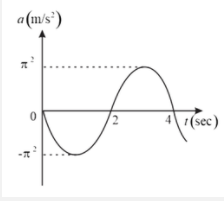
A block performs simple harmonic motion ...

A block performs simple harmonic motion with equilibrium point x = 0 . Graph of acceleration of the block as a function of time is shown. Which of the following statement is correct about the block ?

A

Displacement from equilibrium is maximum at t = 4 s

B

Speed is maximum at t = 4 s

C

Speed is minimum at t = 4 s

D

Speed is maximum at t = 3s

Text Solution

Verified by Experts

The correct Answer is:

B
Promotional Banner

Similar Questions

Explore conceptually related problems

Which of the following statements is incorrect about the f- block elements ?

Which of the following statement is correct for s-block elements:

Which of the following is not true about s-block elements?

For a particle executing simple harmonic motion, which of the following statements is not correct

A simple harmonic oscillator consists of a block attached to a spring with k=200N/m. The block slides on a frictionless horizontal surface, with equilibrium point x=0. A graph of the block velocity v as a function of time t is shown. Correct match the required information in the left column with the values given in table.

A body is performing simple harmonic motion with amplitude a and time period T variation of its acceleration (f) with time (t) is shown in figure If at time t velocity of the body is v which of the following graph is correct?

A body is performing simple harmonic motion with amplitude a and time period T variation of its acceleration (f) with time (t) is shown in figure If at time t velocity of the body is v which of the following graph is correct?

Acceleration of block A varies with time as shown in figure the value of coefficient of kinetic friction between block A and B is

A mass M is performing linear simple harmonic motion. Then correct graph for acceleration a and corresponding linear velocity v is

A 100 g block is connected to a horizontal massless spring of force constant 25.6(N)/(m) As shown in Fig. the block is free to oscillate on a horizontal frictionless surface. The block is displaced 3 cm from the equilibrium position and , at t=0 , it is released from rest at x=0 It executes simple harmonic motion with the postive x-direction indecated in Fig. The position time (x-t) graph of motion of the block is as shown in Fig. Velocity of the block as a function of time can be expressed as
